Nomio has shown up on a lot of start lines this year. Mads Pedersen credits it with his best 90-minute ride ever. Cole Hocker took a shot before a 5K world title. A concentrated broccoli sprout extract selling for around $28 for four doses is now a fixture in pro team fridges, and it is starting to show up in age-group transition bags too. The pitch is simple: it lowers lactate buildup during hard efforts and speeds up recovery afterward. But does Nomio actually work, or is this beet juice’s flashier, greener cousin riding on borrowed credibility?
TL;DR
The research behind Nomio is real, but thinner than the marketing suggests. Small studies from the product’s own research team show promising short-term effects on lactate and time to exhaustion. The largest independent study to date, published in 2026, found the compound gets absorbed just fine but had zero measurable effect on lactate, oxidative stress, or recovery. Treat it as an unproven experiment, not a proven upgrade.
Key Takeaways
- Nomio’s active compounds are isothiocyanates (ITCs), concentrated from broccoli sprouts, aimed at activating your body’s Nrf2 antioxidant pathway.
- The ‘12% less lactate’ claim on Nomio’s marketing actually comes from a study that measured a 12% longer time to exhaustion, not a 12% drop in lactate. Worth knowing before you repeat it to your training partners.
- All three human-relevant studies showing a benefit come from the same research group that co-founded Nomio, with sample sizes of 9 to 15 people.
- A 2026 independent study of 17 people found no effect on lactate, oxidative stress, or recovery, despite confirming the compound was absorbed.
- If you use it, treat it as a personal experiment (N=1), not a guaranteed performance upgrade backed by strong evidence.
What’s Actually In Nomio
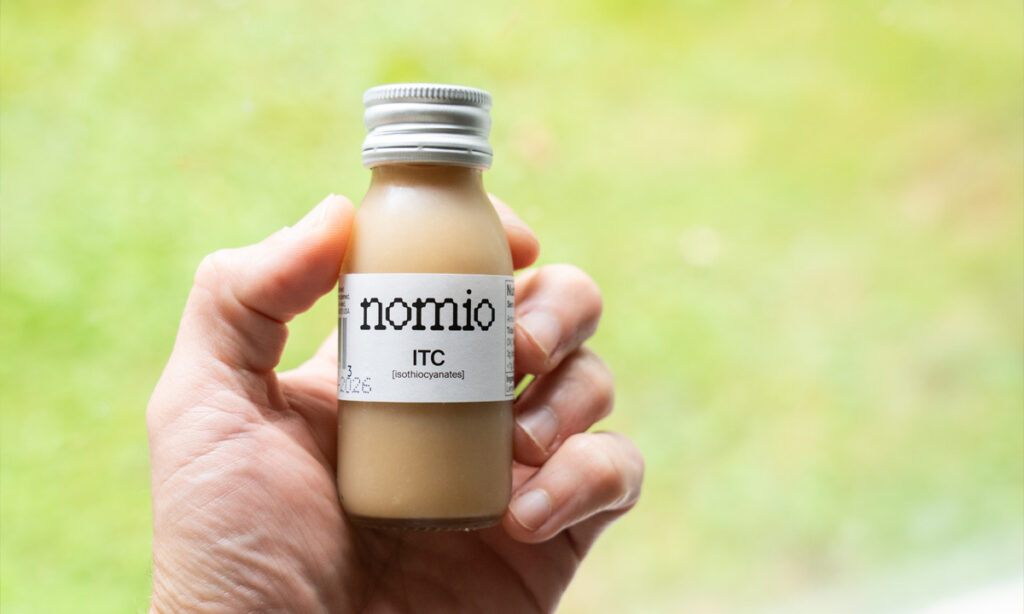
Nomio is a 60ml shot made from broccoli sprout extract (80%), lemon (15%), and sugar (5%). The active ingredients are isothiocyanates, a group of compounds found in cruciferous vegetables like broccoli, kale, and cabbage. The most studied of these is sulforaphane. According to Nomio, each shot concentrates the ITC content of roughly 2.5 to 3kg of raw broccoli into a single dose. That is the entire pitch for why you would drink this instead of eating a side salad.
The theory is that ITCs activate a pathway called Nrf2, which switches on your body’s own antioxidant defence enzymes. In theory, more Nrf2 activation means less oxidative stress from hard training, which in turn means faster recovery and better adaptation. It is a legitimate biological mechanism. Beet juice and nitrates work through a similarly well-established pathway, and that one has held up to scrutiny. The question is whether Nomio’s version holds up the same way, and that is where things get more complicated.
The Studies Behind The Claims
There are three pieces of research Nomio points to. Here is what each one actually tested, who ran it, and what it found.
Flockhart et al., 2023 (Redox Biology)
- Design: Double-blind crossover, 7 days of broccoli sprout shots paired with daily intense interval training
- Sample: 9 people
- Funded / run by: Nomio co-founder Filip Larsen’s lab (GIH)
- Finding: Lower lactate and oxidative stress during exercise, better glucose regulation, and a 12% longer time to exhaustion on a VO2max test. VO2max itself did not change.
Sundqvist et al., 2025 (bioRxiv preprint, not yet peer-reviewed)
- Design: Double-blind crossover, single acute dose, tested 3 hours later
- Sample: 15 people
- Funded / run by: The same Larsen-led research group
- Finding: Lower blood lactate at a given submaximal workload. Effect follows a U-shaped dose curve.
Cesanelli et al., 2026 (Antioxidants)
- Design: Double-blind crossover, 2 weeks of broccoli powder vs. spinach placebo, then a maximal cycling test
- Sample: 17 people
- Funded / run by: An independent lab (Lithuanian Sports University), funded by a different broccoli powder supplier, with no Nomio involvement
- Finding: Confirmed the compound was well absorbed (urine sulforaphane rose sharply), but found no effect on lactate, oxidative stress markers, exercise performance, or muscle power recovery.
A quick note on why funding matters here: it does not automatically make a study wrong, but a small trial run by the people who also sell the product deserves a more careful read than one run by an outside lab with no stake in the outcome.
Where The Marketing Gets Ahead Of The Science
Nomio’s website and resellers repeat a specific claim: ‘12% reduction in blood lactate.’ That number traces back to the 2023 Flockhart study, but the actual result was a 12% longer time to exhaustion on a VO2max test, not a 12% lower lactate reading. The study did find lower lactate at points during the protocol, just not a headline 12% figure attached to it. This is a small distinction, but it is the kind of thing worth knowing before you decide the product is more validated than it is.
It is also worth noting that the 2023 study paired the supplement with seven straight days of hard interval training in both groups. What it measured was whether ITCs helped the intervention group adapt to that training block better than placebo, not just a single-dose acute lactate effect. The single-dose acute claim (the one that matches how most people actually use Nomio, as a pre-race or pre-workout shot) rests mainly on the 2025 preprint, which has not yet cleared peer review.
The Study Nobody’s Talking About
The most methodologically solid test of broccoli-derived ITCs on exercise performance so far did not come from Nomio’s team at all. Published in March 2026 in Antioxidants, a peer-reviewed journal, the study gave 17 healthy men either broccoli powder or a spinach placebo for two weeks, then put them through a maximal cycling test to exhaustion.
- Urine sulforaphane output rose sharply after supplementation, confirming the compound was absorbed and bioavailable.
- Despite that, there was no significant difference between broccoli and placebo groups in blood lactate dynamics, oxidative stress markers (plasma MDA), cycling performance, or muscle power recovery (measured by jump height) at any point after exercise.
- The researchers noted the exercise protocol may have been too mild to trigger enough oxidative stress for an antioxidant compound to make a measurable difference. That is a real limitation, not a dismissal.
This does not prove Nomio does nothing. It is one study, using broccoli powder rather than Nomio’s specific extraction process, testing a different protocol than a single pre-race shot. But it is the largest, most rigorous, and most independent study run on this compound class to date, and it found nothing where the smaller founder-affiliated studies found something. That gap is the honest state of the evidence right now.
How Nomio Recommends You Use It
If you decide to try it, the standard protocol is straightforward:
- One 60ml shot roughly 3 hours before a hard session or race, to line up with when the compound is expected to peak in your system.
- An optional second shot about an hour before bed on especially demanding training days, aimed at recovery rather than performance.
- It is marketed as WADA-compliant, and the base compounds have a long track record of safety in human trials, including a formal phase I safety study on broccoli sprout extracts.
- On taste: it is exactly what it sounds like. Pure broccoli, best sipped cold. Not delicious, not undrinkable, but plan on it being the least enjoyable part of your pre-race routine.
So, Does It Work?
Here is the honest answer, without the marketing gloss. The mechanism is plausible and shares some DNA with the nitrate research that made beet juice a genuinely evidence-backed supplement. But right now, the human evidence for Nomio specifically is thin: three small studies from an affiliated research group showing a benefit, and one larger independent study finding nothing measurable, despite confirming the compound gets into your system. That is not the profile of a settled, proven intervention. It is the profile of an early, promising, unproven one.
This is a common pattern among people who try it: less soreness the next day, but no real way to isolate whether that came from the shot, a lighter taper, better sleep, or plain expectation. That gap between how something feels and what a lactate meter or a jump test actually shows is exactly what the research above keeps running into.
If you have the budget and want to run your own test, treat it like any other N=1 experiment: pick a repeatable effort (a set of intervals, a benchmark long run), use it consistently for a few sessions, and pay attention to something you can actually measure (pace at a given heart rate, next-day resting HR, how sore you feel on a 1 to 10 scale) rather than just vibes. A placebo effect from a $7 shot you believe in is still a real effect on how your training feels, even if it is not the mechanism on the label.
FAQ
Is Nomio safe to take?
The base compounds (isothiocyanates from broccoli sprouts) have a long safety record in human research, including formal phase I trials. Nomio markets the product as WADA-compliant. As with any supplement, if you have a health condition or take medication, check with a doctor first.
Does Nomio actually reduce lactate?
Two small studies from Nomio’s affiliated research group found lower lactate under specific conditions. A larger, independent 2026 study found no measurable effect. The honest answer is: possibly, but it is not yet well established.
Why does Nomio taste like that?
It is 80% broccoli sprout extract. There is no version of that which tastes neutral. Most reviews describe it as an acquired taste at best, and the company does not claim otherwise.
Is Nomio the same as eating broccoli?
Not quite. Nomio uses a stabilization process to concentrate and preserve ITCs, which are otherwise fragile and break down quickly. Eating raw broccoli sprouts delivers the same compound family, just less concentrated and less standardized.
Sources
- Flockhart et al. (2023). Glucosinolate–Rich Broccoli Sprouts Protect against Oxidative Stress and Improve Adaptations to Intense Exercise Training. Redox Biology.
- Cesanelli et al. (2026). Effects of Short-Term Broccoli Powder Supplementation on Acute Oxidative Stress and Recovery Following a Metabolically Demanding Exercise Session. Antioxidants.
- Sundqvist et al. (2025). A glucosinolate-rich beverage lowers blood lactate concentrations during submaximal exercise. bioRxiv preprint.