The pool is predictable. You can see the bottom, the lane ropes keep you straight, and nobody is splashing you in the face. Open water is a different sport. It looks the same from the shore, but once you’re in it, everything you thought you knew about swimming gets tested. Including your ability to stay calm. If you’re heading into your first triathlon or open water race and looking for open water swimming tips for beginners, this post is for you.
TL;DR
Open water swimming has almost nothing to do with your pool fitness. Anxiety, pacing, and swimming in a crowd are the real challenges. Start slow, seed yourself honestly, and know that almost everyone struggles their first time.
Key Takeaways
- Anxiety is normal. It peaks right at the start.
- Starting too fast is the most common mistake. It will cost you more than a slow start will.
- You don’t have to fight for position. The edge of the pack exists for a reason.
- Sighting burns time and energy. Practice it before race day.
- Your first open water swim in a race is a learning experience. Give yourself that.
1. Anxiety Doesn’t Mean Something Is Wrong
The moment you wade into the water at a race start, something primal kicks in. Your heart rate spikes, breathing gets shallow, and your wetsuit suddenly feels like it’s squeezing your chest. None of that means you’re in danger. It means your nervous system recognises that you’re about to do something unfamiliar with a lot of people watching.
The mistake is interpreting that feeling as a sign to go harder or faster. It isn’t. It’s just adrenaline doing its job.
What actually helps: slow your breathing down before you start. Box breathing works: inhale for four counts, hold for four, exhale for four. Do a short warm-up swim if the race allows it. Even five minutes in the water before the gun goes off will help your body adjust to the temperature and the sensation of being out there.
At my first sprint triathlon, I felt fine on the shore. The second I was in the water and moving, the anxiety hit hard. I went out too fast trying to outrun the feeling, was completely gassed after the first buoy, and ended up treading water hanging off a lifeguard’s kayak until my heart rate came back down. I finished the swim, but it was a rough lesson. The anxiety wasn’t the problem. My reaction to it was.
2. You Will Start Too Fast. Everyone Does.
This is probably the most universal open water swimming mistake. The race starts, people around you surge, and you match them. It feels manageable for about 90 seconds. Then it doesn’t.
The issue is that race-start adrenaline masks your effort level. Your perceived exertion is off. What feels like your usual pace is actually 20 to 30 percent faster, and you’re burning through energy you’ll need for the bike and run.
The fix is counterintuitive: seed yourself honestly and hold back in the first 200 metres even when it feels easy. Pick a stroke rate and stick to it. If you have a watch with a heart rate monitor, glance at it. Your target zone for the swim start should feel almost boring. If your heart is already hammering, you’ve already gone out too hard.
By the time I raced my Olympic-distance event, I’d internalised this. Seeding myself near the back of my wave, I let the surge happen around me and held a conservative pace for the first quarter. I felt almost lazy, and fresh getting out of the water, which is the point.
If you want to understand pacing by heart rate better, the heart rate zones post covers how to find your zones and actually use them in training.
Gear note for the data-obsessed: FORM Swim makes smart goggles with a heads-up display built into the lens. In open water mode, paired with a Garmin or Apple Watch, you can see your pace, heart rate, and a digital compass (they call it SwimStraight) directly in your field of vision while you swim. It won’t stop you from going out too fast if you ignore the numbers, but at least you’ll have no excuse. Worth a look if you’re already deep into gadgets: FORM Smart Swim 2.
3. Swimming in a Crowd Is a Skill. You Can Learn It.
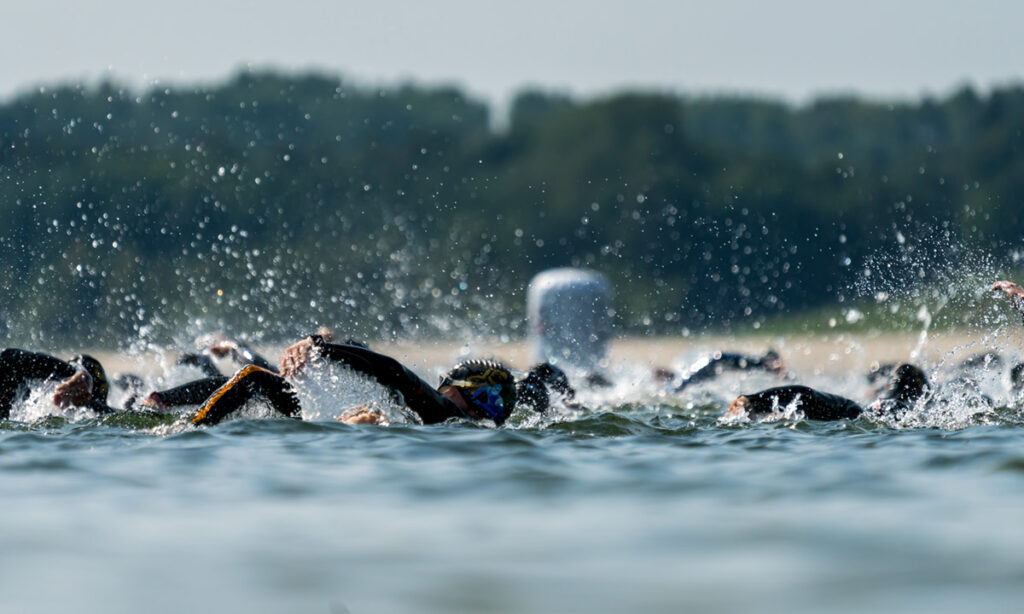
The mass start of an open water swim looks chaotic from the outside. It is chaotic from the inside too, but it’s manageable once you know what to expect.
You will get bumped. Someone will grab your ankle. Someone else will swim directly into you. A hand will appear in your face mid-stroke. None of this is intentional. Everyone is just trying to find their line.
How to handle contact
Don’t panic and don’t stop. If contact bothers you, give it a beat, adjust your position slightly, and keep going. Stopping dead in the water in a race pack creates more chaos, not less.
If you’re genuinely anxious about the crowd, seed yourself at the outside edge or toward the back of your wave. The water is calmer there, the pack thins out quickly, and you’ll have more space to find your rhythm before merging toward the buoy line. You’ll add a bit of distance. It’s worth it.
One more thing: avoid the inside of the buoy turns. That’s where everyone converges and contact peaks. Taking a slightly wider line costs you a few extra metres but gets you through the turn in cleaner water with less chaos.
Drafting is legal and useful
Swimming directly behind someone, close enough to sit in their wake, reduces your effort by a meaningful amount. It’s legal in triathlons. If you find someone going your pace, tuck in about a metre behind them and let them do the work. You’ll also sight less, which keeps your rhythm intact. Just make sure the person you’re drafting is actually swimming straight. If they’re not sighting, you’re both going off course. This takes practice, but it’s worth learning.
4. Sighting Takes Practice and Energy
In a pool, you follow the black line. In open water, there’s no line. To stay on course, you have to lift your head every few strokes and sight off a buoy, a landmark, or the shoreline. This sounds simple. In practice, it’s one of the more technical parts of open water swimming.
Lifting your head too high throws off your body position and costs you speed. Doing it too often adds up to significant energy waste over a long swim. The goal is to get efficient: lift just enough to see, then return your head to neutral without breaking your stroke rhythm.
A common technique is to sight on the breath stroke. As you turn your head to breathe, you also take a quick peek forward before bringing it back. It’s not always reliable in choppy water or strong sun, but it reduces the disruption to your stroke.
Practice this in open water before race day if you can. Even a few sessions in a lake or the ocean will help you calibrate how often you need to sight and what landmarks to aim for. Sighting off a building or tree on shore is often easier than tracking a buoy that disappears in the waves.
5. Your Wetsuit Changes Everything
If your race allows a wetsuit, wear one. Not just for warmth. For buoyancy. A wetsuit lifts your hips and legs, which improves your body position in the water and reduces drag. Swimmers who are weak at kick (most triathletes) benefit the most from this.
That said, wetsuits have a learning curve. They restrict shoulder mobility. They feel tight around the chest, especially when your heart rate is elevated. And if they’re not fitted properly, they can dig into your neck or arms and cause chafing that you won’t notice until you’re three hours into your race and it’s too late.
A few things worth knowing before race day: put the wetsuit on slowly, working it up your legs and torso in sections, not all at once. Apply Body Glide or petroleum jelly to your neck, wrists, and ankles before putting it on. And do at least one open water swim in it before the race so you know how it feels when you’re moving.
The buoyancy is disorienting at first. You feel like you’re riding higher in the water than normal. Give it a few hundred metres and it will start to feel normal.
One More Thing: Give Yourself a Learning Curve
Your first open water race will not go perfectly. That’s fine. Almost everyone who does it says the same thing: the first one is about survival and learning, and by the second or third race, the whole thing clicks.
Every mistake in this post happened to me during my first triathlon. Went out too hard, panicked, lost my line, and ended up hanging off a kayak trying to catch my breath. Finished the swim. Came back for the next one.
The swim is the shortest leg of a triathlon. It ends. What you learn from it carries into every race after that.
Out of the water — now what? How to Speed Up Your Triathlon Transitions (T1 and T2 Guide)
FAQ
Yes, and it’s extremely common. The combination of cold water, a wetsuit, a mass start, and open-water disorientation triggers an anxiety response in a lot of swimmers, including experienced ones. The best thing you can do is slow your breathing before the race and seed yourself where you’ll have more space. If you do panic during the swim, roll onto your back, breathe, and restart when you’re ready. There’s no shame in it.
Use RPE (rate of perceived exertion.) You won’t be checking your watch mid-stroke, and glancing at your heart rate isn’t realistic either. What actually works is knowing what your target effort feels like before race day. Practise at race pace in the pool or in open water training so the effort becomes familiar. When the gun goes off, you’re not chasing a number. You’re matching a feeling you’ve already logged.
Seed yourself on the outer edge of your wave if contact bothers you. The pack spreads out fast in the first couple of minutes, and you’ll have more room to swim your own race. If someone grabs your ankle or swims into you, stay calm, adjust your position slightly, and keep moving.
Not always, but if your race allows one and the water is under 22°C or so, it’s usually worth it. The buoyancy alone improves most swimmers’ body position and reduces fatigue. Just make sure you’ve practised in it before race day.
Lift your eyes just above the waterline. You don’t need to lift your whole head. Try timing it with your breathing stroke so it doesn’t add an extra movement. Aim for a landmark on shore rather than a small buoy that’s hard to see. With practice, sighting becomes automatic.
Sources:
British Triathlon: Open Water Swimming Guide