
You lace up for an easy run. Comfortable pace, normal effort. Then you glance at your watch and your heart rate is sitting at 168 bpm. That is not a Zone 2 number. You slow down, it drops a bit, but the moment you hit any kind of incline or mild headwind it creeps straight back up. If that sounds familiar, you are not broken. There are a handful of specific, fixable reasons why your heart rate spikes on what should be an easy run. Understanding them is the first step to actually training in a high heart rate on easy runs.
TL;DR
A high heart rate on easy runs usually means one of three things: your aerobic base is still developing, you are running faster than your body currently considers easy, or outside factors (heat, fatigue, dehydration) are pushing the number up. It takes consistent Zone 2 training over weeks to see that number drop. The pace will come later.
Key Takeaways
- A high easy-run heart rate is usually an aerobic fitness problem, not a health problem.
- Running too fast for your current fitness is the most common cause.
- Heat, dehydration, fatigue, and poor sleep all push the number up independently.
- Consistent Zone 2 training over 6 to 12 weeks is the fix. Pace will follow fitness.
- A chest strap gives you the accurate data you need to actually train by heart rate.
Your Aerobic Base Is Still Catching Up
This is the most common reason, especially if you are newer to running or returning after a long break. When your aerobic base is underdeveloped, your heart works harder to deliver oxygen at the same pace a fitter runner handles with far less effort.
A well-trained heart pumps more blood per beat. A less-trained one compensates by beating faster. So the same 5:30/km pace can sit comfortably in Zone 2 for one runner and push another deep into Zone 4.
The fix is not complicated, but it requires patience. You need to slow down, stay in Zone 2, and let the adaptations happen. Stroke volume improves, your heart gets more efficient, and the heart rate at a given pace gradually comes down.
From personal experience: it took about two months of consistent Zone 2 training before running at or below 6:00/km stopped pushing the heart rate into uncomfortable territory. The process felt frustratingly slow. The pace looked embarrassing on Strava. But it worked.
You Are Probably Running Faster Than You Think
Most runners have a skewed sense of what easy actually feels like. If you have been running at moderate or hard efforts regularly, easy pace tends to creep upward. What feels comfortable is not the same as what is aerobically easy.
A useful check: if you cannot hold a full conversation during your easy run, you are not in Zone 2. That is the simplest, no-device test available.
Heart rate-based training forces honesty here. If your monitor says 175 bpm on a run that felt fine, that feedback is more reliable than your perceived effort. Over time, especially in the early weeks of building a base, you will probably need to run considerably slower than feels natural to stay in Zone 2.
Use the Even Splits Lab HR Zone Finder to calculate your actual Zone 2 ceiling before you start chasing pace.
Heat and Humidity Add Beats Automatically
Running in warm conditions raises your heart rate independently of pace or fitness. Your body redirects blood flow toward the skin to cool you down, which means your heart has to work harder to maintain the same oxygen delivery to your muscles.
On a cool morning the same route at the same pace might sit 10 to 15 bpm lower than on a humid afternoon. This is not drift in fitness. It is basic physiology. Account for it when evaluating your training data, especially in summer.
The practical adjustment: in hot conditions, train by effort and heart rate rather than pace. Let the pace be whatever it needs to be to keep the number in range.
Fatigue, Sleep, and Stress Push the Number Up
A single bad night of sleep can add 5 to 10 bpm to your easy run heart rate. Accumulated training stress without enough recovery does the same. So does general life stress, caffeine timing, and dehydration going into the run.
If your heart rate is suddenly higher than usual on a route you know well, compare the context before concluding your fitness has dropped. Did you sleep poorly? Are you in a heavy training week? Did you skip breakfast? All of these move the number.
HRV (heart rate variability) is a useful signal for tracking cumulative fatigue. If you are monitoring it, suppressed HRV often predicts these elevated easy-run days. The HRV guide on this site covers that in more detail.
Cardiac Drift on Longer Runs
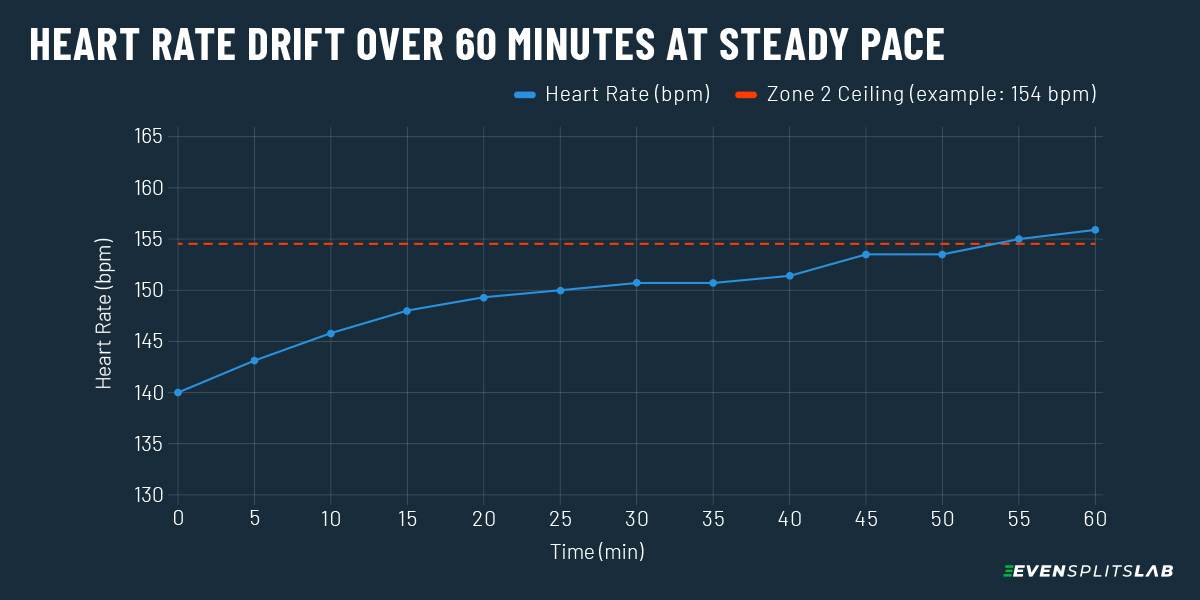
Even on a well-paced easy run, heart rate tends to climb over time. This is called cardiac drift. As you lose fluid through sweat, your blood volume drops slightly, so your heart has to beat faster to maintain the same output.
Some drift is normal. A 5 to 15 bpm rise over an hour-long Zone 2 run is not a problem. If your heart rate is climbing steadily and significantly throughout, it usually means one of two things: you started too hard, or you are dehydrated.
On long runs, some drift toward the upper end of Zone 2 or briefly into Zone 3 near the end is acceptable. The key is that it is gradual and your effort level is not increasing.
Your Heart Rate Monitor Might Be Lying to You
Wrist-based optical sensors are convenient but often unreliable during running, especially at higher cadences or in cold weather. They can read 10 to 20 bpm off and occasionally latch onto your step cadence instead of your actual heart rate (around 160 to 180 bpm for most runners, which is a familiar range for both).
If you are training by heart rate, a chest strap is worth the investment. It makes a meaningful difference in accuracy, particularly during the first 10 minutes of a run and during any intensity changes.
The Garmin HRM 200 and Polar H10 are both solid options. Either one will give you significantly more reliable data than an optical wrist sensor.
How to Actually Lower Your Heart Rate on Easy Runs
The answer is consistent Zone 2 training over time. There is no shortcut. But a few practical adjustments help the process along.
Slow down and stay in Zone 2 for 80% of your training
This is the core of building an aerobic base. The 80/20 principle, roughly 80 percent of training at easy intensity and 20 percent at harder efforts, is well-supported and consistently produces aerobic improvement over time.
It can take 6 to 12 weeks before the pace you can sustain at Zone 2 starts to meaningfully improve. That timeline is frustrating but normal.
Include one quality session per week
Spending all your time in Zone 2 builds the base, but your cardiovascular system also needs to know what hard feels like. One interval or tempo session per week helps maintain the contrast between efforts and stimulates adaptations that pure Zone 2 work does not.
The structure that works well for most self-coached athletes: one interval session, one longer Zone 2 run, and the rest easy. That is it.
Train by heart rate, not pace
Pace-based training on easy days leads to running too hard when you are fatigued or in heat. Heart rate gives you real-time feedback on what your body is actually doing.
Set your Zone 2 ceiling from your actual max heart rate, not an age formula. For more on that, see the guide to heart rate zones on this site.
Questions and Answers
Is a heart rate of 160 bpm too high for an easy run?
It depends on your max heart rate and fitness level. For someone with a max of 200 bpm, 160 bpm is Zone 3 to Zone 4 territory and probably too high for an easy run. For someone with a max of 185 bpm, it is more borderline. Work out your actual zones before judging the number.
How long does it take for heart rate to improve on easy runs?
Most athletes see meaningful improvement after 6 to 12 weeks of consistent Zone 2 training. The first few weeks usually feel discouraging because the pace required to stay in Zone 2 is slow. Stick with it.
Why does my heart rate spike at the start of a run?
A spike in the first 5 to 10 minutes is normal. Your cardiovascular system is adjusting to the demand. It usually settles within the first kilometre. A proper warmup helps reduce this initial spike.
Should I slow down or stop if my heart rate gets too high?
Slow down first. The goal on an easy run is to stay in Zone 2, so adjust pace to bring the number back down. Stopping is not necessary unless you feel genuinely unwell.
Related Posts
If you are building your aerobic base, the Zone 2 vs Zone 3 guide covers the training trade-offs in more detail
For a deeper dive into setting your zones accurately, read: How to Read Your Heart Rate Zones (and Why Most People Get Them Wrong)
If fatigue is affecting your training decisions, the HRV Training Guide is worth a read
Sources
Stoggl, T. & Sperlich, B. (2014). Polarized training has greater impact on key endurance variables than threshold, high intensity, or high volume training. Frontiers in Physiology.
Kreher, J.B. & Schwartz, J.B. (2012). Overtraining Syndrome: A Practical Guide. Sports Health, 4(2), 128-138.
Seiler, S. & Kjerland, G.O. (2006). Quantifying training intensity distribution in elite endurance athletes. Scandinavian Journal of Medicine & Science in Sports.