Your GPS watch has heart rate zones. Your training plan probably references them. But if you’ve ever finished a “Zone 2” run feeling like you just raced, or cruised through a threshold workout wondering if you even did anything — your zones are probably wrong. Most are. The default settings on watches and apps are based on a formula that’s convenient but inaccurate, and training off bad zones means you’re not getting what you think you’re getting. Understanding how heart rate zones actually work is one of the higher-leverage things you can do for your training.
TL;DR
Heart rate zones divide your effort into five training intensities, each with a specific physiological effect. The problem is most people’s zones are based on the 220-minus-age formula, which can be off by 10–20 BPM. Get your max HR right first, then your zones will actually mean something.
Key Takeaways
- Heart rate zones are only as good as the max HR they’re based on
- The 220-minus-age formula is a population average — it may not fit you
- Zone 2 is where most of your aerobic base gets built, and most people train it too hard
- You don’t need a lab test to get better zones — a field test works fine
- The HR Zone Finder Calculator gives you personalised zones in under a minute
What Are Heart Rate Zones, Actually?
Heart rate zones are ranges of intensity, expressed as a percentage of your maximum heart rate. Each zone corresponds to roughly what’s happening physiologically when you’re in it — which fuel you’re burning, which adaptations you’re triggering, and how long you can sustain it.
The standard five-zone model looks like this:
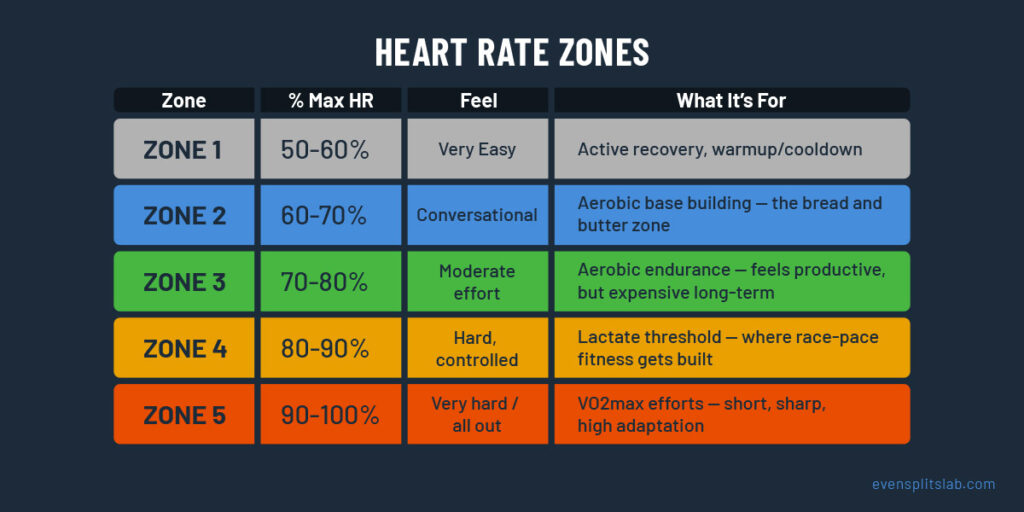
Each zone serves a purpose. You’re not just going easier or harder — you’re targeting different systems. Zone 2 builds the aerobic engine. Pushing into Zone 4 raises your lactate threshold. Zone 5 is for raw top-end capacity. Train everything in Zone 3 and you’re working moderately hard at everything, adapting optimally at nothing.
The Problem: Your Max HR Is Probably Wrong
All of this falls apart if your max HR is off. And for most people, it is.
The default on most watches and apps is the 220-minus-age formula. It’s easy to calculate, which is its main virtue. As a predictor of individual max HR, it’s not great — the standard deviation is around 10–12 BPM. That means your actual max HR could be 10–12 beats higher or lower than the formula says, and stay within one standard deviation of the average.
Here’s why that matters. If your true max HR is 185 but the formula gives you 172, your Zone 2 ceiling (70% of max) would be set at 120 instead of 130. You’d run at 128 BPM thinking you’re pushing into Zone 3, when you’re actually still in Zone 2. Or worse — your watch would tell you to slow down when you’re barely working.
Age also isn’t the only variable. Fitness level, genetics, and even caffeine intake affect your heart rate response. The formula doesn’t account for any of that.
How to Actually Find Your Max HR
You don’t need a lab. A field test on a treadmill or a hill works well enough for most athletes.
One reliable protocol: warm up for 10–15 minutes, then do 3 x 3-minute hard intervals with 90 seconds recovery between each. On the final interval, go all out for the last minute. The highest number your monitor records is a reasonable working max. Do this well-rested and only if you’ve been training for a few months — it’s genuinely hard.
Alternatively, look back at your training data. A hard 5K race or a punishing climb you’ve done recently may already have your real max hiding in there.
Zone 2: The Most Misunderstood Zone
If there’s one zone worth getting right, it’s Zone 2.
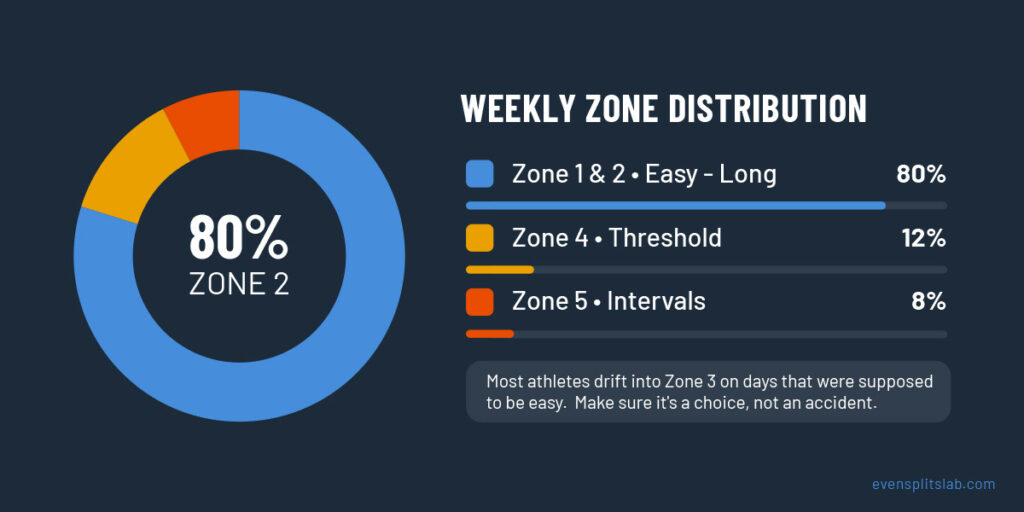
Zone 2 is conversational pace. You could hold a real back-and-forth conversation — not just grunt yes and no. For most recreational athletes training 8–12 hours a week, the goal is to spend 70–80% of total training time here. That’s the foundation of polarised training, and it’s backed by a lot of sports science research on endurance adaptation.
The catch: real Zone 2 often feels embarrassingly easy. If you’ve been running based on feel or a rate of perceived exertion, you’ve probably been drifting into Zone 3 without realising it. Zone 3 feels productive. It’s not easy, but it’s not hard. It’s sometimes called the “grey zone” — too easy to build race-specific fitness, too hard to recover from properly.
If your zones are miscalibrated, you might be running in Zone 3 while your watch says Zone 2. That’s a problem that compounds over time.
How to Actually Use Heart Rate Zones in Training
Once your zones are set correctly, the application is simple.
For easy and long days
Stay in Zone 1 or Zone 2. If your HR drifts into Zone 3, slow down or walk. This is the hard part — it requires ego management. You will be slower than you think you should be, especially early in the season or on hot days.
For threshold work
Target Zone 4. Cruise intervals, tempo runs, and bike TT efforts belong here. This is sustainable hard — you can hold it for 20–40 minutes with focus.
For intensity sessions
Zone 5 is for short intervals — think 30-second to 2-minute efforts with full recovery in between. You can’t sustain it for long, and that’s the point.
One Thing HR Monitors Get Wrong
Heart rate lags. It takes 60–90 seconds to respond to a change in effort, which makes it less useful for short intervals and explosive efforts. If you’re doing 30-second sprints, your HR will still be climbing after the interval ends.
For those efforts, pace or power is more reliable in real time. HR is better used as a check on your overall load and trend across a session, not a second-by-second guide.
Also worth knowing: heat, humidity, caffeine, fatigue, and stress can all elevate your heart rate at a given pace. A high reading doesn’t always mean you’re working too hard. Sometimes your body is just dealing with something.
FAQ
Technically, Zone 2 burns the highest percentage of fat as fuel. But “fat burning zone” is a bit misleading — total calorie burn matters more than the ratio. Training in Zone 2 consistently improves your aerobic base and fat oxidation efficiency, which has real performance benefits, not just body composition ones.
A few possibilities: your max HR is set too low (making zones too narrow), you started too fast, it’s hot, or you’re more fatigued than you think. It’s also possible your aerobic fitness is still developing and your heart has to work harder at a given pace. The solution is usually to slow down and let the aerobic base catch up.
Your zones (as percentages of max HR) stay the same. What changes is how fast you have to run or how hard you have to work to hit them. As your fitness improves, you’ll be able to hold a faster pace at the same Zone 2 heart rate — that’s literally the adaptation you’re training for.
HR is most useful for easy and moderate efforts where it’s giving you accurate, steady-state feedback. For short intervals or explosive efforts, pace or power is more reliable. Most athletes use HR to manage easy days and check on aerobic drift during long efforts.
Different coaches and platforms use different models. Three-zone models are popular in some Nordic endurance sports; Garmin uses a seven-zone model. The physiology is the same — it’s just a different way of slicing the intensity spectrum. The five-zone model is the most common starting point and maps well to how most training plans are written.
Related Posts
If you’re building out your race day approach, read: What to Eat Before a Sprint Triathlon
For hydration planning that actually accounts for your physiology, read: How to Calculate Your Sweat Rate at Home
Sources
Tanaka H, Monahan KD, Seals DR. Age-predicted maximal heart rate revisited. Journal of the American College of Cardiology, 2001.
Seiler S. What is best practice for training intensity and duration distribution in endurance athletes? International Journal of Sports Physiology and Performance, 2010.
American College of Sports Medicine. ACSM’s Guidelines for Exercise Testing and Prescription.