Race morning has a way of making everything feel more complicated than it is. You’ve trained for months, you know the course, and your gear is ready. But now you’re standing in the kitchen at 5:30am wondering if you can eat, and if so, what. Get this wrong and you risk feeling sluggish on the bike, bloated in the water, or running on empty by the run. The good news is that knowing what to eat before a sprint triathlon doesn’t require a sports dietitian, just a simple, repeatable plan.
TL;DR
Eat a carb-focused meal 2–3 hours before your race. Keep it low in fat and fibre. Stick to foods you’ve already tested in training. Avoid anything new, greasy, or high in fibre on race morning.
Key Takeaways
- Eat 2–3 hours before your wave start, not right before
- Focus on easy-to-digest carbohydrates
- Avoid high-fat, high-fibre, and high-dairy foods
- Nothing new on race day. Test your meal in training first
- A sprint tri is short, but on-course fuel and hydration both matter
How Long Before the Race Should You Eat?
Aim to finish eating 2–3 hours before your wave start. That window gives your body time to digest and convert food to usable energy, without leaving you feeling empty by the time the gun goes off.
If your race starts at 7am and you’re in the first wave, that means waking up early enough to eat by 4–4:30am. It’s not fun, but it works. If logistics make that impossible, a small, easily digestible snack 60–90 minutes out can work, but keep the portion small and stick to simple carbs.
The swim is the worst place to have a full stomach. Horizontal body position plus nerves plus cold water can make digestive discomfort significantly worse. Getting your timing right is just as important as getting your food right.
What to Eat Before a Sprint Triathlon
Your pre-race meal should be carbohydrate-focused, moderate in protein, and low in fat and fibre. Carbs are your primary fuel source for a race of this intensity. Fat and fibre slow digestion, exactly what you don’t want right now.
Good options:
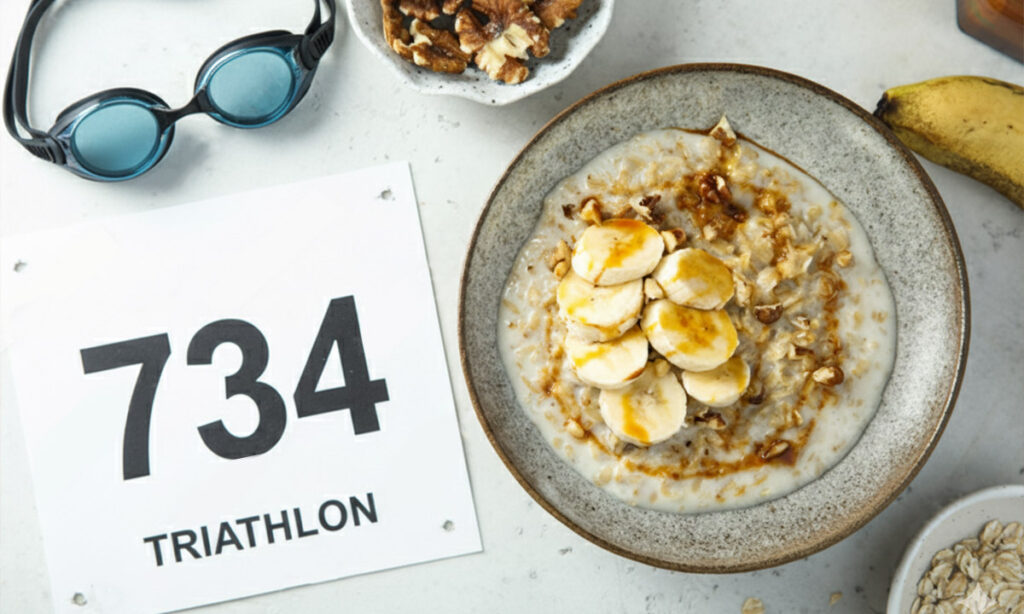
- Oatmeal with banana and a small amount of honey
- White toast or a plain bagel with peanut butter (light on the PB)
- White rice with a small amount of protein like eggs or chicken
- A banana and a sports drink
- Plain rice cakes with jam or honey
These are all low-risk, easy-to-digest options that have been used by athletes at every level. The key is that none of them are surprising to your gut. White bread and white rice digest faster than whole grain versions, which is one of the few times “less nutritious” is actually the right call.
Portion size:
Keep it reasonable. A sprint tri lasts anywhere from 60 to 90 minutes for most first-timers. You’re not loading up for a marathon. A meal in the 400–600 calorie range is plenty for most athletes, with the goal being topped-up glycogen stores — not a full stomach.
What to Avoid on Race Morning
Some foods that are perfectly healthy in daily life become a liability on race morning. Here’s what to skip:
High-fat foods
Bacon, sausage, full-fat cheese, butter-heavy meals. These take a long time to digest and can sit in your stomach during the swim. Skip them.
High-fibre foods
Bran cereal, beans, raw vegetables, whole grain everything. Fibre slows digestion and can cause GI distress at the worst possible moment. Save these for after the race.
Dairy (for most people)
Large amounts of milk, yogurt, or cream-based foods can cause stomach upset during high-intensity exercise. If you’ve used dairy in training without issues, a small amount is fine. If you’re not sure, this isn’t the day to test it.
Anything new
This is the biggest one. Race day is not the day to try a new protein bar, a new pre-workout, or a new breakfast spot. If you haven’t eaten it before a hard training session, don’t eat it before your race.
Excess caffeine
A coffee you’re used to is fine. A large coffee plus an energy gel plus a pre-workout drink is a recipe for a mid-swim bathroom emergency. Stick to what you know.
Hydration on Race Morning
Start drinking water when you wake up. You want to arrive at the start line hydrated but not waterlogged. Aim for 500–750ml of water in the 2 hours before your race, sipping steadily rather than chugging it all at once.
Add electrolytes to your pre-race water bottle — at minimum a pinch of salt, or an electrolyte tablet or sports drink. Plain water alone isn’t enough, especially if you’re prone to cramping or racing in mild to warm conditions. Electrolytes matter even when it doesn’t feel that hot.
On-course, plan on one gel on the bike and potentially one on the run. Taking a gel around the 20–30 minute mark on the bike gives your body time to absorb the carbs before T2. Even for a race this short, ingesting carbohydrates during exercise can boost performance, and research suggests even just having something sweet in your mouth can reduce perceived effort and delay fatigue.
Do You Need On-Course Fuel During a Sprint Tri?
Yes, even for a sprint. A sprint triathlon typically lasts 60–90 minutes, and while your pre-race meal carries most of the load, taking a gel on the bike is still a smart move. It helps top up your glycogen before the run, which is where many first-timers begin to fade.
Research shows that ingesting carbohydrates during exercise can improve performance, even in shorter events. A small boost of fast carbs during the bike leg can help keep energy levels steady heading into the run.
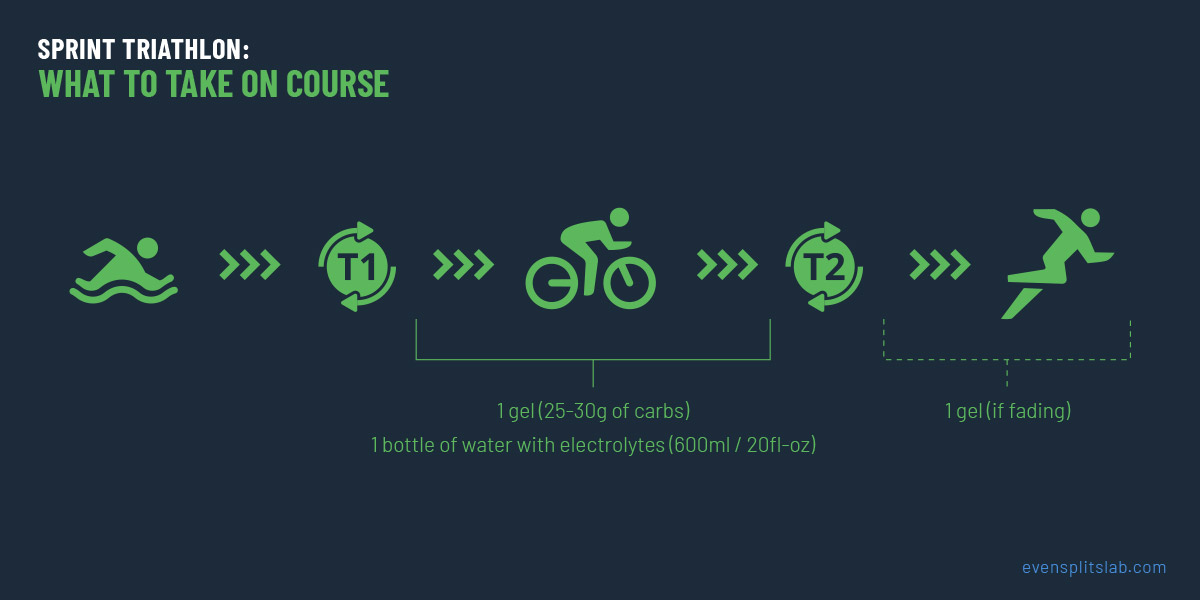
Keep it simple: take one gel on the bike, and consider another when starting the run if you feel your energy dropping. Test this in training beforehand. Drink at every water station and don’t wait until you feel thirsty.
A Sample Race Morning Timeline
Here’s what a race morning might look like for a 7:00am start:
| Time | Action |
|---|---|
| 4:00am | Wake up. Drink a glass of water. |
| 4:15–4:30am | Eat your pre-race meal. Keep it familiar: oatmeal, toast, rice. Whatever you’ve used in training. |
| 4:30–6:00am | Sip water steadily. Aim for 500–750ml total before you get to the venue. |
| 5:30–6:00am | Arrive at transition. Set up your gear. Sip water, not a bottle. |
| 6:30am | If you need it: a small snack (banana, rice cake) or a coffee if that’s part of your normal routine. |
| 6:45–6:55am | Stop eating. Move to the water. Focus on your warm-up. |
| 7:00am | Race start. |
FAQ
Q: What if I can’t eat early in the morning?
Some people genuinely struggle to eat at 4am. If that’s you, a small liquid option (like a banana blended with oat milk and honey) can be easier to get down. Alternatively, a larger snack 90 minutes before the race works for some athletes. Test it in training before race day.
Q: Can I drink coffee before a triathlon?
Yes, if coffee is already part of your routine and you’ve trained with it. Caffeine can improve focus and performance. The risk comes from too much caffeine, or using it for the first time on race day. Stick to your normal amount.
Q: What should I eat the night before a sprint triathlon?
A normal, carb-adequate dinner the night before is plenty. Think pasta, rice, or potatoes with a protein source and vegetables. You don’t need to do an aggressive carb-load for a sprint, it’s a relatively short event. Just don’t eat something heavy, greasy, or unfamiliar.
Q: Should I use gels during a sprint triathlon?
Yes — one or two gels on the bike is a good call, even for a sprint. Taking one around the 20–30 minute mark gives your body time to absorb it before the run. Research shows carb intake during shorter events can still improve performance, so it’s not wasted effort. Just make sure you’ve tested your gel of choice in training first.
Q: What if I feel nauseous during the race?
Nausea during a triathlon is usually caused by one of three things: starting the swim too hard, too much food too close to the start, or dehydration. Prevention is easier than treatment. Pace your swim start, nail your timing, and drink at every water station. If it hits mid-race, ease off the intensity and sip water.
Related Posts
- Got your nutrition sorted? Make sure it’s organised for transition too: How to Speed Up Your Triathlon Transitions (T1 and T2 Guide)
- If you’re dialling in your hydration strategy, read: How to Calculate Your Sweat Rate at Home
- Learning your sweat profile to optimise on-course hydration: How Much Should You Drink During a Race?
Sources / References
- Burke, L.M. et al. (2011). Carbohydrates for training and competition. Journal of Sports Sciences.
- Jeukendrup, A.E. (2004). Carbohydrate intake during exercise and performance. Nutrition.
- Thomas, D.T., Erdman, K.A., & Burke, L.M. (2016). Position of the Academy of Nutrition and Dietetics, Dietitians of Canada, and the American College of Sports Medicine: Nutrition and Athletic Performance. Journal of the Academy of Nutrition and Dietetics.