Hydration advice is everywhere. Drink to thirst. Drink 500ml per hour. Drink before you’re thirsty. Most of it is vague, and none of it accounts for the fact that you might sweat twice as much as the person running next to you. The fix is simpler than most people think. Learning how to calculate your sweat rate gives you an actual number to train and race around.
TL;DR
If you want to know how to calculate your sweat rate, you only need a scale and a one-hour run. Weigh yourself before and after, every kilogram you lose equals roughly one litre of sweat. That’s it. No lab, no fancy equipment.
Key Takeaways
- Sweat rate varies a lot between athletes — knowing yours removes the guesswork from hydration
- The at-home sweat test takes one run and a basic kitchen scale
- Heat, humidity, and intensity all affect how much you sweat — test in different conditions for a full picture
- Knowing your sweat rate helps you plan fluid intake before, during, and after training
- Even a 2% drop in body weight from fluid loss can hurt performance
Why Sweat Rate Matters
Most hydration advice is vague. “Drink to thirst” works fine for easy days, but when you’re 90 minutes into a long run in July, thirst is already behind the curve.
Knowing how to calculate your sweat rate gives you an actual number to plan around. Instead of guessing, you can figure out roughly how much fluid you need per hour, and whether your current intake is even close.
Sweat rates vary more than most people expect. Some athletes lose less than 500ml per hour. Others lose over 2 litres. Body size, fitness, heat acclimatisation, and genetics all play a role. “Drink 500ml per hour” might leave one person over-hydrated and another cramping by kilometre 25.
What You Need for the Test
You don’t need a lab or a sports dietitian. Here’s what you actually need:
- A scale accurate to at least 0.1 kg (200g is fine)
- A 45–60 minute run at steady effort
- No food or drink during the run (this keeps the math clean)
- A towel to dry off before your post-run weigh-in
- A notepad or your phone to record the numbers
That’s it. Run the test on a typical training day — same type of effort, same time of day, similar weather to what you usually train in.
How to Calculate Your Sweat Rate: Step by Step
Step 1: Weigh yourself before the run
Do this right before you head out. Go to the bathroom first. Wear as little as you reasonably can (ideally just shorts or a sports bra, no shoes).
Record your weight in kilograms.
Step 2: Run for 45–60 minutes
Keep the effort steady and representative. A tempo run or a moderate long run pace works well. Avoid stopping for water. If you do drink, measure it and add that back into the calculation later (more on that below).
Step 3: Weigh yourself immediately after
Come back inside, towel off your sweat (this matters, wet skin adds fake weight), strip back down to the same clothing, and step on the scale again.
Record this number.
Step 4: Calculate your sweat rate
Sweat Loss (litres) = Pre-run weight (kg) − Post-run weight (kg)
For example:
- Pre-run: 72.4 kg
- Post-run: 71.1 kg
- Weight lost: 1.3 kg = 1.3 litres of sweat
If your run was 60 minutes, your sweat rate is approximately 1.3 L/hour.
If it was 45 minutes: divide by 0.75 to get the per-hour rate (1.3 ÷ 0.75 = ~1.73 L/hour).
What if you drank during the run?
Add the fluid you consumed back in. If you lost 1.0 kg but drank 500ml (0.5 kg) during the run, your actual sweat loss was 1.5 litres.
Adjusted Sweat Loss = Weight lost + Fluids consumed
How to Interpret Your Results
Here’s a rough guide to where most endurance athletes fall:
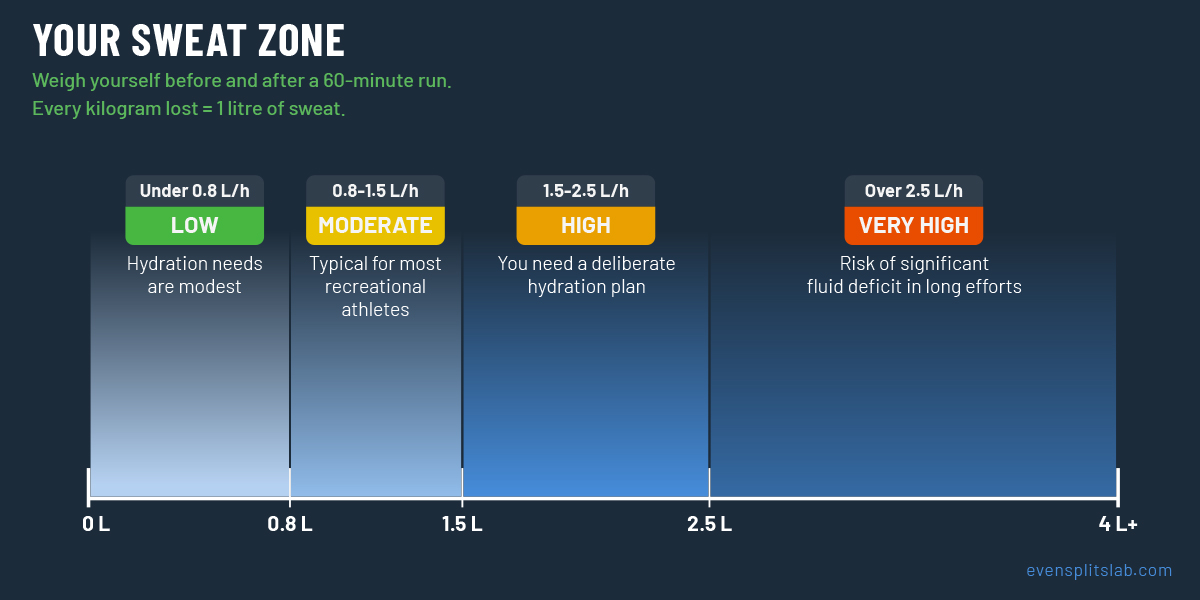
Keep in mind: these numbers shift with temperature and effort. A sweat rate of 1.0 L/hr on a cool day might become 1.8 L/hr in summer heat. That’s why it’s worth doing this test more than once.
When to Retest
One test is a good start. But sweat rate isn’t fixed, it changes with:
- Weather: Heat and humidity drive sweat rate up significantly
- Intensity: Harder efforts = more sweat
- Fitness: As you get fitter and more heat-acclimatised, your body actually starts sweating earlier and more efficiently
- Time of year: Your winter sweat rate won’t reflect what happens on a hot race day
A good practice is to test in at least two conditions: your typical training weather and something closer to race day conditions.
FAQ
Q: Do I need to do the test on a specific type of run? A: A steady-effort run of 45–60 minutes works best. Avoid very easy jogs (sweat rate will be artificially low) or all-out intervals (hard to replicate consistently). Match the test conditions to the training you’re planning around.
Q: What if I eat something before the run? A: Food won’t meaningfully affect your short-term weight during a 60-minute run, but stick to your normal pre-run routine. Don’t eat mid-run during the test — that complicates the math.
Q: Is it normal to lose 1–2 kg on a one-hour run? A: Completely normal, especially in warm conditions or if you run at higher intensities. A 1–2 kg loss (1–2 litres) in an hour is common for many recreational athletes. Above 2 litres per hour, you’ll want a solid in-race hydration strategy.
Q: Can I use this test for cycling or swimming? A: Yes for cycling — same method applies. Swimming is trickier because you absorb some water through your skin and can’t easily dry off for an accurate weigh-in. The test is most reliable for running.
Q: Does sweat rate affect electrolyte needs too? A: Yes. Higher sweat rates usually mean higher sodium losses. If you’re a heavy sweater (and especially if you notice white salt streaks on your kit), sodium replacement during long efforts becomes more important — not just fluid replacement.
Related Posts
- If you’re figuring out race day fuelling, read: What to Eat Before Your First Sprint Triathlon (and What to Avoid)
- Working on your long run hydration strategy? Read: How to Calculate Your Sweat Rate at Home
- Want to understand what electrolytes actually do? Read: Sodium and Endurance Performance: What the Research Says
Sources / References
- Sawka MN, et al. “American College of Sports Medicine Position Stand: Exercise and Fluid Replacement.” Medicine & Science in Sports & Exercise, 2007.
- Burke L, Deakin V. Clinical Sports Nutrition (5th ed.). McGraw-Hill, 2015.
- Sports Dietitian’s Australia — Fluid in Sport Fact Sheet