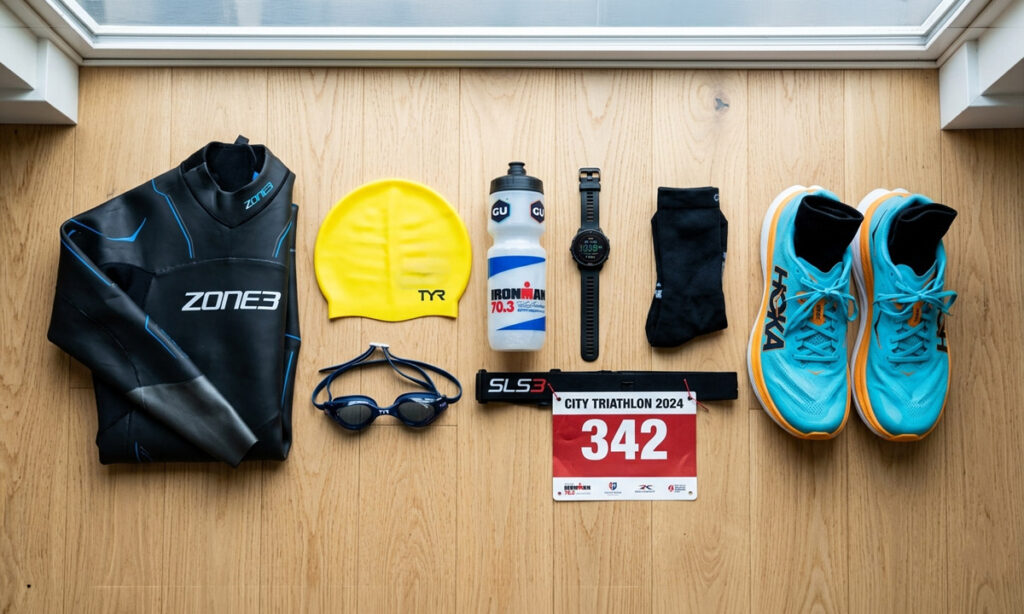
Most people overthink gear before their first triathlon. They see the pros on Instagram and assume they need a $5,000 bike, a full aero kit, and more gadgets than a Formula One car. You don’t. A sprint triathlon is a 750m swim, 20km bike, and 5km run. Not Kona. If you already own running shoes and a road bike, you’re most of the way there. This post covers the minimum triathlon gear for beginners: what’s truly required, what’s helpful, and what you can skip or buy used.
Note: Some links in this post may be affiliate links. If you buy through them, I earn a small commission at no extra cost to you.
TL;DR
You need: goggles, a swim cap, a bike (used is fine), a helmet, a number belt, and something to run in. A tri kit saves transition time and a wetsuit adds buoyancy, but neither is mandatory. Budget $500–$900 CAD if you’re starting from scratch.
Key Takeaways
- A used road bike is completely fine for your first race. Don’t buy new if budget is tight
- A tri kit speeds up transitions but changing clothes works just as well
- A wetsuit may be required or prohibited depending on water temp; check race rules
- Cycling shoes and a GPS watch are nice-to-have, not must-have
- Number belt > pinning your race bib directly to your kit
What You Actually Need (And What You Don’t)
The minimum triathlon gear for beginners breaks down into three categories: mandatory, strongly recommended, and optional but helpful. This section goes through each item, what to look for, and where you can afford to go cheap.
Swim Gear
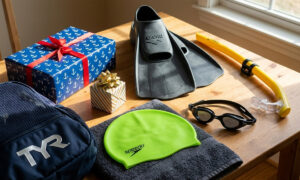
Goggles: Non-negotiable. You cannot do the swim leg without them. You don’t need anything fancy. This Speedo Vanquisher 2.0 is a solid pick around $15–25 CAD.
Swim cap: Most races provide one — it’s how they identify your wave. But you’ll want your own for training. Material matters more than brand here: silicone is more resistant than latex, which tears easily. This Arena silicone cap is what I started with and it’s held up well. About $8–12 CAD.
Wetsuit: Optional at some races, required at others, and prohibited above a certain water temperature. Check your race rules. If water temp is below 24°C, a wetsuit is usually allowed, and it’s worth having one. It adds significant buoyancy (read: free speed), keeps you warm, and reduces anxiety in open water. Decathlon’s 500 Neoprene wetsuit comes in men’s and women’s versions and is one of the best budget options available.
Tri Kit (or Just Wear What You Have)
A trisuit is a one-piece kit designed to go from swim to bike to run without changing. It’s padded enough for cycling, dries fast, and won’t slow you down in transitions. It’s not mandatory. If you’re willing to change in transition (many beginners do), a swimsuit or tri shorts plus a shirt works fine. But if you want one, Decathlon makes a short-sleeved trisuit for both men and women that’s good value at roughly $50–80 CAD.
Do you really need it? Probably not for your first sprint. Is it nicer to have? Yes.
Bike
Your biggest cost. But it doesn’t have to be a new one. A road bike, a hybrid, even a decent mountain bike will get you to the finish line. The key is having something reliable with working gears and brakes.
My first tri bike was a used Cannondale CAAD9 I found on Facebook Marketplace. An 10-speed from 2010 that cost me a fraction of what the same spec would cost new. It was fast, light, and race-ready. Don’t underestimate what’s sitting in someone’s garage.
If you want to buy new, the Decathlon RC 100 is a solid entry-level road bike with Shimano components at an honest price. But seriously, check Marketplace first.
Helmet
Required by race rules. You cannot start the bike leg without one. This is one area where I’d push back on going ultra-cheap: a no-name helmet from an unknown brand isn’t worth the risk. The Decathlon Roadr 500 is affordable, certified, and fits well. Around $40–70 CAD.
Cycling Shoes
Clipless cycling shoes are more efficient than riding in running shoes. You’ll notice the difference on the bike. But they’re not required for your first race. Plenty of beginners race in running shoes and finish just fine.
If you want to invest, the Decathlon EDR Discover road cycling shoes are a good entry point at around $60–90 CAD. Just make sure your bike’s pedals are compatible with the shoes you choose. If they’re not, budget for a pedal and cleat swap too.
Sunglasses
Helpful on the bike to keep bugs, wind, and sun out of your eyes. You don’t need cycling-specific frames. These ROCKBROS Polarized cycling glasses are a solid affordable option.
Water Bottle
For a sprint triathlon (20km bike leg), one 500 ml bottle is enough. For Olympic distance (40km), go with 750 ml. The Elite Fly water bottle is light weight, easy to drink from one-handed while riding, which matters more than you’d think.
GPS Watch
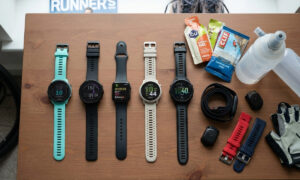
Not required, but really useful. A triathlon GPS watch tracks swim, bike, and run in a single activity. The Garmin Forerunner 55 is the entry point and does the job. The Forerunner 165 adds more features if you want to invest a bit more. Both are budget-friendly options, just depends on how much data you want.
Can you race without one? Yes. Should you eventually get one if you stick with the sport? Definitely.
Run Gear
Hat or visor: Keeps sun and sweat out of your face on the run leg. The Decathlon Ultra Light Running Cap is light enough that you’ll forget it’s on your head.
Number belt: Your race bib goes here. Wear it backwards on the bike and spin it to the front for the run. Way faster than pinning directly to your kit. This number belt is cheap and works perfectly.
Running Shoes
Use whatever you already train in. Shoes are personal and the wrong pair causes more problems than the right pair solves. If you need a starting point, the ASICS Versablast 4 (men’s / woman’s) and the Adidas Duramo Speed 2 (men’s / woman’s) are well-reviewed options at an honest price. For more comparisons, RunRepeat is worth a look.
Gear Summary Table
Here’s a quick reference for everything covered in this post.
| Item | Est. Cost (CAD) | Recommended | Notes |
|---|---|---|---|
| Goggles | $15–25 | Speedo Vanquisher 2.0 | Non-negotiable. Buy before your first pool session. |
| Swim Cap | $5–10 | Arena Classic Silicone | Race provides one, but you need one to train. |
| Tri Kit | $50–80 | Decathlon Trisuit | Skip it if you’re fine changing — but most aren’t. |
| Wetsuit | $100–180 | Decathlon 500 Neoprene | Check race rules first. Adds buoyancy and warmth. |
| Road Bike | $390–900+ | Decathlon RC 100 or used road bike | Biggest cost. Used is totally fine. |
| Helmet | $40–70 | Decathlon Roadr 500 | Required by race rules. Don’t go no-name. |
| Sunglasses | $20–30 | Rockbros Polarized Sunglasses | Optional but helpful on the bike. |
| Water Bottle | $10–15 | Elite Fly | 500 ml fine for sprint; 750 ml for Olympic. |
| Cycling Shoes | $60–90 | Decathlon EDR Discover | Optional but worth it once you’re committed. |
| GPS Watch | $150–250 | Garmin Forerunner 55 or 165 | Track all three disciplines. |
| Hat / Visor | $15–25 | Decathlon Ultra Light Running Cap | For the run leg. Keeps sun and sweat out. |
| Running Shoes | $80–150 | See options in post | Very personal. Use what you train in. |
| Number Belt | $8–12 | Fitletic Race Number Belt | Makes T2 transitions faster. Get one. |
*Prices are approximate CAD at time of writing.
Want a printable version? Download the free one-page gear checklist — everything organised by swim, bike, and run, with notes on what’s mandatory and what you can skip.
Where to Actually Save Money
The bike is the obvious place. Facebook Marketplace, Kijiji, and local cycling clubs are full of perfectly good road bikes from people who got into cycling and fell out again. A used CAAD9 or any comparable aluminum-framed road bike from a reputable brand (Cannondale, Trek, Giant, Specialized) from the 2010s is going to outperform most entry-level new bikes at the same price point.
Cycling shoes are also worth buying used. They don’t wear out the same way running shoes do.
Splurge on the helmet. It’s the one item where cutting corners isn’t worth it.
FAQ
Q: Do I need a triathlon-specific bike for my first race?
No. A road bike or even a hybrid is fine for your first sprint triathlon. Aero bars and carbon wheels are nice if you’re racing competitively, but they’re not going to make or break a beginner’s race day.
Q: Can I wear a regular swimsuit instead of a tri suit?
Yes. A swimsuit under a pair of shorts and a top works fine, especially if you’re okay with a slightly slower transition. A tri suit just makes life easier because you wear it the whole race.
Q: Is a wetsuit required?
It depends on the race and the water temperature. Most races allow wetsuits below 24°C and prohibit them above 28°C. Check your race info. If it’s allowed and the water is cold, strongly consider using one. The buoyancy alone is worth it for most beginners.
Q: What’s a realistic total budget for first-time triathlon gear?
If you’re starting from scratch (no bike, no running shoes), budget $900–1,200 CAD with a new Decathlon bike. If you buy a used bike and already own running shoes, you can gear up for $300–500 CAD.
Q: Do I really need cycling shoes?
No, not for your first race. You can complete a sprint triathlon in running shoes on flat pedals. Clipless shoes do improve efficiency on the bike, but they’re an investment you can make after you’ve decided triathlon is something you’re sticking with.
Related Posts
Already sorted your gear? Now practise using it: How to Speed Up Your Triathlon Transitions (T1 and T2 Guide)
If you’re getting ready for race day, read: What to Eat Before a Sprint Triathlon
For hydration planning: How to Calculate Your Sweat Rate at Home
Sources / References
Triathlon Canada race rules and equipment regulations
Decathlon product pages (linked inline)
Amazon product pages (linked inline)