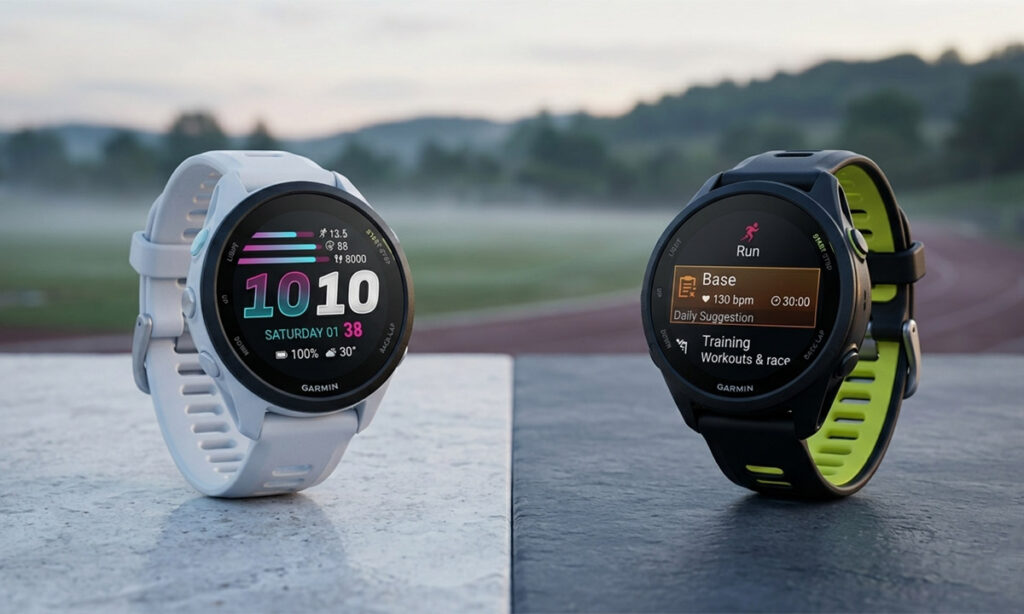
Garmin launched the Forerunner 70 and Forerunner 170 on May 12, 2026. Both replace the watches that came before them — the Forerunner 55 and Forerunner 165 — and both land with more features than their predecessors at higher price points. The line between entry-level and mid-range is blurrier than ever. If you’re trying to figure out which one fits your situation, here’s a clear breakdown of the Garmin Forerunner 70 vs 170.
TL;DR
The Forerunner 70 ($349.99 CAD) is the better buy for most recreational runners. It gets the same training software as the 170, lasts three extra days on a charge, and costs $70 less. The 170 makes sense if you specifically want Garmin Pay, a barometric altimeter, or phone-free music playback.
Key Takeaways
- The 70 and 170 run virtually identical training software — the differences are hardware
- The 170 adds an altimeter, compass, Garmin Pay, and (on the Music version) offline music
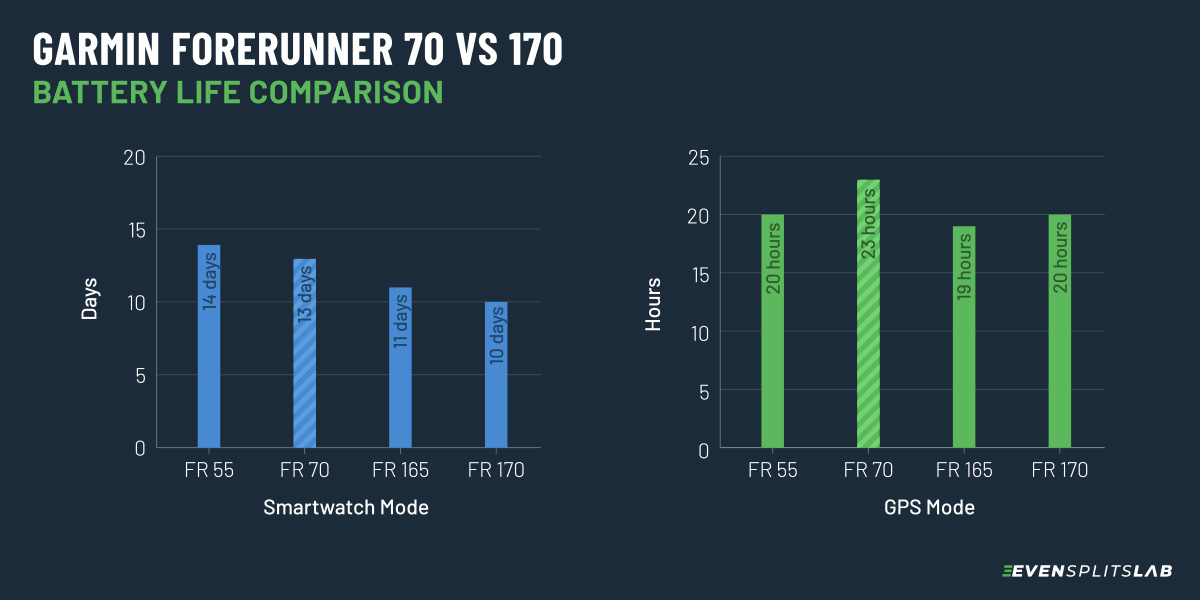
- The 70 has better battery life: 13 days vs 10 days in smartwatch mode
- If you’re on a Forerunner 55, the jump to the 70 is significant — AMOLED screen, full training stack, HRV tracking
What the Forerunner 70 and 170 Have in Common
More than you might expect. Garmin built both watches on the same chassis: a 43mm case, a 1.2-inch AMOLED touchscreen, a five-button layout, and water resistance to 50 metres. They feel identical in hand because they basically are.
Both run the same core software, which is the bigger story here. The full training and health stack — Training Readiness, Training Status, HRV Status, wrist-based running power, running dynamics, daily suggested workouts, Garmin Coach plans, Body Battery, sleep tracking, Sleep Coach, Pulse Ox — is on both watches. All of it. Garmin didn’t reserve the good stuff for the more expensive model.
Both also support 80+ sport profiles, including running, cycling, swimming, strength training, and plenty more. Neither has multi-band GPS. Both use the Elevate V4 heart rate sensor (same generation as the Forerunner 165, one step behind the current V5 on higher-end models). And neither has ECG or skin temperature.
If you want to know how to actually use Training Readiness and heart rate zones together, that’s worth a separate read — check our guide on how to read your heart rate zones.
Forerunner 70 vs 170: Price Comparison
The gap between the Forerunner 70 and 170 comes down to $70 CAD. The 70 is $349.99, the base 170 is $419.99, and the 170 Music runs $489.99 for onboard storage. That’s not a small jump for a watch in this range; the 70 costs about 17% less for a device that runs the exact same training software.
What you’re actually paying the extra $70 for is four pieces of hardware: a barometric altimeter, Garmin Pay, open water swim tracking, and VO2 max estimation. None of those touch the core running experience. Training Readiness, HRV Status, Garmin Coach plans, and wrist-based running power are identical on both watches regardless of which one you buy.
So the price decision isn’t really “which watch is better.” It’s “do I need any of those four specific features.” If the answer is no, the 70 isn’t a compromise pick, it’s the smarter buy, and it comes with three extra days of battery life for saving the money. If you want phone-free music, skip straight to the 170 Music at $489.99. The base 170 doesn’t include music storage, so buying it to save $70 over the Music version only makes sense if the altimeter or Garmin Pay matter to you on their own.
Forerunner 70 vs 170: Full Spec Comparison
The gap between the 70 and 170 comes down to a handful of hardware additions and a $50 price difference. Here’s the complete picture.
| FR 55 | FR 70 (new) | FR 165 | FR 170 (new) | |
|---|---|---|---|---|
| Price (CAD) | $289.99 | $349.99 | $299.99 | $419.99 |
| Display | 1.04″ MIP | 1.2″ AMOLED | 1.2″ AMOLED | 1.2″ AMOLED |
| GPS | Yes | Yes | Yes | Yes |
| HR Sensor | Elevate V3 | Elevate V4 | Elevate V4 | Elevate V4 |
| Battery (smartwatch) | Up to 14 days | Up to 13 days | Up to 11 days | Up to 10 days |
| Battery (GPS) | Up to 20 hrs | Up to 23 hrs | Up to 19 hrs | Up to 20 hrs |
| Training Readiness | No | Yes | No | Yes |
| HRV Status | No | Yes | Yes | Yes |
| Wrist Running Power | No | Yes | Yes | Yes |
| Barometric Altimeter | No | No | Yes | Yes |
| Garmin Pay | No | No | Yes | Yes |
| Music Storage | No | No | 165 Music only | 170 Music only |
| Open Water Swim | No | No | Yes | Yes |
| VO2 Max | Yes | Yes | Yes | Yes |
| Water Resistance | 5 ATM | 5 ATM | 5 ATM | 5 ATM |
Sensors
The Forerunner 170 adds a barometric altimeter, compass, gyroscope, and thermometer. The altimeter is the one that actually changes how you use the watch day-to-day — it enables floor climbing counts and gives more accurate elevation data during runs. For road runners, it’s mostly irrelevant. For trail runners or anyone who cares about precise elevation gain, it matters.
Garmin Pay
The 170 has NFC and supports Garmin Pay for contactless payments. The 70 does not. In theory, this lets you leave your card at home on long runs and tap to pay mid-run. In practice, Canadian support is limited. As of launch, the participating banks list for Canada includes ATB, Brim Financial, CWB, Questrade, STACK, and a handful of others — but none of the Big Five. If you bank with RBC, TD, Scotiabank, CIBC, or BMO, Garmin Pay won’t work with your card. Worth checking the Garmin Pay participating banks list before treating this as a deciding factor.
Music
Only the Forerunner 170 Music ($489.99 CAD) supports offline music storage — 4GB, which holds around 500 songs. You pair Bluetooth headphones and leave your phone behind. The base Forerunner 170 and the Forerunner 70 both require your phone nearby for music. If phone-free music is a priority, the 170 Music is the only option in this lineup.
Open Water Swimming and VO2 Max
These are on the 170 but not the 70. The 70 supports pool swimming but not open water. The 170 adds open water swim tracking and VO2 max estimation. For triathletes or open water swimmers, this is a meaningful difference. Pure road runners probably won’t care.
Garmin Forerunner Comparison
Forerunner 55 vs 70 vs 165 vs 170
Tap a watch in the legend below to hide it and compare the rest
evensplitslab.com
If you’re shopping as a triathlete, neither of these is the right starting point. Our comparison of the best GPS watches for triathletes covers what actually matters for multisport.
Forerunner 70 vs 170: Battery Life Compared
Battery life is where skipping the 170 gets easier to justify. The Forerunner 70 runs up to 13 days in smartwatch mode and roughly 23 hours with GPS on. The 170 and 170 Music drop to 10 days smartwatch and 17 to 20 hours GPS. That’s a real difference, not a rounding error.
Three extra days means the 70 comfortably survives a full training week without touching the charger. The 170 needs a mid-week top-up if you’re running daily and tracking sleep overnight, since overnight sleep tracking is one of the bigger silent battery drains on both watches.
For anyone training for an ultra or doing back-to-back long days without easy charger access, like a multi-day trail race or a camping trip, the 70’s extra runway is the more practical advantage of the two watches. It’s arguably more useful day-to-day than the altimeter or Garmin Pay you’d be paying for on the 170.
The gap comes down almost entirely to what’s driving the screen and radios. The altimeter, compass, and Garmin Pay’s NFC chip on the 170 all pull power the 70 simply doesn’t have to spend. If battery anxiety is part of why you’re upgrading from a Forerunner 55 or 165, that’s a point in the 70’s favour worth weighing against the features you’d be giving up.
Which One Should You Buy?
The right answer depends almost entirely on which hardware features matter to you. The training software is nearly identical on both, so the decision comes down to a few specific questions.
Do you want phone-free music?
If yes, the Forerunner 170 Music is your only option in this lineup. The base 170 and the 70 both require a nearby phone for audio. The 170 Music adds 4GB of onboard storage and pairs with Bluetooth headphones. If music is irrelevant to how you run, this whole tier disappears from the decision.
Do you run trails or care about precise elevation?
The Forerunner 170 has a barometric altimeter. The 70 uses GPS-derived elevation, which is noticeably less accurate on hilly routes. For road runners, the difference is minimal. For trail runners, it matters.
Do you want to pay from your wrist?
Garmin Pay is only on the 170. If you run without your phone and want to stop for water or a snack mid-run, this is a real convenience. If you always carry your phone or don’t need to buy anything mid-run, it’s irrelevant.
Does $70 matter to your decision?
We covered the full price breakdown above. Short version: if none of the 170’s extras (altimeter, Garmin Pay, open water tracking, VO2 max) apply to how you run, the 70 gives you the same training experience for less, plus better battery life. If one of those does apply, the 170 is worth the premium.
Is It Worth Upgrading from the Forerunner 55?
Probably yes, if your 55 is showing its age.
The jump from the Forerunner 55 to the Forerunner 70 is the biggest generational leap in this lineup. The 55 uses a small 1-inch MIP display — functional, but dim indoors. The 70 has a 1.2-inch AMOLED screen that’s genuinely bright and readable. That alone changes the day-to-day experience significantly.
On the training side, the 55 has no Training Readiness, no HRV Status, no wrist-based running power, no sleep coaching, and no morning reports. The 70 has all of those. If you’ve been using a 55 and wondering why your Garmin Connect dashboard feels light on insights, that’s why.
The one real cost of upgrading is the price. The Forerunner 55 is currently $289.99 CAD on Garmin’s site. The Forerunner 70 is $349.99 CAD. That’s a $60 gap. If your 55 is still running fine and you’re not missing any specific features, there’s no urgent reason to replace it. But if you’re buying new, the 70 is a much stronger watch for not that much more money.
If you’re still comparing options before committing, our roundup of the best budget running watches covers where the 55 still fits in the market.
Is It Worth Upgrading from the Forerunner 165?
Harder sell, honestly.
The Forerunner 165 already has AMOLED, music storage, and open water swimming. It doesn’t have Training Readiness, HRV Status, or wrist-based running power — those are new to the 170. If those training metrics matter to you and you’re actively using them, the 170 makes sense.
But the 165 is still a very capable watch, and it’ll likely be discounted now that it’s been replaced. If you’re not actively missing Training Readiness or HRV tracking, there’s not a compelling reason to upgrade immediately. Wait for a sale on the 165 or hold what you have until something genuinely new appeals to you.
For more on how to actually act on training metrics like Training Readiness, our guide to using an AI training plan covers how to feed that data into a plan that adapts around your recovery.
FAQ
The hardware. The 170 adds a barometric altimeter, compass, Garmin Pay, open water swimming, and VO2 max. The 170 Music also adds 4GB of offline music storage. Both watches run virtually the same training and health software. The 70 has better battery life at 13 days vs 10.
No. Garmin Pay is exclusive to the Forerunner 170 and 170 Music in this lineup.
For most runners, yes. The 70 brings a dramatically better display, a full training stack including Training Readiness and HRV Status, and a much more modern software platform. The main trade-off is price — the 70 costs about $50 more than the 55 did at launch.
Not phone-free. The 70 can control music playback on your phone, but it has no onboard storage. Only the Forerunner 170 Music supports downloading songs directly to the watch.
Sources
- Garmin Newsroom — Forerunner 70 & 170 press release: garmin.com/en-US/newsroom
- DC Rainmaker — Forerunner 70: Everything That’s New & Changed: dcrainmaker.com
- Garmin Rumors — Forerunner 70 & 170 launch overview: garminrumors.com