
Most recreational athletes train too hard. Not race-hard : just hard enough that their easy days aren’t really easy, and their hard days aren’t hard enough to matter. The result is a lot of middle-ground effort that doesn’t produce much of anything. Zone 2 and Zone 3 sit right at the centre of this problem. They feel similar, they’re easy to confuse, and which one you prioritise makes a real difference to how fit you actually get. Understanding zone 2 vs zone 3 training is one of the more useful things you can sort out early in your running or cycling.
TL;DR: Zone 2 and Zone 3 are close in effort but very different in effect. Most athletes spend more time in Zone 3 than they realise, including on days that were supposed to be easy. The zone you’re actually training in might not be the one you think.
Key Takeaways
- Zone 2 builds your aerobic base : the foundation everything else sits on
- Zone 3 isn’t useless, but most athletes spend too much unintentional time there
- The physiological difference between the two zones is more significant than the effort gap feels
- This applies equally to running, cycling, and any other aerobic sport
- New athletes often find Zone 2 uncomfortably slow : that’s the point, and it gets easier
What Zone 2 and Zone 3 Actually Are
Heart rate zones divide your training intensity into five bands, each with a different physiological effect. Zone 2 sits in the lower-middle, roughly 60 to 70 percent of your maximum heart rate, depending on the model you use. Zone 3 is just above it, at around 70 to 80 percent.
On paper, that’s a small gap. In practice, the difference between the two zones is meaningful.
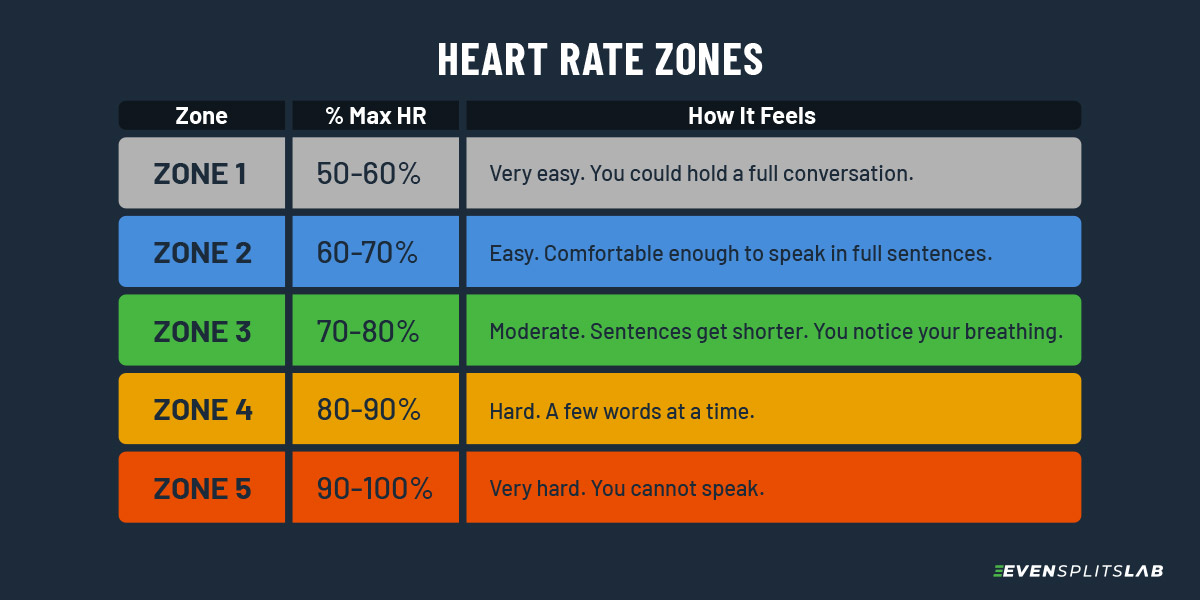
The percentages above are approximate. Your exact zones should be calculated from your actual max heart rate, not the 220-minus-age formula. That formula is convenient but often wrong by 10 to 20 BPM, which can put your entire zone structure off.
Need to figure out your actual zones? Read: How to Read Your Heart Rate Zones (and Why Most People Get Them Wrong)
What Zone 2 feels like
Zone 2 should feel easy. Conversation-pace easy. If you’re running, you should be able to talk in full sentences without gasping. If you’re cycling, it should feel like a comfortable spin you could sustain for hours.
For a lot of new athletes, this pace feels embarrassingly slow. You might be doing a run/walk to stay in zone. Your GPS pace might be slower than you’d like to admit. That’s fine. That’s what Zone 2 looks like when you’re still building a base.
What Zone 3 feels like
Zone 3 is where effort starts to register. Your breathing picks up. Sentences get shorter. It’s not uncomfortable, but you’re definitely working. This is roughly tempo pace in running, or a moderate sustained effort on the bike.
The tricky part: Zone 3 doesn’t feel hard. It feels like a solid training effort, which is why so many athletes gravitate toward it. Not uncomfortable enough to back off, but not easy enough to question whether you’re doing enough. That sweet spot of feeling productive is exactly the problem.
Why Zone 2 Builds Fitness (and Zone 3 Doesn’t Do It as Efficiently)
Zone 2 training primarily develops your aerobic energy system. At this intensity, your body fuels itself mostly from fat, your heart and lungs work efficiently, and the stress on your muscles and connective tissue is low. Over time, consistent Zone 2 work improves your cardiovascular efficiency, increases the density of mitochondria in your muscle cells, and raises the ceiling for everything else you do.
Think of it like building a bigger engine before you start pushing harder on the accelerator.
Zone 3 does produce aerobic adaptations, but less efficiently relative to the recovery cost. You’re working harder, burning more carbohydrate, and accumulating more fatigue without generating the specific low-intensity adaptations that make Zone 2 so valuable. For high-volume athletes, this matters a lot. For recreational athletes doing 6 to 10 hours a week, it still matters, just on a smaller scale.
The research on polarised training consistently shows this approach produces better endurance adaptations than spending large amounts of time in the middle zones. Polarised training means the majority of time in Zone 1 and 2, a smaller amount in Zone 4 and 5, and very little in Zone 3.
This applies the same way whether you’re running or cycling. The zones are based on your cardiovascular system, not the sport. A Zone 2 run and a Zone 2 bike ride are training the same system.
Why Zone 3 Gets a Bad Reputation (The Grey Zone Problem)
Zone 3 is sometimes called the grey zone, and the label is a bit unfair to the zone itself. The actual problem isn’t Zone 3. It’s accidentally being in Zone 3 when you intended to be in Zone 2.
Here’s how it usually goes: you head out for an easy run. The pace feels comfortable. Ten minutes in, you pick it up slightly without thinking. Fifteen minutes later, you’re in Zone 3. You finish the run feeling like you worked, but not like you really did anything. Your legs are a bit flat for your next session. Nothing is wrong exactly, but nothing is optimally right either.
That’s the grey zone trap. Not Zone 3 itself. Zone 3 by accident, on days that were supposed to be easy.
When Zone 3 is deliberate (a tempo run, a race-specific effort, a hard day in a structured plan) it has a place. The issue is when it becomes the default intensity, every day, because athletes don’t train easy enough on easy days.
A Note for Newer Athletes: Zone 2 Is Harder to Sustain Than It Sounds
If you’re relatively new to running or cycling, you might find Zone 2 frustrating at first. Staying in the zone might mean slowing down significantly. A pace that feels almost too easy, or a heart rate that climbs faster than your effort justifies.
This is normal. A less-trained cardiovascular system has to work harder to move you at the same pace. Your heart rate spikes more easily. Zone 2 might mean a run-walk combination, or a cycling pace that feels like you’re barely moving.
The temptation is to push harder, to train at the pace you think you should be able to do. This is where most new athletes go wrong. They train hard all the time, never build an aerobic base, and plateau earlier than they should. The athletes who do the boring Zone 2 work in year one tend to be the ones who are still improving in year three.
It gets better. As your fitness builds, your Zone 2 pace gets faster for the same heart rate. That’s the adaptation working.
How to Actually Split Your Training Between Zones
A common recommendation for endurance athletes is the 80/20 rule: roughly 80 percent of training time in Zone 1 and 2, and 20 percent at higher intensities (Zone 4 and 5). Zone 3 doesn’t get a dedicated allocation. It’s used deliberately when the plan calls for it, not as filler between easy and hard.
For a recreational athlete doing 8 hours of training per week, that looks something like:
- 6 to 6.5 hours in Zone 1 and 2 (easy runs, long rides, recovery sessions)
- 1 to 1.5 hours in Zone 4 to 5 (intervals, tempo work, race-pace efforts)
- Zone 3 appearing occasionally when the plan calls for tempo work, not by default
The exact split matters less than the principle: protect your easy days. If your easy days drift into Zone 3, you accumulate fatigue without the recovery benefit of Zone 1 and 2, and without the stimulus of Zones 4 and 5. You’re in the grey zone in every sense of the phrase.
Building a training plan and not sure where to put your zones? Read: How to Get a Useful Training Plan Out of AI (Most People Do It Wrong)
How to Know Which Zone You’re Actually In
The only reliable way to train to zones is to know your max heart rate accurately, and to wear a heart rate monitor during training.
The 220-minus-age formula gives you a rough number, but it can be off significantly. A 40-year-old with a formula-predicted max HR of 180 BPM might actually max out at 194. That error shifts every zone up. What looks like Zone 2 on the formula might actually be Zone 1 for that athlete, or Zone 3.
To find your actual zones, you need either a field test or a lab test. For most recreational athletes, a field test on a track or a hill works fine.
Once you have your real max HR, your zones will actually mean something. Until then, you’re training to a number that might not be yours.
Read our full guide to finding your heart rate zones: How to Read Your Heart Rate Zones (and Why Most People Get Them Wrong)
FAQ
Not inherently. Zone 3 has a legitimate place in structured training. Tempo runs and some race-specific work sit in this zone. The problem is when athletes spend most of their training time in Zone 3 by default, without intending to. Used deliberately, it’s fine. Used accidentally, it can undermine your recovery and limit your aerobic development.
Most endurance coaches recommend that the majority of your training volume (roughly 70 to 80 percent) comes from Zone 1 and 2. If you’re training 8 hours a week, that’s around 6 hours at easy to moderate intensity. The exact number is less important than the habit of keeping your easy days actually easy.
Not really. Zone 3 doesn’t replicate the specific adaptations of Zone 2. If you’re short on time, a shorter Zone 2 session is still more useful than pushing into Zone 3. The aerobic base you’re building in Zone 2 is the foundation your harder sessions sit on. Skipping it to go harder tends to work fine short-term and catch up with you over a full season.
It should feel easy, easy enough to hold a conversation without breathing hard. For many newer runners, this means slowing way down or using run-walk intervals. Your GPS pace will probably be slower than feels productive. If you finish a Zone 2 run feeling like you didn’t do enough, you’re probably doing it right.
Yes. Heart rate zones are based on your cardiovascular system, not the sport. A Zone 2 run and a Zone 2 bike ride are producing the same aerobic adaptations. One practical note: your heart rate tends to run slightly higher during running than cycling at the same perceived effort, so if you use the same HR targets for both, be aware your cycling Zone 2 might feel a touch easier.
Sources:
- Seiler S, Tønnessen E. Intervals, Thresholds, and Long Slow Distance: the Role of Intensity and Duration in Endurance Training. Sportscience. 2009.San-Millán I, Brooks GA. Assessment of Metabolic Flexibility by Means of Measuring Blood Lactate, Fat, and Carbohydrate Oxidation During an Incremental Exercise Test. Sports Medicine. 2018.