If you’ve ever watched a triathlon and thought ‘I want to do that,’ the first question is always the same: which one? The sport has more distances than most people realise, and they’re not just different lengths. They feel like completely different experiences.
Some people start at the sprint and race it for years. Others use it as a stepping stone and move up as their confidence builds. There’s no right answer, and no timeline you have to follow. The goal of this post is to give you an honest look at each triathlon distance so you can figure out which one makes sense for where you are right now.
TL;DR
Triathlon distances range from the beginner-friendly super-sprint (400m swim / 10km bike / 2.5km run) all the way up to the full Ironman (3.8km swim / 180km bike / 42.2km run). Most beginners start with a sprint or super-sprint and build from there. Each distance is a legitimate goal on its own.
Key Takeaways
- There are five main triathlon distances: super-sprint, sprint, Olympic, half-Ironman, and full Ironman.
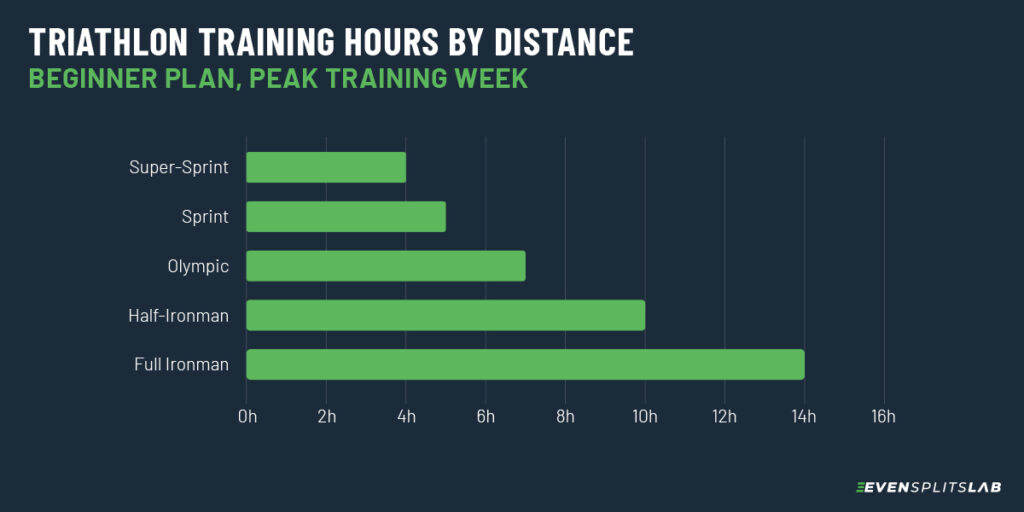
- Each distance has a different training commitment: from 5 hours per week (sprint) to 14+ hours at peak (full Ironman).
- Most beginners do well starting with a sprint or super-sprint, especially if swimming is a limiting factor.
- Moving up distances is a personal decision. Some people race the same distance for years, and that’s completely fine.
- The biggest jumps in difficulty are sprint to Olympic (swim volume) and Olympic to half-Ironman (everything gets harder, especially the run).
All Triathlon Distances at a Glance
Here’s the full breakdown. We’ll go deeper into each one below.
| Distance | Swim | Bike | Run | Avg Finish Time (Beginner) |
|---|---|---|---|---|
| Super-Sprint | 400m | 10km | 2.5km | 45–75 min |
| Sprint | 750m | 20km | 5km | 1h 15 – 2h |
| Olympic | 1.5km | 40km | 10km | 2h 30 – 3h 30 |
| Half-Ironman | 1.9km | 90km | 21.1km | 5–7h |
| Full Ironman | 3.8km | 180km | 42.2km | 11–16h |
Super-Sprint: The Real Entry Point
Super-sprint triathlons don’t get nearly enough attention. They’re the shortest standardised format in the sport: a 400m swim, 10km bike, and 2.5km run. Probably the most beginner-friendly thing you can sign up for.
If the sprint distance feels overwhelming at first, or you’ve never done open water swimming, this is a legitimate starting point. Plenty of super-sprint races use a pool swim, which takes a lot of the anxiety out of your first race. You’re also looking at a finish time under an hour for most people. That’s a morning well spent.
Worth knowing: super-sprint distances can vary a bit depending on the race organiser. The numbers above are the standard benchmark, but don’t be surprised if you see slightly different splits.
Who It’s For
- Complete beginners with limited swim confidence
- Athletes returning to sport after a long break
- Anyone who wants to try triathlon before committing to longer training blocks
Training Commitment
A 12-week beginner plan for a super-sprint will have you training around 3–4 hours per week at peak. It’s manageable alongside most schedules.
Sprint Triathlon: Where Most Beginners Start
The sprint is the most popular triathlon distance in the world, and it’s not hard to see why. It’s short enough to be approachable, but long enough that you genuinely have to train for it. A 750m swim, 20km bike, and 5km run doesn’t sound like much until you do all three back to back.
The biggest thing beginners underestimate about the sprint is the bike-to-run transition. Your legs feel strange coming off the bike. Heavier than you’d expect. A lot of people go out too hard on the run and pay for it in the last kilometre. Pacing takes practice.
Most people finish their first sprint in 1h 15 to 2 hours depending on fitness level. If you can swim 750m, ride comfortably for an hour, and run 5km without stopping, you’re already most of the way there.
Who It’s For
- First-time triathletes with a base in at least one of the three sports
- Recreational athletes who want a structured goal without overhauling their life
- Runners or cyclists making the transition to multisport
If a sprint is where you’re starting, our free 12-week sprint triathlon training plan lays out every session, with heart rate zones and field tests built in.
Training Commitment
A 12-week beginner sprint plan peaks at around 5 hours per week. That’s roughly 6 sessions: two swims, two bikes, two runs, spread across the week. Tight but doable.
If you’re just getting started with gear, check out our post on the minimum triathlon gear you actually need. It’ll save you from overspending before your first race.
Olympic Triathlon: The First Real Step Up
The Olympic distance (1.5km swim, 40km bike, 10km run) is where the sport starts to feel like an endurance event. It’s the format used at the Olympic Games, and it’s also where a lot of triathletes find their home. Some race Olympic distance for years without ever feeling the need to go longer.
The jump from sprint to Olympic is bigger than the numbers suggest. The swim goes from 750m to 1.5km. Double the distance. For a lot of people, that’s the hard part. Sessions that used to be 1,500m are now 2,500m, and you feel it. The run is also twice as long, and running 10km after a 40km bike requires a different kind of pacing discipline.
That said, finish times under 3 hours are very achievable for most beginners with solid training, and the Olympic format attracts a huge range of ages and abilities. It’s a serious race that doesn’t require you to rearrange your life.
Who It’s For
- Athletes who’ve done one or more sprint triathlons and are ready for more
- Competitive recreational athletes who want a real challenge without long-course training
- Strong swimmers and cyclists who find the sprint distance too short
Training Commitment
A 12-week beginner Olympic plan peaks around 7–8 hours per week at its highest. More sessions per discipline, longer long rides, and more swim volume than the sprint block.
Moving up in distance means changing how you train. See Olympic vs 70.3 training for what shifts.
Half-Ironman (70.3): Where Training Becomes a Lifestyle
The half-Ironman (1.9km swim, 90km bike, 21.1km run) is where things get serious. Not just the race itself, but the training block leading up to it. You’re looking at 16+ weeks of structured work, and the demands on your schedule, your sleep, and your nutrition all go up meaningfully.
The run is the hardest part at this distance for most people. Running a half-marathon is one thing. Running a half-marathon after swimming nearly 2km and cycling 90km is something else. The fatigue accumulation is real, and if you haven’t practised your race-day nutrition strategy, you’ll know about it by kilometre 15.
The good news: the half-Ironman is one of the most satisfying distances in the sport. Crossing the finish line after 5–7 hours of continuous effort feels genuinely different from a sprint or Olympic finish. And the training block, while demanding, is manageable for most people who plan it well.
Not all 70.3 courses are equally hard. This breakdown of the easiest Ironman 70.3 courses by leg shows how much they vary.
Who It’s For
- Athletes who’ve completed a sprint or Olympic and want a bigger challenge
- People who have 16–20 weeks to train and can handle 8–10 hours per week at peak
- Anyone drawn to the idea of long-course racing without committing to a full Ironman yet
Training Commitment
Plan for 16 weeks minimum. Twenty is better, especially if you’re building from an Olympic base. Peak training weeks will hit around 10 hours. Starting early gives your body time to adapt without cramming volume into the final weeks.
Nutrition becomes much more important at this distance. You can get through a sprint on adrenaline and a gel or two, but the half-Ironman requires a proper fuelling plan from the start. Our sodium intake guide and energy gel comparison are worth reading before you race.
Full Ironman (140.6): The Long Game
The full Ironman is 3.8km swim, 180km bike, and a full marathon run. Total: 226km. It’s the kind of race people sign up for a year in advance and spend the intervening months equal parts excited and terrified.
Training for a full Ironman is a genuine lifestyle commitment. A 24-week beginner plan will peak at around 14 hours per week. That’s multiple workouts per day in the heavy weeks, long rides that take most of a Saturday, and long runs that eat into Sunday. Recovery, sleep, and nutrition stop being optional extras and become part of the training.
The race itself takes most age-group athletes 11–16 hours to complete. The cut-off is usually 16–17 hours depending on the event. It’s not just about fitness. It’s about managing effort, pacing every single segment, and staying mentally in it for the entire day.
Most experienced triathletes recommend building through the distances before attempting a full Ironman. That’s not a rule. Some people do it as their first race. But it’s solid advice. Understanding how your body responds to each distance teaches you things that no training plan can fully prepare you for.
Who It’s For
- Athletes who’ve completed at least a half-Ironman and want the ultimate challenge
- People who can dedicate 20–24 weeks of serious training
- Anyone who’s been thinking about it for more than a year and keeps coming back to the idea
Training Commitment
Plan for a 24-week block as a beginner. Peak weeks will be around 14 hours. The earlier you start, the more gradual the build. That’s better for your body and your injury risk. This is not a 12-week event.
Which Distance Should You Start With?
Here’s the honest version: pick the distance that scares you a little but doesn’t feel completely unreachable. That’s usually the right one.
For most beginners, that’s a sprint or super-sprint. The sprint gives you a real race experience without requiring you to restructure your entire schedule. You’ll learn about transitions, open water swimming, and pacing. That puts you in better shape for the next distance up, whenever you decide to make that jump.
Some people do one sprint and immediately sign up for a half-Ironman. Others race sprint distance for three seasons and love every race. Both approaches are valid. The ladder exists, but nobody’s forcing you to climb it on a schedule.
Training Hours by Distance (Beginner, Peak Week)
| Distance | Plan Length | Peak Week (approx.) |
|---|---|---|
| Super-Sprint | 8–10 weeks | 3–4 hrs |
| Sprint | 12 weeks | Up to 5 hrs |
| Olympic | 12 weeks | Up to 7 hrs |
| Half-Ironman | 16 weeks | Up to 10 hrs |
| Full Ironman | 24 weeks | Up to 14 hrs |
These are beginner estimates for people whose primary goal is finishing. Training hours increase significantly for intermediate and advanced athletes. Plan length matters too. A longer block means more time to adapt to the load gradually, which is almost always better for beginners than cramming the same volume into fewer weeks. The distances in the table are a reasonable starting point, not a fixed prescription.
If you want help building a plan, take a look at our post on how to get a useful training plan out of AI. It covers exactly how to structure a block for any of these distances.
A Note on Moving Up the Distances
For what it’s worth: starting with a duathlon (run-bike-run) before touching a triathlon is a perfectly reasonable path into the sport. It lets you figure out transitions and pacing without adding the swim variable on day one.
The jump from sprint to Olympic felt manageable on the bike and run. The swim was a bigger ask than expected. Going from 750m race swims to 1.5km changes what you need to do in the pool during training. Sessions got longer, and the open water comfort had to be there before race day.
Moving from Olympic to half-Ironman, the run was the hardest adjustment. Running further is one thing; running further on already tired legs is a different kind of problem. It’s something you have to practise in training, not just hope you can manage on race day.
Each distance teaches you something the previous one couldn’t. There’s no shortcut to that. Once you know the distances, you can start picking a bucket-list triathlon.
Ready to race? Don’t leave time on the table: How to Speed Up Your Triathlon Transitions (T1 and T2 Guide)
FAQ
The super-sprint is the shortest standardised triathlon distance: 400m swim, 10km bike, and 2.5km run. It’s the recommended starting point for complete beginners, and many super-sprint events use a pool swim instead of open water.
Most beginners finish a sprint triathlon in 1 hour 15 minutes to 2 hours. It depends on your fitness level, the course, and conditions. Competitive age-groupers typically aim for under 1 hour 15 minutes.
You don’t need to be fast, but you do need to be comfortable in the water. For a super-sprint or sprint, being able to swim 400–750m without stopping is usually enough. Open water comfort matters more than pace, especially for your first race.
A 16-week beginner plan is a realistic minimum. Peak training weeks will be around 10 hours. Starting 20 weeks out gives you more room to build gradually, which reduces injury risk and usually produces better race results.
Technically yes, but it’s a big jump. The Olympic distance teaches you how to pace across a longer race and handle the run on fatigued legs. Both of those things matter a lot at the half-Ironman. Most coaches recommend at least one Olympic before attempting 70.3.
Sources
- World Triathlon — triathlon.org
- Ironman — ironman.com