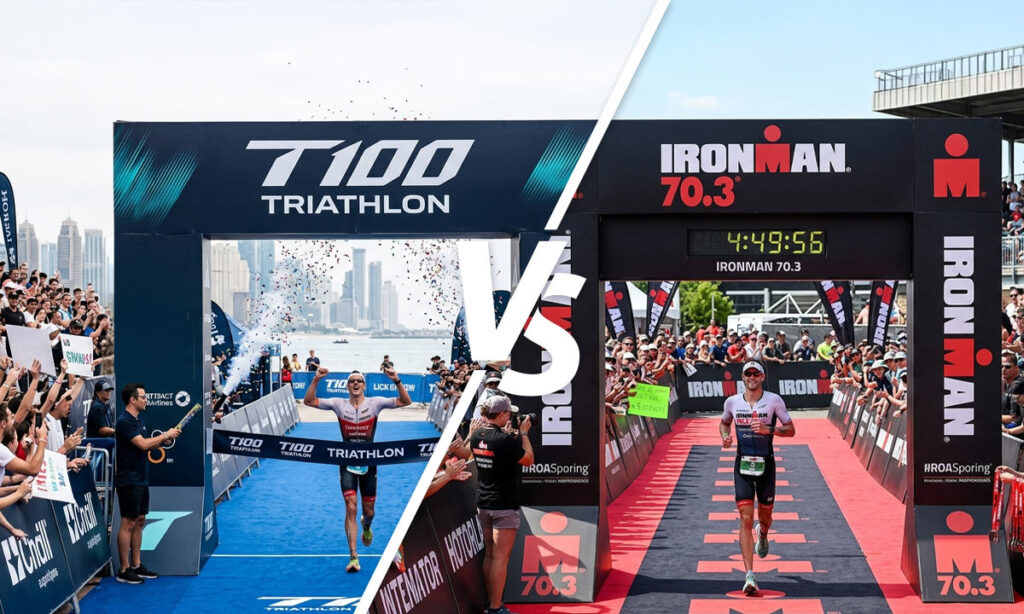
If you’ve done a 70.3 and you’re eyeing a T100 race, you’ve probably noticed the marketing. Pro athletes, big prize money, a course you supposedly get to share with the best in the world. It sounds like the next level up. I went straight to Lucas, a training partner of mine who’s raced two Ironman 70.3 events and T100 Vancouver, to find out what it’s really like to race t100 vs 70.3.
TL;DR
T100 is actually shorter than a 70.3 (2km swim, 80km bike, 18km run vs 1.9km, 90km, 21.1km), so it’s not a step up in distance, just a different format. Whether it’s worth it comes down to the specific race you’re comparing, not the brand name on the bib.
Key Takeaways
- T100 is shorter than a 70.3, not longer, despite how it’s marketed
- Race quality varies more by venue than by series. A local 70.3 and a flagship T100 are not the same experience
- Cost varies a lot by venue and how close to home the race is. Research the specific event before assuming either series is cheaper.
- Watching the pro race the day before changes how you feel on your own race day
- Ironman still carries more weight in most triathletes’ heads, even when a specific T100 event delivers a comparable experience.
The numbers: T100 vs 70.3
First, let’s kill the assumption. T100 sounds like the bigger, harder race because of how it’s positioned (pro tour, big money, ‘the F1 of triathlon’). It isn’t. It’s shorter than a 70.3 overall, though the swim is slightly longer (2km vs 1.9km). The bike and run are both shorter, and that’s where the time really adds up.
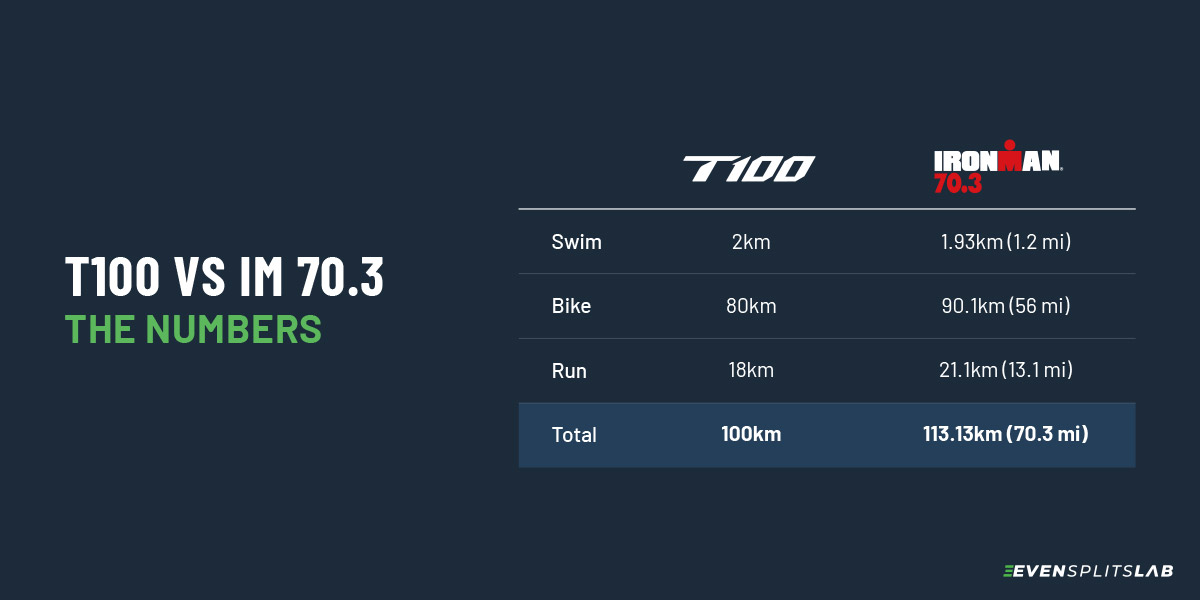
In practical terms, T100 slips neatly between Olympic and 70.3 on the distance ladder: Sprint, Olympic, T100, 70.3, Full. Only 13km separates T100 from a 70.3. You’re not dropping a full category, just trimming the edges.
For a race-day view of the format, read the T100 Vancouver Olympic distance race review.
Race quality isn’t about the brand, it’s about the venue
This was the most useful thing Lucas’s experience taught me. The assumption going in is usually ‘Ironman = polished, established brand’ and ‘T100 = newer, so it must be less developed.’ That’s not what actually played out for him.
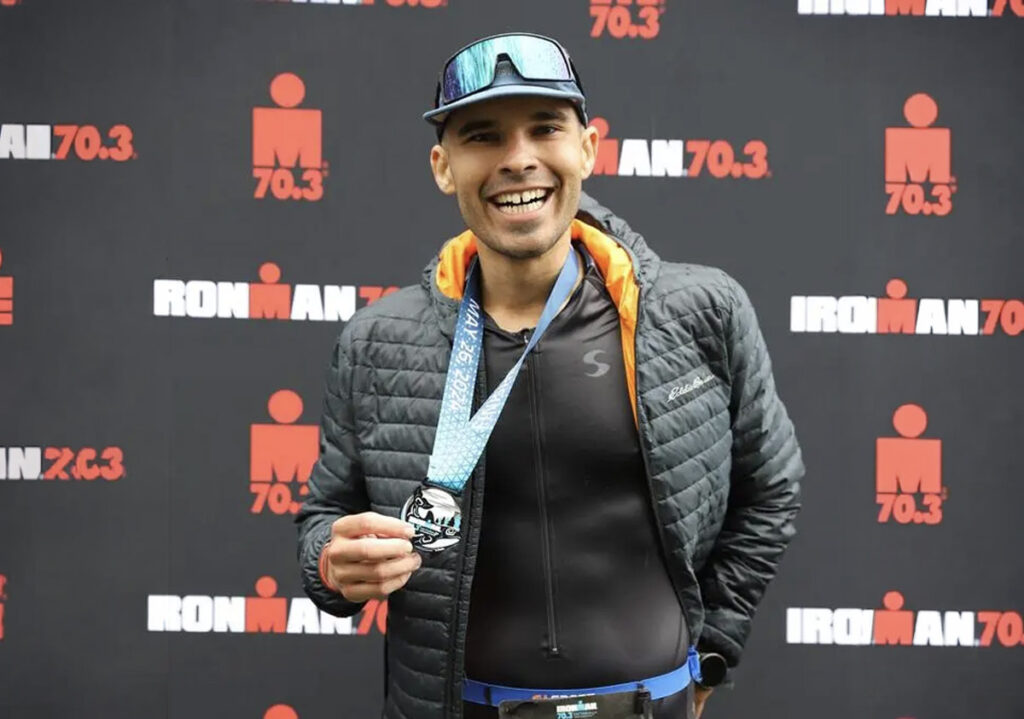
Lucas’s first 70.3 was Victoria, BC, in May 2024, and it didn’t match the Ironman experience he’d seen marketed on TV. The store and race stands felt small, with limited stock, more like a local race than a global brand event. He chalks some of that up to the logistics of shipping Ironman-branded gear out to Vancouver Island. Nothing about the organization was wrong, it just didn’t feel like the version of Ironman sold through races like Kona.
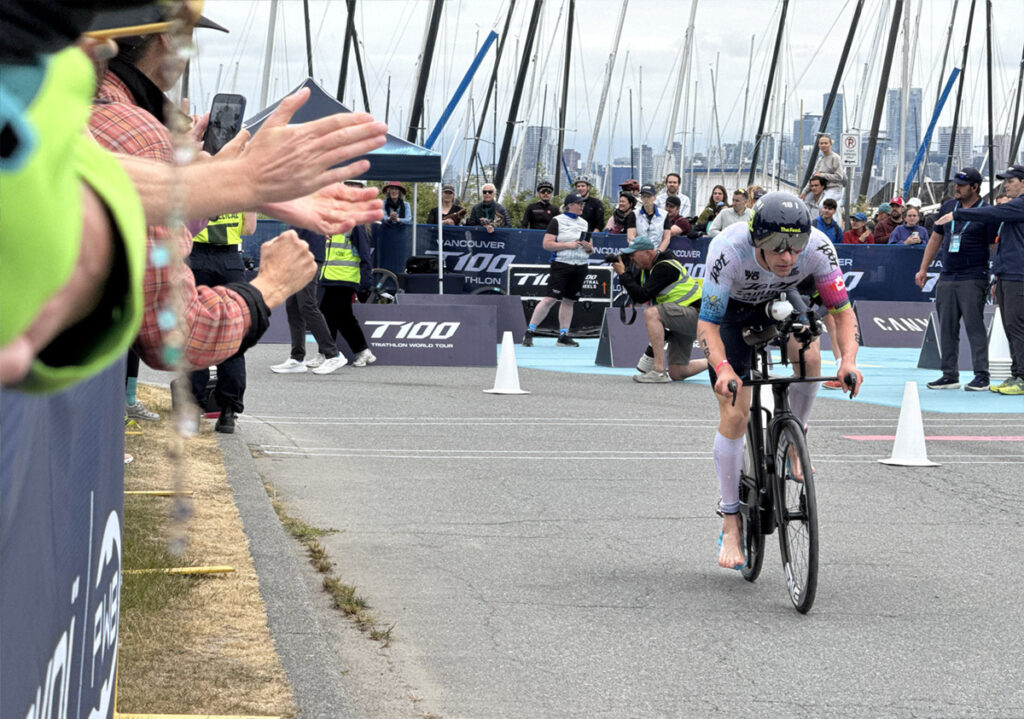
T100 Vancouver was a different scale entirely. The pros were in town for a full week beforehand, training on course, and Lucas described watching Taylor Knibb, Jelle Geens, and Paula Findlay doing loops at Spanish Bank Hills. The stands and store were bigger, with far more on offer. And because the pro race had happened the day before, some of that production carried straight into the age-group race. As Lucas put it:
Crossing the finish line at the T100 was like a ‘pro-like experience’. The carpet and the cameras were all still out there due to the PRO race on the day before.
He still uses the bag that came with his 100km race entry, a small detail, but the kind that sticks.
Here’s the part that keeps this from being a clean win for T100, though. Lucas’s second 70.3, Washington Tri-Cities in September 2026, matched T100 Vancouver almost feature for feature: big stands, a well-stocked store, and a field of nearly two thousand athletes. In his words, the two races were “very comparable.”
The lesson: don’t pick your race based on which series sounds bigger on paper. A flagship T100 can outclass a small-market 70.3, and a strong 70.3 can match a flagship T100 stride for stride. Look at the specific event, not just the series name.
The cost comparison
This is where T100 had a real edge for Lucas, at least in this one comparison. Entry fees for both series vary by venue and how early you register, so treat any figure here as a starting point to verify before you commit, not a fixed rule. But his actual experience was straightforward: T100 Vancouver cost him roughly half what he’d paid for a 70.3, with organization and swag he rated as good or better.
Distance from home mattered just as much as the entry fee. T100 Vancouver was effectively in Lucas’s backyard as a Richmond, BC resident, so there was no travel or accommodation cost layered on top. That’s not a given with T100 generally. The series currently runs at around nine venues worldwide each year, almost all destination-style events (Singapore, Gold Coast, Dubai, Qatar). A 70.3, by comparison, is far easier to find close to home, with well over a hundred races globally.
If you happen to live near a T100 stop, you can come out ahead on both entry cost and travel. If you don’t, factor in flights and accommodation before assuming T100 is the cheaper option.
Watching the pros changes your race
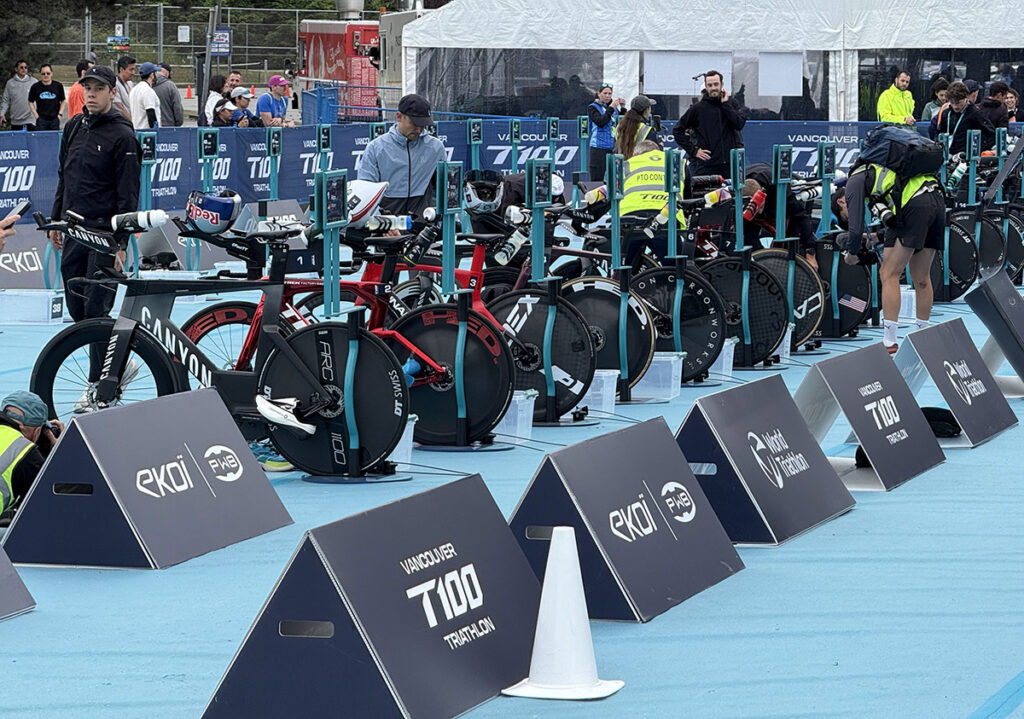
One thing a standard 70.3 doesn’t offer: a televised pro race on the same course, the day before you toe the line. At T100 Vancouver, that mattered more than Lucas expected going in. He’d been nervous, putting pressure on himself ahead of the race. Watching the pros compete for a living, giving everything they had, reset his own expectations. As he told me:
Watching the PROs out there doing that for a living, giving it their all, helped take some of my edges and put things into perspective. The perspective that I’m not a PRO, and I’m doing this sport to better myself and get better and better results over time. And honestly, seeing some of them and their bikes close by was pretty f***ing cool!
If race-day nerves tend to get the better of you, that pre-race atmosphere, watching elite athletes handle the same course under far more pressure, can be a genuinely useful reset before your own start.
Why Ironman still wins the imagination, even when it loses on paper
Here’s the part that surprised me most. Even with T100 matching or beating his 70.3 experience on organization, atmosphere, and cost, Lucas isn’t chasing T100 as his big goal race. He’s still putting his eggs in the Ironman basket, working toward a 70.3 Worlds slot and eventually a full Ironman.
I’d race T100s but not with a milestone and a goal, but as a training ground. Again, nothing wrong about T100 and the brand, I really loved the race atmosphere and the organization. They just don’t have the same ‘strength’ that the Ironman brand has yet, and things like Kona, or 70.3 worlds are very unique and play with our imagination.
That’s worth sitting with. T100 can be the better race weekend and still not be the race that means as much to you. Brand weight isn’t rational, but it’s real, and it’s a legitimate factor in choosing where you put your training time.
Picking a 70.3 for your next race? Here are the easiest Ironman 70.3 courses, leg by leg.
So which one should you race?
There isn’t a universal answer here, but a few practical filters:
- If there’s a T100 venue near you, it’s worth a serious look. The same logic applies to 70.3: local racing always changes the math on cost and travel, regardless of the series.
- T100 has its own age-group pathway. Top finishers in your age group at a T100 race qualify for the T100 Age-Group World Championship in Dubai. Different goal, different road.
- Don’t assume either series guarantees a polished experience. Research the specific race, not just the series name.
- If race-day nerves are a problem for you, a T100 weekend’s pro-race build-up is a genuine, practical benefit.
- If you want the full destination-race spectacle without Ironman’s price tag, and you’re willing to travel, T100 delivers that.
Either way, the smartest move is the one Lucas landed on: race both when you can, and let the specific event, not the series name, make the call.
The T100 and 70.3 are only part of the picture. See the best triathlons in the world for more variety.
Related Posts
If you’re still working out which distance suits you in the first place, start with Sprint vs Olympic vs Half vs Full: Triathlon Distances Explained.
And if transitions are still eating into your race time regardless of which format you choose, check out Triathlon Transition Tips: T1 and T2 Guide
Sources
- T100 Triathlon — official race distance and format details
- IRONMAN.COM — official site