There’s no single “easiest Ironman 70.3.” Depending on which leg gives you the most trouble, swimming, biking, or running, a completely different race is the right call. A lot of “easiest 70.3” roundups also treat a current-assisted swim as one race’s unique selling point, when it’s actually a fairly common course feature. Augusta, Washington Tri-Cities, North Carolina, and Waco all use one. This guide skips the vague “top 10 easiest” format and breaks the easiest Ironman 70.3 courses down by leg instead, so the pick actually matches your weakness.
TL;DR
There’s no one “easiest” Ironman 70.3, it depends which leg worries you most. This picks the strongest option for swim, bike, and run individually, plus the single most forgiving course for a first 70.3 once race-week weather is factored in.
Key takeaways
- Current-assisted downriver swims aren’t rare. Augusta, Washington Tri-Cities, North Carolina, and Waco all use one, so a fast swim isn’t one race’s exclusive selling point.
- Ironman 70.3 Washington Tri-Cities was voted Best Run Course in the World and ranked #3 for Best Swim Course in North America in the 2025 Athletes’ Choice Awards, real athlete-voted data, not hype.
- Gulf Coast has the flattest bike course of this group, though Panama City Beach’s humidity and storm risk in May work against it.
- Galveston is the only course here that’s flat across all three legs and sits in a genuinely comfortable temperature range.
- The same course can be a great pick for one weakness and a poor pick for another. Match the course to what actually worries you, not to a single ranking.
There’s No Single “Easiest” Ironman 70.3
Course difficulty isn’t one number. A race with a genuinely flat bike course can still wreck a beginner’s day with heat, humidity, or a rough current. A race with a fast, current-assisted swim can still be a hard day if the bike rolls through hill country. Treating “easiest Ironman 70.3” as a single ranking flattens all of that into one answer that doesn’t actually help anyone pick a race. The comparisons below are built from each race’s own course data, third-party elevation profiles, and race-week climate normals, cross-checked against athlete race reports rather than marketing copy alone. What matters most is which leg is the one giving you trouble, and what the calendar looks like on race day.
Pick Your Course By Your Weakest Leg
Start here instead of a ranking. Match your actual weak spot to the course that covers for it:
| Weak spot | Best course for it |
|---|---|
| Weak swimmer | Washington Tri-Cities, Augusta, North Carolina, or Waco, all current-assisted downriver swims. |
| Hate hills | Gulf Coast, the flattest bike course of this group. |
| Run falls apart | Galveston, just 56 feet of elevation gain over the whole run. |
| Heat/humidity | Galveston (April) or Washington Tri-Cities (late Sept). Avoid Gulf Coast (May) and Eagleman (June). |
| Cold mornings | Galveston or Washington Tri-Cities. Skip North Carolina’s October start. |
| Just want easiest | Galveston. |
Easiest Swim: Ironman 70.3 Washington Tri-Cities (and Other Downriver Options)
A current-assisted downriver swim isn’t unique to one race. Augusta, North Carolina, and Waco all send athletes down a river instead of across open, still water, and the current does real work shortening the swim split. Among that group, Washington Tri-Cities in Richland, Washington has the strongest independently verified reputation: it was voted Best Run Course in the World and ranked #3 for Best Swim Course in North America in the 2025 Ironman 70.3 Athletes’ Choice Awards, voted on by the athletes who actually raced it. The Columbia River swim runs downriver from Howard Amon Park, water sits around a comfortable 70°F/21°C, and the course is typically wetsuit-legal. The tradeoff: Washington Tri-Cities’ bike course is rolling through wine country, not flat, so it’s a pick for the swim (and run) specifically, not an easy day start to finish.
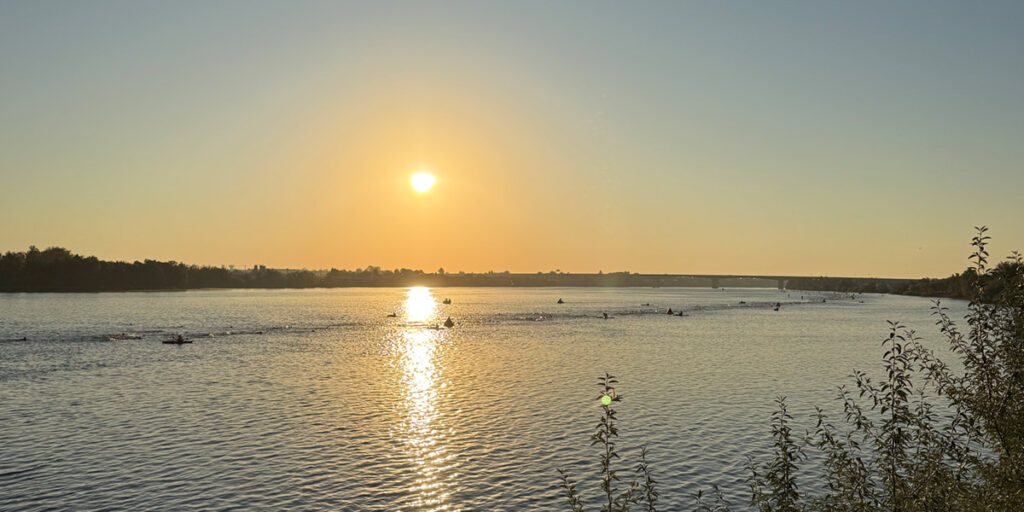
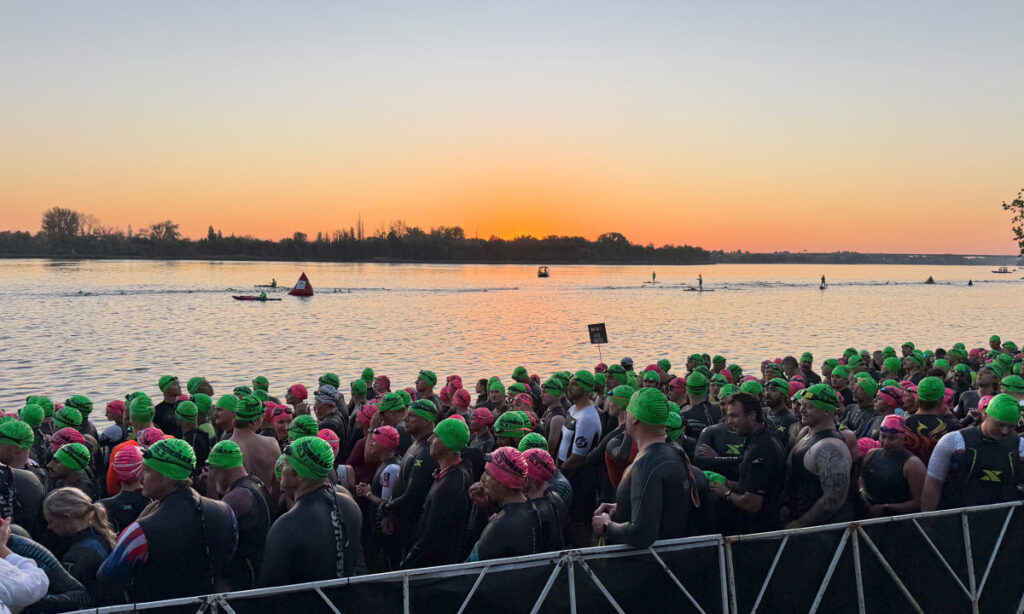
I raced this one myself, so here’s what it’s actually like leg by leg. The current is real, not just hype: my swim pace came in roughly 40 seconds faster than a recent ocean swim over a similar distance.
The bike backs up the “rolling, not flat” label. The hardest stretch is a sustained climb starting around the 20km mark, about 2.8km long, gaining roughly 120 metres at an average 4.4% grade. A longer, faster downhill on the other side makes up for it. Most of the course sits fairly exposed to wind. It stayed calm the year I raced it, but a friend who did the previous edition called it genuinely windy, so treat that as a coin flip rather than a guarantee either way.
The run is dry desert heat rather than the humid kind, and close to 99 percent pavement. Dry heat with good hydration is a different, more manageable kind of hard than Gulf Coast’s humidity, but it’s still worth training for if you’re coming from somewhere cooler or more humid.
Ironman 70.3 Washington Tri-Cities Official Website →
Easiest Bike: Ironman 70.3 Gulf Coast
Ironman 70.3 Gulf Coast’s one-loop bike course through the Florida pines stays close to sea level for all 56 miles, one of the flattest bike legs in the series. Wind is usually light in the morning, though it tends to pick up as the day goes on. The bigger factor for this race isn’t the bike course itself, it’s what’s happening around it: Gulf Coast sits on Florida’s Panhandle in early May, when Gulf humidity regularly runs near 85 percent and the weather can turn fast. One recent edition saw the swim disrupted by storms with a tornado watch in the area. The bike is flat. The forecast isn’t always cooperative.
Ironman 70.3 Gulf Coast Official Website →
Easiest Run: Ironman 70.3 Texas (Galveston)
Galveston’s three-lap run course gains just 56 feet total, starting and finishing at 11 feet above sea level. It loops through Moody Gardens and along Offats Bayou, flat enough that pacing is really the only variable left to manage. Washington Tri-Cities’ flat riverfront run deserves a mention too, it was the Athletes’ Choice pick for best run course in the world, but its rolling bike keeps it out of contention here. Combined with a protected bay swim and a flat, if occasionally windy, bike course, Galveston is arguably the most consistently flat 70.3 on this list, leg for leg.
Ironman 70.3 Texas Official Website →
The Most Forgiving First 70.3: Ironman 70.3 Texas (Galveston)
If the goal is simply the least amount of friction for a first 70.3, full stop, Galveston is the pick. Held the first weekend of April, typical race-day conditions run a high of 79°F/26°C, a low of 67°F/19°C, and water around 71°F/22°C, warm enough to be comfortable, not so warm it becomes a hazard. Compare that to Eagleman in June, where race-day temperatures often climb into the 90s with no shade on the run, or North Carolina in October, where the swim can start in water as cold as 67°F/19°C with an air low of 43°F/6°C. Both of those courses are flat on paper. Both ask a lot more of a first-timer than Galveston does.
Ironman 70.3 Texas Official Website →
Racing somewhere hot?
Find out how much fluid you actually need to replace on course.
When Flat Isn’t Easy: Heat, Humidity, and Cold
Every Ironman 70.3 covers the same distances, a 1.2-mile swim, 56-mile bike, and 13.1-mile run (see our full breakdown of triathlon distances if you’re comparing this to other race formats), so what separates an easy day from a hard one is almost entirely terrain and conditions.
Eagleman in Cambridge, Maryland is a good example of the trap. Its bike course gains well under 100 feet over the full 56 miles by most sources, and the run is just as flat. On paper, it reads as one of the easiest courses around. In practice, race weekend in mid-June regularly pushes into the low 90s°F with little shade on the run, and more than one athlete has described the course as deceptively hard for exactly that reason.
North Carolina in Wilmington has the opposite problem. Also flat, also a downriver current swim that helps rather than hinders, but held in mid-October when race mornings can start with air temperatures near 43°F/6°C and water around 67°F/19°C. Washington Tri-Cities, by contrast, races in late September with air and water temperatures that sit in a comfortable middle ground, warm enough without tipping into heat risk. Cold isn’t dangerous the way heat can be, but a cold, stiff start to a race is its own kind of hard, especially for someone doing this for the first time.
If there’s a heat-heavy race in the plan regardless, whether that’s Gulf Coast, Eagleman, or a local 70.3 in the middle of summer, our guide to hot-weather triathlon nutrition covers fluid and electrolyte strategy in more detail. And if the open-water swim is the part causing the most nerves, our beginner open-water swimming tips are worth a read before race week, whichever course ends up on the calendar.
Full Comparison
| Race | Swim | Bike | Run | Date | Temps (race day) |
|---|---|---|---|---|---|
| Augusta, GA | Downriver current (fast) | Hilly | Hilly | Late Sept | Verify at publish |
| Gulf Coast Panama City, FL | Ocean, possible currents | Flat | Flat | Early May | Warm, ~85% humidity |
| Galveston, TX | Protected bay, calm | Flat, can be windy | Flat, 17m/56ft gain | Apr 4 | 26°C/79°F H · 19°C/67°F L · Water 22°C/71°F |
| Eagleman Cambridge, MD | River current, warm | Flat (gain varies by source) | Flat | Mid-June | Often 90s°F, little shade |
| N. Carolina Wilmington, NC | Downriver current | Flat | Flat | Oct 17 | 6°C/43°F L · Water 19°C/67°F |
| Wash. Tri-Cities Richland, WA | Downriver current, #3 in N.A. | Rolling, not flat | Flat, #1 in the world* | Sept 20 | 25°C/78°F H · 10°C/50°F L · Water 21°C/70°F |
*Voted Best Run Course in the World and #3 Best Swim Course in North America, 2025 Ironman 70.3 Athletes’ Choice Awards.
FAQ
No, but it’s more common than a lot of beginners realize. Augusta, Washington Tri-Cities, North Carolina, and Waco all use a current-assisted downriver swim. The current is a real advantage on swim time, but it doesn’t remove the need to be comfortable in open water and hold a straight line.
It’s built specifically for the 70.3 distance. If a first triathlon overall is the goal, a sprint or Olympic-distance race first is the more common (and more forgiving) way in.
It depends on water temperature on the morning of, decided race day under Ironman’s wetsuit rules. Galveston’s average water temperature (71°F/22°C) sits right around the line where it can go either way; Washington Tri-Cities, Augusta, and North Carolina’s cooler water usually keeps wetsuits legal.
Look for the same things in any 70.3: whether the swim uses a current, a bike course profile under a few hundred feet of total elevation gain, and race-week weather that isn’t sitting at a temperature extreme. Most organizers publish this, and third-party course-profile tools can fill in the rest.
Not by itself. Wind, heat, and humidity all slow athletes down regardless of elevation, which is exactly why Gulf Coast and Eagleman don’t automatically produce faster times despite flat profiles.
Sources / References
Frontiers in Physiology — core temperature and heat stress in Ironman-distance racing
RaceRaves — Ironman 70.3 Eagleman course reviews and elevation data
PJAMM Cycling — Ironman 70.3 course elevation profile tool
Playeasy — Ironman 70.3 Washington Tri-Cities, 2025 Athletes’ Choice Award results
RaceRaves — Ironman 70.3 Washington Tri-Cities course reviews