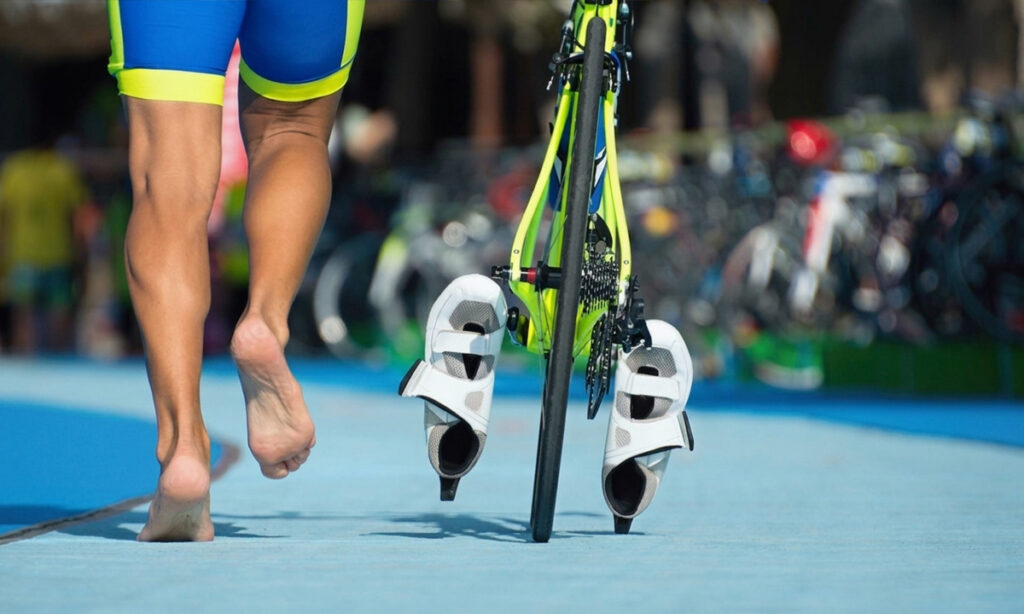
If you’ve registered for your first triathlon, you’ve probably heard someone mention brick workouts. Maybe at a club run, maybe in a Facebook group, maybe in a race forum where everyone seems to already know what everyone else is talking about. A brick workout is simply two disciplines done back to back in a single session — most often a bike ride followed immediately by a run. The name likely comes from how your legs feel when you start running after cycling: like someone replaced your quads with actual bricks. Understanding brick workouts is one of the most useful things you can do to prepare for triathlon training.
TL;DR
A brick workout combines two triathlon disciplines in one session, usually cycling followed by running with no break in between. The goal is to get your body used to the transition, specifically the shift in muscle recruitment from the bike to the run. If you’ve never done one before, start short and simple.
Key Takeaways
- Brick workouts train your body to switch between cycling and running muscles
- The heavy, dead-leg feeling at the start of the run is normal and gets better with practice
- You don’t need to go long or hard — short bricks are effective for beginners
- Doing at least 2–3 bricks before race day makes T2 (bike-to-run transition) feel much less shocking
- Bricks are also a good opportunity to practise your nutrition and transition setup
What Is a Brick Workout, Exactly?
A brick workout is a training session where you complete two disciplines consecutively, with minimal rest between them. The most common format is bike followed by run. Some athletes do swim-to-bike bricks, but the bike-to-run version is what most beginners are referring to when they use the term.
The session doesn’t need to be long. A 30-minute ride followed by a 15-minute run is a real brick workout. What matters is the transition — getting off the bike and starting to run before your legs have had time to reset.
The heavy legs you feel in those first few minutes of running? That’s the whole point. Your body is learning to adapt. With repetition, the adaptation happens faster and the discomfort shortens.
Why Triathletes Do Brick Workouts
Triathlon asks your body to do something it doesn’t naturally do: switch from one movement pattern to another under fatigue, without a break. Cycling and running use overlapping but different muscles. On the bike, your hip flexors and quads do the heavy lifting. Running shifts demand toward your hamstrings, glutes, and calves.
When you dismount after a long ride, your neuromuscular system is still locked into cycling mode. The first kilometre of the run often feels awful. Your stride is short, your legs feel wooden, and your pace is slower than you expected. This is normal. It’s also something you can train.
Repeated brick sessions teach your body to make that switch faster. The adaptation is partly muscular and partly neurological. Over time, the dead-leg phase shortens from several minutes down to the first few hundred metres. For a sprint triathlete, that can be the difference between a rough race and a confident one.
If you want to understand the underlying physiology, the bonking vs. cramping post covers what’s actually happening in your muscles when things go wrong mid-race.
How to Structure Your First Brick Workout
Keep it simple. The goal of your first brick isn’t fitness, it’s familiarity. You want to experience the transition feeling in a low-stakes setting so it doesn’t ambush you on race day.
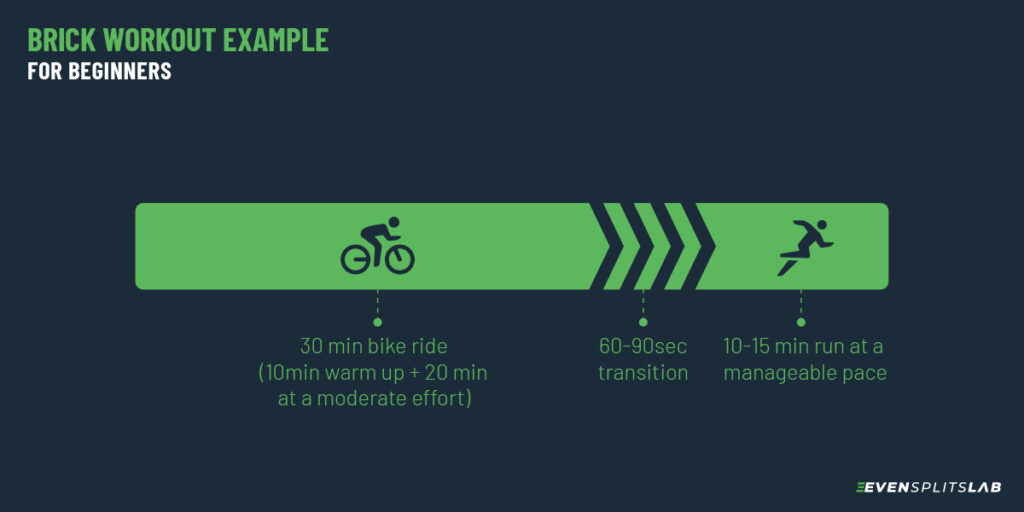
A Basic Beginner Brick
- Warm up on the bike for 10 minutes at an easy pace
- Ride for 20–30 minutes at a moderate effort (not all-out)
- Rack your bike, switch to running shoes, and start running within 60–90 seconds
- Run for 10–15 minutes at whatever pace feels manageable
- Cool down with a short walk
That’s it. The first time you do this, just focus on getting through the transition smoothly. Don’t worry about pace. Don’t worry about heart rate. Just notice what your legs feel like and let the experience teach you something.
Building from There
Once you’ve done your first brick, you can start adding volume gradually. A common pattern for a beginner over four weeks might look like this:
- Week 1: 20-min bike / 10-min run
- Week 2: 30-min bike / 15-min run
- Week 3: 40-min bike / 15-min run
- Week 4: 45-min bike / 20-min run
You’re not trying to simulate full race distance every session. You’re building the pattern and accumulating time in that uncomfortable transition zone.
Keep your brick intensity aligned with your heart rate zones — most beginner bricks should stay in Zone 2–3 on the bike. Zone 4–5 efforts are fine closer to race day once the pattern is established.
How to Use Bricks to Practise Race Day Logistics
Bricks are not just training for your legs. They’re a dress rehearsal for everything that happens in T2.
Use your brick sessions to practise:
- Racking your bike quickly and efficiently
- Switching from cycling shoes to running shoes
- Deciding whether you’ll wear a hat or visor for the run
- Taking in nutrition on the bike before the run starts
- Starting the run at a controlled, sustainable pace rather than sprinting out of transition
The more you’ve done this in training, the less mental energy it takes on race day. Race day already has enough going on.
On the nutrition side: make sure you’re eating and drinking during the bike leg, not just after. The pre-race nutrition guide for sprint triathletes covers what to take in before and during.
Common Brick Workout Mistakes
Going too hard on the bike
If you hammer the bike portion, the run is going to feel terrible — not just uncomfortable, but unmanageable. Most of your bricks should be done at a pace you could hold a conversation at. Save race-pace efforts for specific sessions closer to your event.
Waiting too long to start running
The whole point of a brick is the immediate transition. If you take a 10-minute break between the bike and the run, you’ve essentially done two separate workouts. Get moving within 90 seconds of racking your bike.
Skipping bricks entirely until race week
Showing up to race day never having experienced the bike-to-run transition is one of the most preventable mistakes in triathlon. You don’t need to do bricks every week, but aim for at least 2–3 in the final 4–6 weeks before your race.
Panicking when your legs feel heavy
This is the most common reaction from first-timers: you start running, your legs feel completely wrong, and you assume something is broken. Nothing is broken. Ease into the first kilometre and trust that your body will find its rhythm. It almost always does.
How Often Should You Do Brick Workouts?
For most beginner triathletes training for a sprint or Olympic distance event, one brick per week is plenty. Two per week is fine if you’re further along in your training and your weekly volume supports it.
The sessions don’t need to be long. A 45-minute brick (30 min bike + 15 min run) done consistently is worth more than a two-hour brick done once and never repeated.
If your race is more than 8 weeks out, bricks don’t need to be a focus yet. Build your aerobic base on the bike and in your run sessions separately. Introduce bricks in the final 6–8 weeks as race day approaches.
FAQ
The most popular explanation is that your legs feel like bricks when you start running after the bike. There’s also a theory that the name is an acronym (Bike, Run, ICK), but that’s probably backronym territory. Either way, the name is accurate.
Not before every race, but you should do at least 2–3 brick sessions before your first triathlon. After that, your body will remember the pattern. Occasional bricks in the weeks before a race are a useful tune-up, but you don’t need to overdo it.
Yes, and some triathletes do. The swim-to-bike transition (T1) is a different challenge — you’re moving from horizontal to vertical, often in a wetsuit, and getting your heart rate under control quickly. That said, bike-to-run bricks are more universally recommended because the leg fatigue is more pronounced and more trainable.
hort. A 20-minute ride followed by a 10-minute run is a legitimate first brick. The length matters less than the experience of making the transition. Build from there over the following weeks.
Treat it like any moderate-intensity training session. Eat something 60–90 minutes before if it’s longer than 45 minutes total. During the bike portion, take in fluids and consider a gel or real food if you’re riding for more than 40 minutes. The pre-race nutrition guide has more detail on timing.
Related Posts
If you’re building toward your first race, these are worth reading next: What to Eat Before Your First Sprint Triathlon, How to Read Your Heart Rate Zones, and The Difference Between Bonking and Cramping.