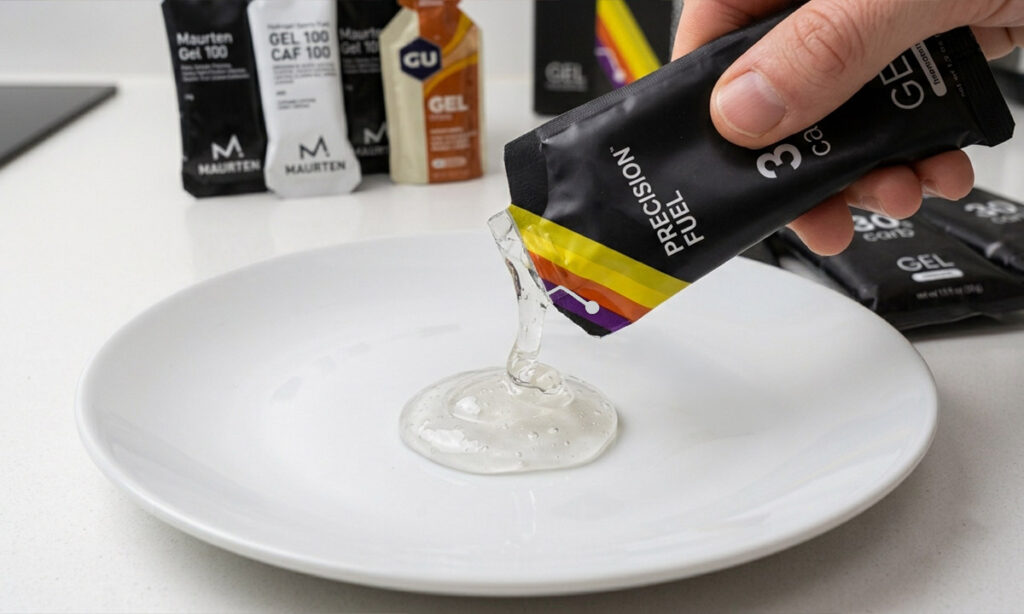
Pick up five gels and you will find at least three different carb ratios on the back. Maurten prints 1:0.8. Precision Fuel prints 2:1. SiS reformulated Beta Fuel a few years ago and now sells both numbers across its range. Each brand talks about its number like it settled an argument, which is odd, because they cannot all be right at the same time. So here is what the glucose to fructose ratio actually does, and where the marketing gets out ahead of the evidence.
TL;DR
They’re the same idea, not rival formulas. Both ratios are built to put the same amount of glucose on your gut’s absorption ceiling. The ratio only shifts because the target dose does. And for most recreational athletes, the number on the label isn’t the thing holding you back.
Key Takeaways
- Glucose and fructose enter your bloodstream through separate doors. That is the entire reason mixed gels exist.
- 2:1 was built around a 90 g per hour target. 1:0.8 was built around roughly 110 to 120 g per hour. Neither is universally better.
- Below about 60 g per hour, the ratio makes almost no practical difference.
- The gut comfort edge claimed for 1:0.8 comes from small differences in a handful of studies, not a landslide.
- How much you can absorb is trainable. That is a much bigger lever than which ratio you buy.
What the glucose to fructose ratio on the label actually means
A 2:1 ratio means two parts glucose to one part fructose. In a 30 g gel, that is 20 g glucose and 10 g fructose. A 1:0.8 ratio is closer to even: the same 30 g gel comes out around 16.7 g glucose and 13.3 g fructose.
One source of confusion. Maurten prints theirs as 0.8:1, fructose first. Same formula, written backwards. If a brand does not tell you which sugar comes first, check whether the bigger number sits next to glucose. It usually does.
Also worth knowing: “glucose” on an ingredients list often means maltodextrin. Maltodextrin is a chain of glucose molecules that your gut snips apart on the way in. For absorption purposes it counts as glucose, and it has the practical advantage of being less sweet and less osmotically aggressive than the same weight of pure glucose. If you want to see how this plays out across actual products, we broke down ten of them in our roundup of the best energy gels.
Why the mix exists in the first place
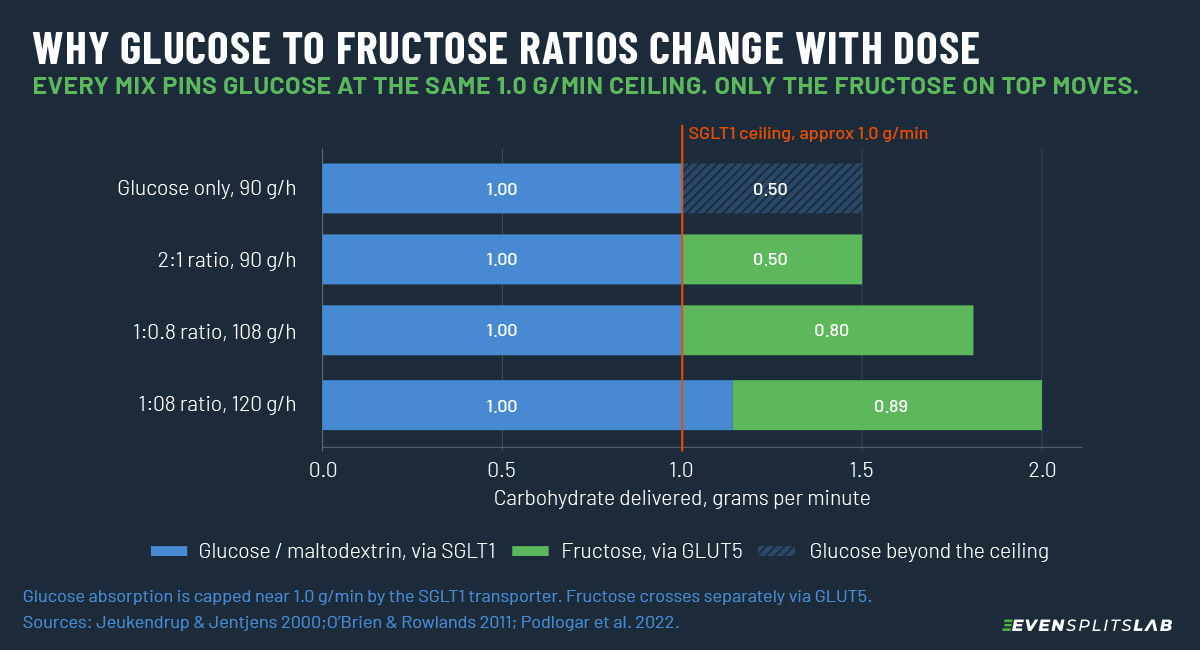
Glucose crosses your gut wall using a transporter called SGLT1. It is a door with a fixed width. Push more glucose at it and it does not open wider. In practice that ceiling sits around 60 g per hour, which is why fuelling advice stopped dead at that number for decades.
Fructose uses a completely different door called GLUT5. Adding fructose does not compete with glucose for space. It opens a second lane.
When Asker Jeukendrup’s group at Birmingham tested this in the early 2000s, mixed glucose and fructose drinks pushed the rate of ingested carbs actually getting burned to roughly 1.2 to 1.5 g per minute, against about 1.0 g per minute for glucose alone. That finding created the modern gel market. Everything since has been an argument about the proportions.
Where 2:1 came from
2:1 is arithmetic, not magic. If you are aiming for 90 g per hour, two thirds of that is 60 g of glucose, which lands exactly on the SGLT1 ceiling. The remaining 30 g goes down the fructose lane. Nothing wasted, nothing oversupplied.
Jeukendrup has been fairly blunt about this on his own blog. He explains that the ratio was picked so the glucose portion would just saturate the glucose transporter, and that there is no single optimal ratio because the right one shifts with how much you are eating. Worth sitting with, given he is the person who proposed 2:1 in the first place.
Where 1:0.8 came from
The 1:0.8 number traces mostly to Dave Rowlands’ lab in New Zealand. In a 2011 study in the American Journal of Physiology, O’Brien and Rowlands had ten cyclists ride while taking 1.8 g per minute of carbohydrate, about 108 g per hour, at three different fructose to maltodextrin ratios. The 0.8 ratio came out on top for how much of the ingested carbohydrate got burned: 1.14 g per minute, against 1.04 and 1.05 for the other two. Gut comfort ratings leaned slightly the same way.
Look at the actual numbers though. The gap is about a tenth of a gram per minute, in ten riders, with a coefficient of variation around 20 percent. That is a real result. It is not a landslide, and it does not deserve the certainty it gets on product pages.
And here is the part the marketing skips. At 108 g per hour, a 0.8 ratio puts your glucose intake at roughly 60 g per hour. Same ceiling, same logic as 2:1. The ratio changed because the dose changed. That is the whole story.
Three claims that do not survive contact with the papers
“1:0.8 is simply the better ratio”
Only if you are eating enough for it to matter. At 60 g per hour, a 2:1 split gives you 40 g glucose and 20 g fructose. A 1:0.8 split gives you 33 g and 27 g. Neither transporter is anywhere near saturated in either case. You have swapped some glucose for fructose and gained nothing except a higher price per gram.
“2:1 causes stomach problems”
This one is backwards on its face. Fructose is the sugar most associated with GI distress, and 1:0.8 contains more of it, not less.
The real comfort argument for 1:0.8 is subtler. At high intakes, a glucose-heavy mix leaves unabsorbed glucose sitting in your small intestine pulling water in behind it. Shifting some of that load onto the fructose lane clears it faster. That mechanism is plausible and the data lean that way.
But at moderate intakes there is nothing sitting there to clear. If your stomach turns on you at 60 g per hour, the ratio is not the culprit. Race pace, heat, dehydration and how little you practised your fueling all matter more. Heat in particular does its own damage, which we covered in the hot weather nutrition guide.
“More carbs per hour is always better”
This is the one with the cleanest counter-evidence. In 2022, Tim Podlogar and Gareth Wallis had eleven highly trained cyclists ride for three hours while taking either 120 g per hour at a 0.8:1 ratio or 90 g per hour at 1:2. The 120 g condition did burn more of the ingested carbohydrate: 1.51 versus 1.29 g per minute.
Then the interesting part. Efficiency dropped. At 90 g per hour, 86 percent of what went in got used. At 120 g per hour, only 76 percent. And the higher intake did not spare the riders’ own glycogen stores at all. The authors’ own conclusion was that from a whole-body metabolism standpoint, going above 90 g per hour offered no benefit.
Two caveats worth naming, because the study is not a knockout. It changed the dose and the ratio at the same time, so you cannot pin the difference on either one alone. And it measured metabolism, not finish times. Performance could still differ. But it is a useful brake on the idea that the arms race upward is settled.
When the ratio actually matters
Here is the practical version, based on what you are actually taking in per hour rather than what the packet claims to enable.
| Intake | Ratio matters? | What to use |
| Under 60 g/h | Not really | Whatever settles. Buy on taste, texture and price. |
| 60 to 90 g/h | Slightly | 2:1 or 1:0.8. Both work. Pick one and stop thinking about it. |
| 90 to 120 g/h | Yes | Lean 1:0.8. The extra fructose lane is doing real work here. |
| Over 120 g/h | Yes | 1:0.8 or closer to 1:1, plus months of deliberate gut training. |
One practical wrinkle nobody mentions. Almost nobody eats a single product. If you take a 2:1 gel and wash it down with a 1:0.8 drink mix, your actual ratio lands somewhere in between and you will never know exactly where. That is fine. Your transporters do not read labels. They respond to what shows up. If you are mixing products, our comparison of electrolyte powder and sports drink is worth a look for the other half of that equation.
The lever actually worth pulling
Your gut adapts. GLUT5 in particular gets upregulated when you feed it fructose regularly, which is why a rider who spent the winter fueling long sessions can handle intakes that would flatten someone doing the same race off a low-carb diet.
That adaptation takes weeks of deliberate practice. It is a much bigger lever than the ratio decision, and it is the unglamorous one. Switching gels is an afternoon of shopping. Training your gut is a training block.
It probably does not matter much what format you take it in either. A 2022 study by Hearris and colleagues gave athletes 120 g per hour as a drink, a gel or a chew and found comparable oxidation across all three. Take whichever one you can actually get down at race pace with a heart rate of 165.
And if you are still working out whether your problem is fuel at all, the difference between bonking and cramping is a useful place to start, because they are separate failures with separate fixes.
Not sure what your hourly target should be in the first place? Our Fuel Calculator gives you a carb and fluid number based on your distance, pace and conditions. Get that number right first. Ratios are a rounding error next to it.
Questions this raises
Is plain table sugar as good as a glucose-fructose blend?
Close to it. Sucrose is glucose and fructose bonded together roughly 1:1, and studies comparing sucrose against a separated glucose-fructose mix find similar oxidation rates. It is also far cheaper. The catch is sweetness and osmolality once you concentrate it, which is why commercial products lean on maltodextrin instead.
Does the ratio matter for anything under 90 minutes?
No. Efforts under roughly 75 to 90 minutes are not limited by how fast you can absorb carbohydrates. Take whatever settles and move on.
What about gels that look like 4:1 or higher?
Some older glucose-dominant gels sit well above 2:1, and a few do not publish a ratio at all. At intakes under 60 g per hour they are fine. At 90 g per hour you are pushing more glucose at SGLT1 than it can move, and the surplus just sits there. Check the sodium content while you are reading the label, since that varies even more wildly between brands.
Related Posts
- Comparing what is actually on the shelf: The 10 Best Energy Gels for Runners and Cyclists
- The other number on the label: How Much Sodium Do You Actually Need During a Race
- When fuelling goes wrong: The Difference Between Bonking and Cramping
Sources
- Jeukendrup, A. “The optimal ratio of carbohydrates.” mysportscience.
- O’Brien, W.J. and Rowlands, D.S. (2011). Fructose-maltodextrin ratio in a carbohydrate-electrolyte solution differentially affects exogenous carbohydrate oxidation rate, gut comfort, and performance. American Journal of Physiology: Gastrointestinal and Liver Physiology, 300(1), G181-G189.
- Podlogar, T., Bokal, Š., Cirnski, S. and Wallis, G.A. (2022). Increased exogenous but unaltered endogenous carbohydrate oxidation with combined fructose-maltodextrin ingested at 120 g/h versus 90 g/h at different ratios. European Journal of Applied Physiology, 122(11), 2393-2401.
- Hearris, M.A. et al. (2022). 13C-glucose-fructose labelling reveals comparable exogenous CHO oxidation during exercise when consuming 120 g/h in fluid, gel, jelly chew or co-ingestion. Journal of Applied Physiology.