What is a good W/kg? It’s the number cyclists compare most, and the one most people feel slightly bad about.
Part of that is the benchmarks. Most charts of what counts as a good W/kg come from racing cyclists. Most of the people checking those charts are not racing cyclists. They have jobs, kids and a 6 a.m. trainer slot.
So here’s what a good W/kg looks like for real riders, where most of them actually sit, and when the number stops mattering.
Key highlights
- A good W/kg for most trained amateurs is 3.0 to 3.5. Above 4.0 is competitive racer territory.
- The average man in his 40s on Zwift holds 2.84 W/kg for 20 minutes. Even the top 10% sit just under 3.9.
- Pros hold around 6.6 to 6.8 W/kg on big Tour climbs. Their FTP lands closer to 5.5 to 6.5.
- Two riders at 3.2 W/kg aren’t equally fast. A 90 kg rider beats a 60 kg rider by about 4 minutes up Alpe d’Huez.
- For a 3.2 W/kg rider, adding 10 W saves almost 3 minutes on Alpe d’Huez. Losing 2 kg saves 1:40.
What is a good W/kg? The short answer
For most trained amateurs, 3.0 to 3.5 W/kg is solid. Above 4.0 is competitive racer territory. Pros sit somewhere around 5.5 to 6.5 W/kg at threshold.
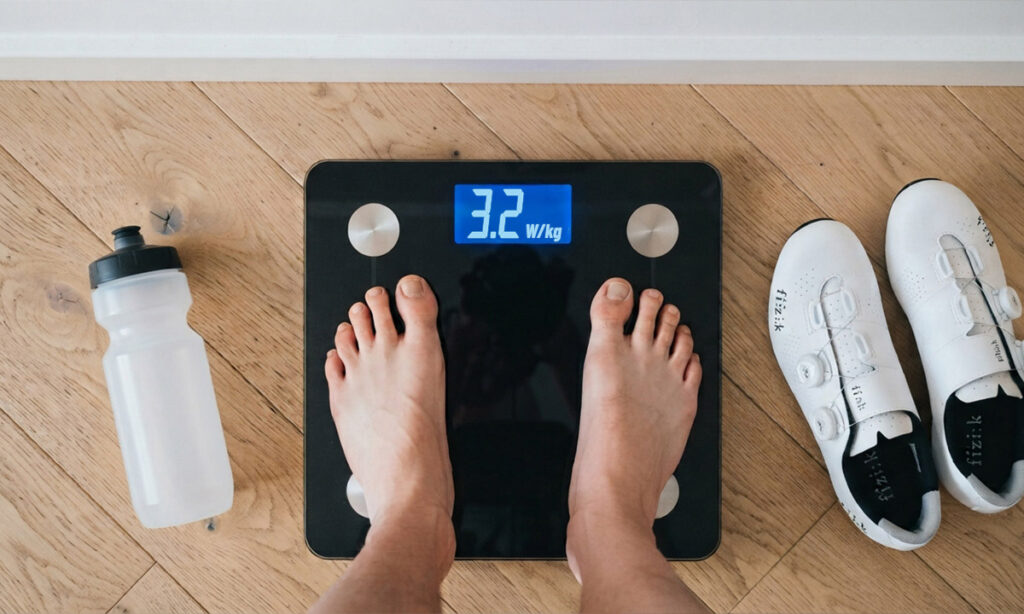
W/kg is your FTP divided by your body weight. A rider with a 240 W FTP who weighs 75 kg is at 3.2 W/kg. That’s the default in our Power-to-Weight Calculator, and it’s a pretty typical number for someone who trains a few times a week.
Here are the bands the calculator uses. They’re adapted from Andrew Coggan’s power profile chart, from the book Training and Racing with a Power Meter by Hunter Allen and Coggan.
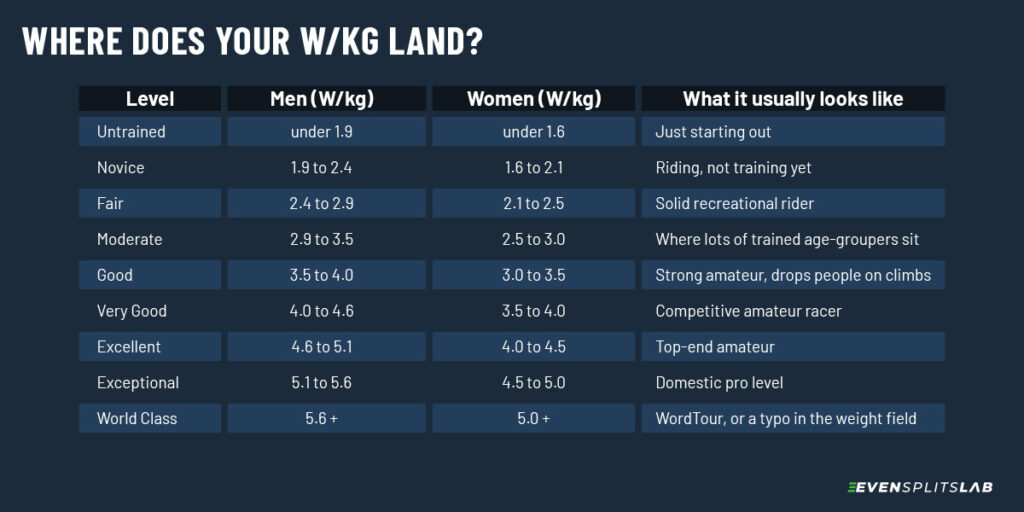
One honest note. Coggan built this chart from racing cyclists. If you ride for fitness or race triathlon, expect to land a band or two lower than you’d guess. That’s normal. It’s not a verdict on you.
Where do you fit on this table?
Enter your FTP and weight to get your W/kg and see where you rank.
Where most riders actually sit
The more useful comparison is other people who ride like you.
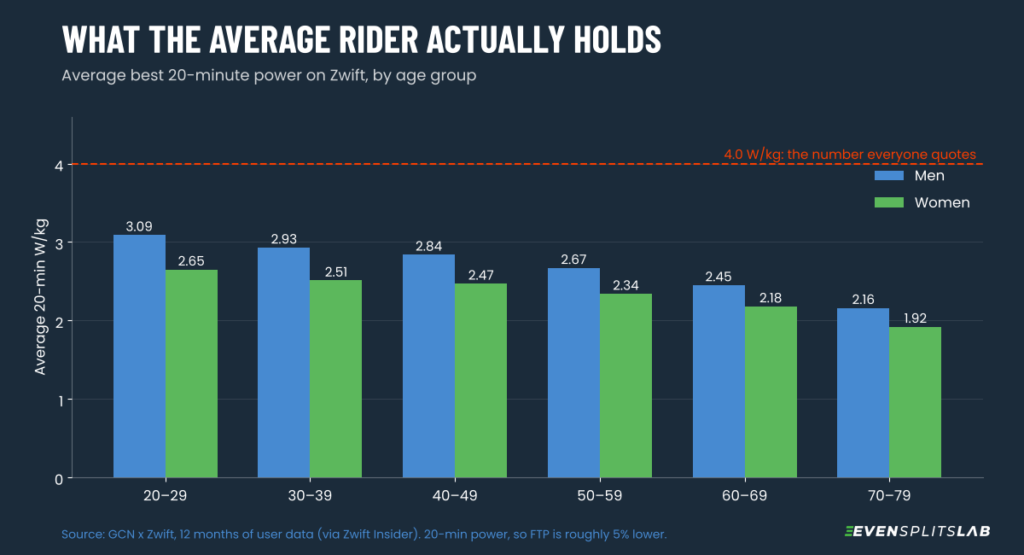
GCN and Zwift pulled a year of Zwift users’ power data and broke it down by age and sex. Zwift Insider published the tables. The average man in his 40s held 2.84 W/kg for 20 minutes. The average woman in her 40s held 2.47.
Quick clarification: that’s 20-minute power, not FTP. Most FTP estimates take about 95% of your 20-minute number. So the average 40-something man’s FTP lands closer to 2.7 W/kg.
A few things jump out.
The top 10% of men aged 40 to 49 held 3.89 W/kg for 20 minutes. So the famous 4.0 W/kg sits above the top 10% for that age group. On the group ride it feels like everyone has it. In the data, almost nobody does.
The drop with age is real but gradual. For men it’s roughly 0.1 to 0.2 W/kg per decade until the 60s, then it speeds up a bit. Women follow a similar, slightly flatter line.
And the data has limits that pull both ways. Zwift users skew toward people keen enough to own a smart trainer. But Zwift Insider also points out that not every rider did a true max 20-minute effort, so the real numbers are probably a little higher. Treat it as a rough map, not a census.
Still, if you’re a 45-year-old age-grouper at 3.0 W/kg, you’re above average for people who ride indoors on purpose. Worth remembering the next time someone on the group ride mentions their numbers unprompted.
Why your Garmin says Good and our calculator says Moderate
If you’ve seen the FTP rating on a Garmin, you might notice it’s more generous. Garmin’s manual rates men from 2.79 to 3.92 W/kg as Good, and women from 2.36 to 3.32. It cites the same Allen and Coggan book.
The difference is resolution. Garmin squeezes the scale into five levels. Our calculator keeps nine, closer to the original chart. So a 3.2 W/kg rider is Good on a Garmin and Moderate in our calculator. Same rider. Same legs. Different ruler.
Neither is wrong. Just compare like with like, and don’t screenshot whichever one flatters you more. (Fine. Maybe once.)
Where the pros sit
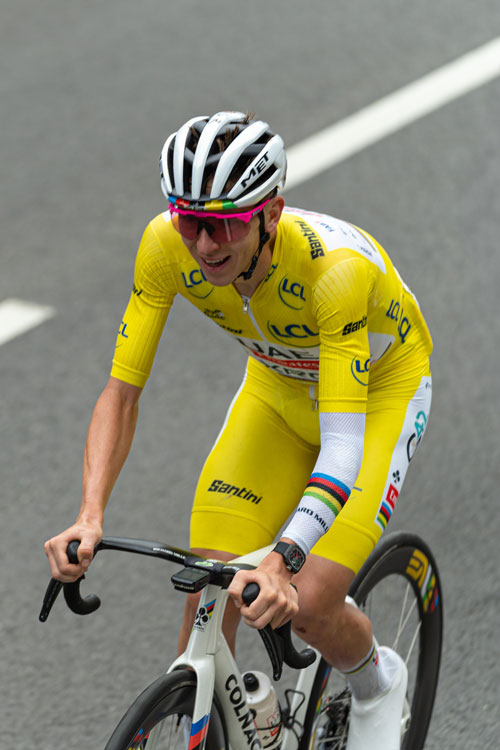
For context, and a bit of humility. Tadej Pogačar averaged about 453 W, roughly 6.9 W/kg, for 38 minutes up Plateau de Beille at the 2024 Tour de France. That’s from an analysis published by Velo. WorldTour coaches told Velo that 6.6 to 6.8 W/kg is now the benchmark for repeated big climbs. A decade ago it was closer to 6.0 to 6.2.
Those are 30 to 40 minute efforts, not a full hour. Pro FTP numbers land a bit lower, usually in the 5.5 to 6.5 range. Still another planet.
Photo: Hugo LUC, CC BY-SA 4.0, via Wikimedia Commons
Two riders at 3.2 W/kg are not equally fast
This is where W/kg gets a bit misleading.
Take two riders, both at 3.2 W/kg. One weighs 60 kg and holds 192 W. The other weighs 90 kg and holds 288 W. Same ratio. Now run them through the physics model behind our calculator, with the same 9 kg bike and kit.
| Rider | Alpe d’Huez | Sa Calobra | Flat 40 km |
|---|---|---|---|
| 60 kg, 192 W | 1:13:49 | 44:54 | 1:05:27 |
| 90 kg, 288 W | 1:09:50 | 42:32 | 57:21 |
The heavier rider wins everywhere. Even up Alpe d’Huez, by about four minutes. On the flat, by about eight.
Here’s why. W/kg only counts your body weight, but the road doesn’t care what’s you and what’s your bike. You have to move all of it.
Add the 9 kg bike and kit, and the numbers change:
- Light rider: 192 W ÷ 69 kg total = 2.78 W/kg
- Heavy rider: 288 W ÷ 99 kg total = 2.91 W/kg
Same 3.2 W/kg on paper, but the heavier rider has more power for every kilo they actually move. The bike weighs the same for both of them, so it holds the light rider back more.
On the flat, there’s a second reason. Most of your effort goes into pushing air out of the way, not into carrying weight. The heavy rider has 96 extra watts, but they’re not 50% wider. They just have a lot more power to push through roughly the same hole in the air.
One catch. The times in the table treat both riders as the same size in the wind. That’s not realistic. A 90 kg rider is bigger, so they catch more air, and that slows them down.
So I ran the numbers again with the heavy rider about a third bigger in the wind. They were still around three minutes faster, up Alpe d’Huez and on the flat. The big rider’s lead got smaller, but they still won.
Lose 2 kg or add 10 watts?
This is the question most people actually have. For our default rider (75 kg, 240 W, 3.2 W/kg), the answer is pretty clear.
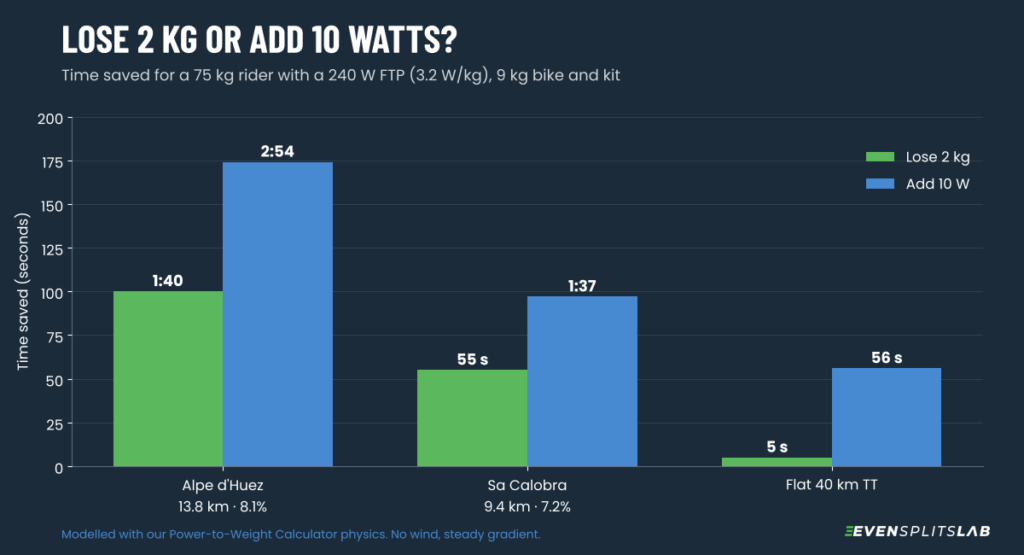
Adding 10 W saves almost three minutes on Alpe d’Huez. Losing 2 kg saves 1:40. On a flat 40 km, 2 kg is worth about five seconds. Ten watts is worth close to a minute.
The maths is simple once you see it. 10 W is about 4% more power. 2 kg is only about 2.4% of the total weight you’re moving, because the bike and kit count too.
And the two aren’t independent. Dropping weight by eating less during a training block usually costs you watts. In practice, plenty of riders who chase a lighter number end up at the same W/kg, just more tired. If weight comes off, let it come from consistent training, not from skipping the food on long rides.
Our Fuel Calculator helps with the second part.
Does W/kg matter in triathlon?
Less than most triathletes think.
Most triathlon bike courses are flat or rolling. On that terrain, raw watts and how aero you are do most of the work. Weight mostly matters when the road tilts up and stays up.
The run is a different story. On the bike, a heavier, stronger rider can push big watts and not pay much for the kilos. On the run there are no wheels, and every kilo gets carried. That’s where body weight genuinely matters for a triathlete. It’s also a much bigger conversation than one post.
So W/kg is worth tracking if your race is hilly. For a flat Olympic or 70.3 course, I’d watch FTP and your aero position first. If you’re building toward one of those, our Olympic vs 70.3 training block breakdown covers where the bike time should go.
No power meter yet? You can still train well with heart rate. Our HR Zone Finder sets your zones in a minute. When you’re ready for watts, our Favero Assioma PRO RL review covers one of the simpler ways in.
Getting an honest W/kg number
W/kg is only as good as the two numbers that go into it. A few things quietly skew it.
- Test protocol. Ramp tests tend to read higher than a 20-minute test for riders with a strong top end. Pick one and stick with it.
- 20-minute power isn’t FTP. Comparing your raw 20-minute number against an FTP chart flatters you by about 5%.
- Weigh yourself the same way each time. Morning, before breakfast, is the usual choice. A 1 kg swing between days is normal and means nothing.
- Indoor and outdoor power differ. Many riders hold fewer watts on the trainer. Compare indoor with indoor, outdoor with outdoor.
So what’s a good W/kg for you?
Honestly? The one that’s going up. That’s the most useful benchmark there is. Compare you in March to you in September, not to a pro chart.
If you want a starting point, put your FTP and weight into our Power-to-Weight Calculator. It shows your band, what your number is worth on Alpe d’Huez and Sa Calobra, and whether 2 kg or 10 W buys you more time. Spoiler: it’s usually the watts.
Where does your W/kg land?
Enter your FTP and weight to see your band, your times on Alpe d’Huez and Sa Calobra, and what 10 extra watts would buy you.