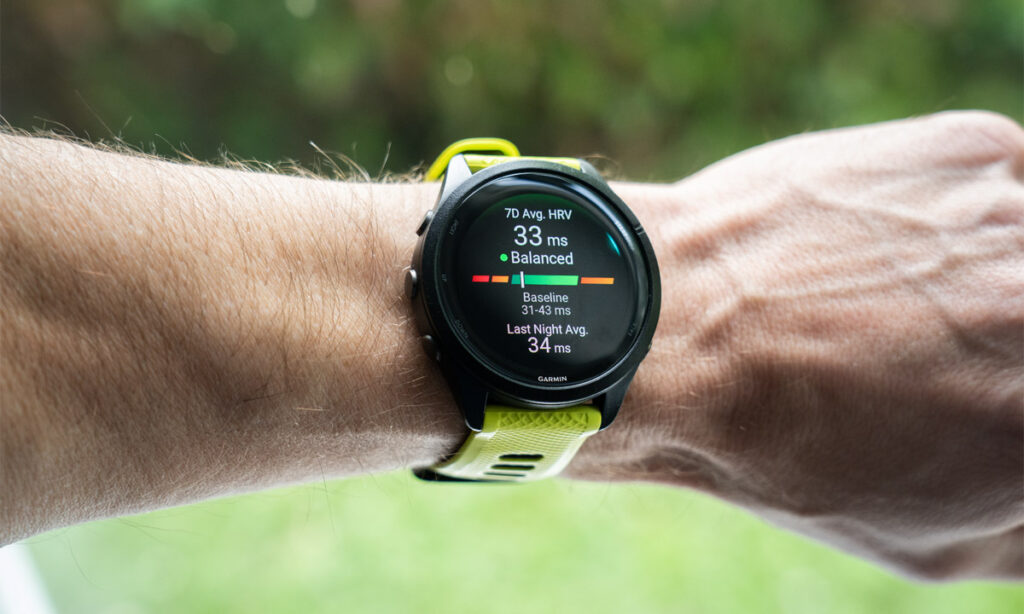
Most runners and cyclists have seen the number. It shows up every morning on your Garmin, your Whoop, your Polar. Two digits, sometimes with a coloured status next to it, and absolutely no explanation of what you are supposed to do about it. That number is your HRV score, and it is more useful than most athletes realise. This HRV training guide breaks down what the metric actually means, why it matters for endurance training specifically, and how to use it to train smarter rather than just harder.
TL;DR
HRV (heart rate variability) measures how well your nervous system is recovering between heartbeats. For endurance athletes, a consistently low or dropping HRV is an early signal that something is off: accumulated fatigue, an oncoming illness, or inadequate recovery. Tracking trends over time, not single-day readings, is where the real value is.
Key Takeaways
- HRV reflects your autonomic nervous system’s recovery state, not your fitness level directly
- Compare your HRV to your own baseline. Comparing it to anyone else’s is meaningless
- A single low reading means very little. A sustained downward trend means something
- HRV can flag overtraining, incoming illness, and poor recovery before you feel it in your legs
- Use it as one input alongside sleep, mood, and perceived effort. Not as a daily verdict
What Is HRV?
HRV stands for heart rate variability. It measures the variation in time between consecutive heartbeats, typically in milliseconds. A heart beating at 60 bpm does not actually beat once per second like clockwork. The gaps between beats fluctuate slightly, and that fluctuation is HRV. More variation generally indicates a healthier, more recovered nervous system.
The metric your device tracks is usually rMSSD (root mean square of successive differences), which is the standard time-domain measure used in endurance sport research. Your device simplifies this into a single number and, depending on the platform, assigns a colour or status to it.
HRV is controlled by the autonomic nervous system (ANS), which has two branches. The sympathetic branch drives the fight-or-flight response. The parasympathetic branch handles rest and recovery. Higher HRV reflects parasympathetic dominance: your body is calm, recovered, and ready to absorb training. Lower HRV reflects sympathetic dominance, the same state produced by hard training, poor sleep, stress, illness, or alcohol.
HRV and Age: Why Your Number Is What It Is
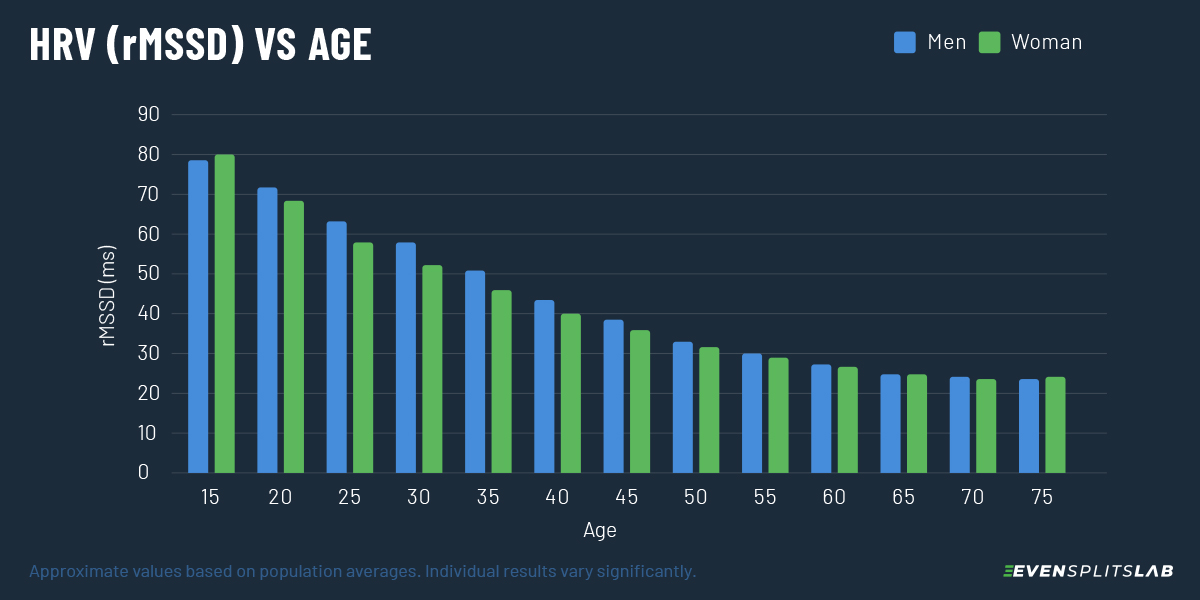
One of the most common mistakes athletes make is comparing their HRV to someone else’s. The chart below shows why that is a bad idea. Average rMSSD values decline steadily with age, and there is meaningful variation between men and women at every age group. A score of 40ms might be perfectly normal for a 45-year-old and low for a 22-year-old. Context is everything.
What the chart also shows is that HRV is not a fixed number. It shifts with age, fitness level, recovery status, and dozens of other factors. The only meaningful comparison is against your own established baseline, tracked consistently over time. That is the foundation everything else in this guide builds on.
Why HRV Matters for Endurance Athletes
Endurance training works by applying stress and then recovering from it. The adaptation happens during recovery, not during the session. HRV gives you a window into whether that recovery is actually happening.
Research published in the Journal of Science and Medicine in Sport found that athletes following HRV-guided training completed fewer high-intensity sessions than those on fixed plans, yet showed comparable or better physiological adaptations. The point is not to skip hard sessions. It is to time them on days when your body can actually absorb them.
HRV is most useful as a signal for three things in particular: whether you are adapting to your training load, whether you might be heading toward overtraining, and whether you are coming down with something.
Adaptation vs. Overtraining
During a hard training block, HRV will typically trend down. That is normal and expected. You are accumulating fatigue. What you want to see is HRV rebounding during recovery weeks. If it bounces back above your baseline after a rest week, that is your body adapting.
Overtraining looks different. HRV stays suppressed for days or weeks even with reduced load. Performance stagnates or drops. Sleep quality deteriorates. If your HRV is consistently below your personal baseline for five or more days and rest is not fixing it, that is a meaningful signal to investigate, not push through.
Illness Detection
One of the more practical uses of HRV is catching illness early. Some athletes notice their score drops one to two days before cold or respiratory symptoms show up. It does not always happen, and it is not a diagnostic tool. But a sudden unexplained suppression, especially when training load, sleep, and stress all seem normal, is worth taking seriously rather than pushing through.
How to Read Your HRV Score
The single most important rule: never compare your HRV to someone else’s. Absolute values vary enormously between individuals. An rMSSD of 45ms might be excellent for one person and low for another. What matters is your own baseline.
Most devices establish your baseline over the first four to eight weeks of use. Once that baseline is set, you can start reading the trends with more confidence.
A practical way to think about it:
- HRV at or above your baseline: your nervous system is recovered. Good day for a quality session.
- HRV slightly below baseline (5-15%): consider dialling back intensity. Keep the session but don’t chase hard numbers.
- HRV significantly below baseline (15%+): swap the hard session for easy aerobic work or rest. Ask why.
Track the seven-day rolling average, not individual readings. A single low score can be explained by a poor night’s sleep, a glass of wine, late measurement timing, or even measurement position. One data point is noise. A trend is a signal.
Factors That Affect HRV Readings
HRV is sensitive to more than just training load. Before you panic about a low score, consider what else might be driving it.
- Sleep quality and quantity: even one poor night will suppress HRV
- Alcohol: one or two drinks can noticeably lower overnight HRV
- Travel and time zone shifts: jet lag activates the same stress response as hard training. Flying across time zones will usually suppress HRV for a day or two on arrival, even if you slept on the plane and feel fine. Your body does not distinguish between “flew six hours” and “did a hard ride.” Worth factoring in before you judge a low score after landing
- Life stress: work pressure, anxiety, and poor sleep outside training all activate the same stress response as a hard session
- Heat and humidity: training in the heat adds physiological stress that HRV captures
- Measurement consistency: time of day, body position, and whether you measure before or after coffee all affect readings
- Menstrual cycle: HRV naturally drops in the luteal phase. This is physiological, not a training problem
Measure at the same time every day, in the same position, ideally first thing after waking. That consistency is what makes the data usable.
HRV and Your Training Cycle
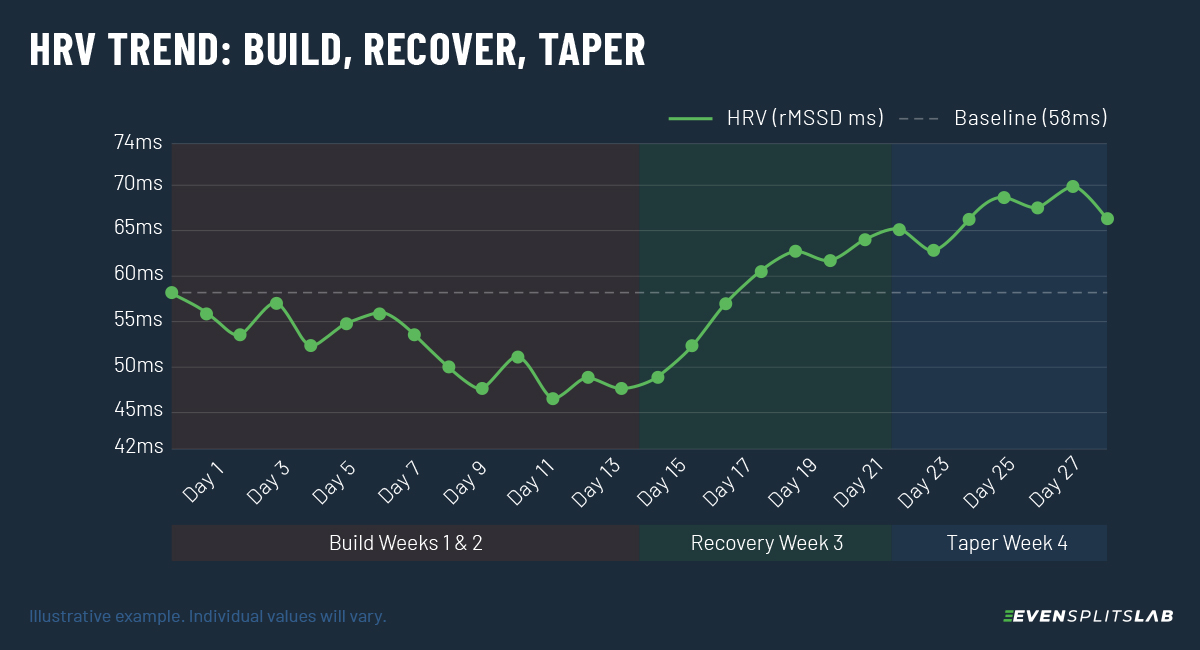
One of the most useful things about HRV is that it tends to follow a predictable pattern across a well-structured training block. Once you know what that pattern looks like, a lot of the anxiety around low readings disappears. You stop seeing a suppressed score as a failure and start seeing it as information.
The basic rhythm of a training block goes: apply stress, recover, adapt. HRV mirrors that cycle pretty faithfully. During hard weeks, it drops. During recovery weeks, it rebounds. Before a race, it should be climbing. If yours is not following something close to that pattern, that is worth investigating.
It also helps to think about HRV as a bucket. Hard training drains it. Poor sleep drains it. Life stress drains it. Good food, proper recovery, and low-stress days refill it. All of those inputs draw from the same resource. A week where work is chaotic and sleep is short may leave you with less capacity for hard training than your plan assumes, even if your legs feel fine. HRV often catches that before you do.
Build Weeks
During hard weeks, expect HRV to trend down. You are applying stress deliberately. The goal is progressive suppression without it collapsing. A gradual decline across a three-week build block is normal. A sharp drop in the first few days of a block, or a reading that does not stabilize between hard sessions, suggests the load may be too high for where your recovery currently sits.
Pay attention to how much your HRV drops between sessions compared to how much it recovers overnight. A pattern of small drops followed by solid overnight recovery is healthy. A pattern of large drops with little overnight recovery is a sign you are not absorbing the work.
Recovery Weeks
HRV should rebound during a down week and ideally rise above your recent average. This rebound is the adaptation signal. It means your body has processed the stress and come back stronger. If HRV does not recover after a down week, two things are worth considering: the recovery week was not easy enough, or the preceding block was too heavy for too long.
Some athletes find their HRV actually dips in the first one to two days of a recovery week before climbing. This is common. The body is still processing residual fatigue from the block. Give it time before drawing conclusions.
Taper
As volume drops in the two to three weeks before a race, HRV should rise. Climbing HRV during taper is a good sign you are freshening up properly. Your legs feel springy. You might feel slightly restless. That is the signal you want.
If HRV stays flat or continues dropping during taper, it usually means one of two things: the taper is not aggressive enough, or you were carrying more accumulated fatigue into it than you realised. In either case, err on the side of more recovery rather than less.
Race Day
Pre-race nerves activate the sympathetic nervous system. For many athletes, HRV reads lower on race morning than at any point during taper, even after weeks of recovery. This does not predict a bad race. Elite athletes frequently post their best performances on mornings when HRV is suppressed. Many coaches deliberately keep athletes away from their HRV data on race morning because the number can create doubt where none is warranted.
What HRV Cannot Tell You
HRV is a useful tool, not a complete picture. A few honest caveats worth knowing.
It will not predict your performance on a given day with any precision. The pre-race example above is a good illustration of that.
It also does not tell you where the problem is. Low HRV tells you something is off. It does not tell you if it is sleep, training load, nutrition, or life stress. That context comes from you. HRV is a prompt to investigate, not a diagnosis.
For endurance athletes, HRV tends to be a blunter tool than it is for strength or power athletes. It is still useful, just not the whole picture. And sometimes context overrides the number entirely. Arriving in Mallorca after a long flight with a suppressed HRV score and a week of riding ahead of you is not the same as a low score on a random Tuesday at home. The number does not know you are in Mallorca. Use your judgment. After a week of 400km of riding there, arriving in Barcelona with a score that had been trending down for days and then getting sick shortly after was a good reminder that the signal was real, even if it was easy to ignore at the time. HRV is a prompt to investigate, not a verdict.
If you are already tracking heart rate zones, think of HRV as the layer underneath. It tells you whether your aerobic system is in a state to actually respond to the training you are doing. The two work well together. More on setting those zones: How to Read Your Heart Rate Zones (And Why Most People Get Them Wrong).
HRV Tools and Devices
Most modern GPS watches track HRV automatically overnight. Garmin’s HRV Status feature and Polar’s Nightly Recharge both use overnight data to report a rolling average and flag deviations. COROS and Suunto offer similar functionality.
Dedicated wearables like Whoop and Oura Ring track HRV continuously and surface trends more granularly. They are generally more accurate for overnight measurement than wrist-based GPS watches, though both are useful.
If you want to measure manually, a chest strap with a compatible app (HRV4Training and Elite HRV are both popular) gives you more control over timing and conditions. A five-minute morning reading in a consistent position is often more accurate than passive overnight wrist tracking.
Whichever tool you use, accuracy matters less than consistency. The trends are what you are tracking.
FAQ
There is no universal good score. HRV values vary widely between individuals based on age, sex, fitness, and genetics. As a general reference, younger athletes tend to have higher rMSSD values than older ones, and values decline gradually with age across both men and women. What matters is whether your score is at, above, or below your own established baseline.
Not necessarily. A single low reading is rarely a reason to skip a session entirely. The more useful response is to dial back intensity rather than cancel the workout. Reserve rest for sustained drops across five or more days that are not recovering with lighter training.
Generally yes. Sustained aerobic training tends to increase parasympathetic activity over time, which often raises baseline HRV. But it varies by individual, and HRV can stay stable even as fitness improves. A rising baseline over months is a positive sign. A flat baseline alongside improving performance is also fine.
Pre-race anxiety activates the sympathetic nervous system, which suppresses HRV. This is extremely common and does not predict a bad race. Many coaches deliberately keep athletes away from HRV data on race morning because the suppression can create unnecessary doubt.
Research suggests yes, with caveats. HRV has been shown to drop before illness symptoms appear in some athletes, giving a one to two day window. It is not a reliable diagnostic tool on its own, but a sudden unexplained suppression combined with elevated resting heart rate or poor sleep is worth paying attention to.
Sources