
Here is a pattern that shows up in almost every beginner’s training log. Every run sits in the same narrow band of pace. The easy days are not really easy, and the hard days are not really hard. It all feels productive, because every run leaves the legs a little tired. That constant tiredness is the tell. For most new runners, the biggest hidden mistake is running their easy runs too fast.
TL;DR
Most beginner runners spend nearly every session at a medium effort that is too hard to recover from and too easy to build real speed. Easy runs are supposed to feel almost annoyingly slow. Get that one thing right and the rest of your training starts to click. How slow, and how to get there, is below.
Key Takeaways
- Most beginners run their easy days at a moderate effort that quietly stalls progress.
- Easy means conversational. If you cannot speak in full sentences, you are going too fast.
- Roughly 80 percent of your weekly running should feel genuinely easy, mostly in Zone 2.
- Slowing down feels wrong at first. Do it anyway for a few weeks and let your fitness catch up.
The short answer: probably yes
If you run mostly by feel and rarely think about pace, the odds you are running your easy runs too fast are high. It is the most common pattern in recreational running, and it is not a discipline problem. Easy pace honestly feels too slow when you are new, so you drift up into a moderate effort that feels comfortable but is not. That middle zone hands you the fatigue of hard training without the reward.
Tip: If you can’t hold a full conversation, or sing a line without gasping, you’re not running easy yet.
What easy actually means
Easy has a specific meaning, and it is stricter than most people expect. On a true easy run you can hold a full conversation. Full sentences, out loud, without your breathing falling apart. That is the talk test, and it lines up well with the effort your body can actually recover from.
The moment talking gets awkward, you have drifted out of easy. Most beginners sit just past that line without noticing, because a bit puffed but still fine feels like the honest definition of a workout. On a hard day, sure. On an easy day, that is exactly the problem.
Why running easy runs too fast holds you back
Easy running is where you build your base, and that base is the whole point. Run easy often enough and your body gets better at the boring but crucial stuff. Pushing more blood with each beat. Growing the tiny vessels that feed your muscles. Burning more fat for fuel so you spare your carbs for when it counts. This is what people mean by Zone 2 running: low effort, sustainable, repeatable day after day.
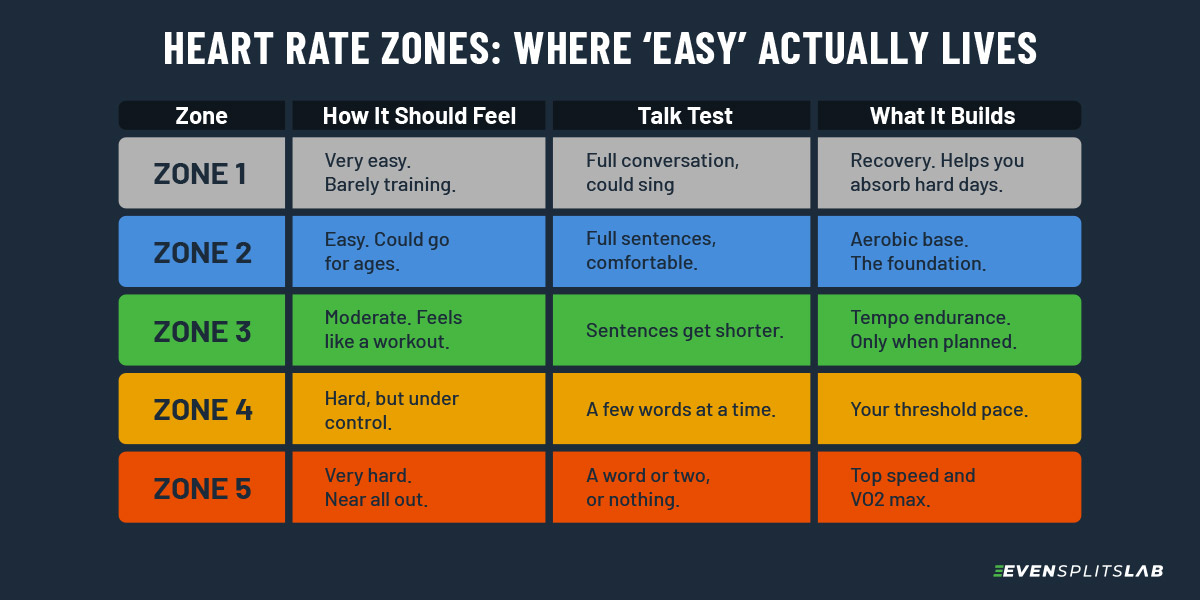
Most watches split your effort into five heart rate zones, and easy runs should mostly sit in Zone 2. If you have never set your zones properly, here is how to read them, because the default numbers on your watch are usually off.
The trouble is the zone right above easy. Zone 3 is the gray zone: too hard to recover from, too easy to make you meaningfully faster. It is not that Zone 3 is wrong, though. Done on purpose, it has a job, depending on what you are training for. The problem is drifting up there by accident on a day that was meant to be easy.
When every run drifts up into Zone 3, two things go wrong at once. You are too tired to hit your hard days with any real quality, so your fast running is never actually fast. And you never fully recover, so fatigue just piles up. Plenty of training, not much to show for it.
The fix is unglamorous. Keep most of your easy days genuinely easy, down in Zone 2, and save the hard stuff for one or two focused sessions a week. Studies that pit lots of easy running against a diet of mostly moderate work tend to favour the easy end, or at least find it works just as well for less wear and tear. For the longer version of why Zone 2 beats Zone 3 for building fitness, we broke it down here.
Tip: Easy runs build the engine. Hard runs use it. Grind everything in the middle and you get neither.
Here is the same idea as a quick reference:
How to tell if you are going too fast
Three checks, roughly in order of how reliable they are.
The talk test. Try saying a couple of full sentences out loud mid run. If you cannot, ease off. It is not perfect, though. You can still chat a little past the true easy line, so treat comfortable talking as the ceiling, not the target.
The next day check. Easy runs should leave you fresh enough to run again the next morning. If your legs feel heavy and flat the day after an easy jog, it was not easy.
Heart rate. If you train with a monitor, easy runs should sit mostly in Zone 2. Once your heart rate starts creeping into Zone 3 on an easy day, you are back in the gray zone and going too hard. And when your easy pace sends your heart rate through the roof no matter how slow you go, that is common early on and worth a read on its own.
How slow is slow enough
Probably slower than you think. Most beginners believe they are already running easy when they are actually a notch too hard, so the honest starting point is to back off more than feels necessary and see how it goes.
For a lot of beginners, easy pace ends up a fair bit slower than the pace they would naturally fall into, sometimes closer to a brisk shuffle than a run. It can feel almost embarrassing, like you are barely trying. That feeling is normal, and it is usually a sign you have finally found the right effort.
Pace is the least reliable way to judge this, though. Heat, hills, fatigue, and bad sleep all change what easy costs you on a given day. The same pace can feel easy on Monday and a grind on Thursday. That is why effort and heart rate beat pace for easy days. Set the effort first and let the pace fall where it needs to.
Slowing down doesn’t mean the plan is broken. A few of the zone 2 myths that make people doubt it are worth clearing up.
Tip: If your easy pace feels a little embarrassing, you are probably doing it right.
How to actually slow down
Knowing you should slow down and actually doing it are two different problems. A few things that help:
- Start slower than you think you need to. The urge to speed up fades once you are a few minutes in.
- Use walk breaks without guilt. Walking a hill to keep your effort easy is a tool, not a failure.
- Set a heart rate alert. Most watches will buzz when you drift above a set number, which catches you before your ego does. If you are still shopping for one, here are some solid budget options.
- Run with someone slower, or just talk out loud. If you cannot hold a conversation, you have your answer.
- Give it a few weeks. Easy running feels wrong at first and normal soon after. Your easy pace gets faster on its own, and your hard days start to feel sharp again.
Tip: The watch does not care about your ego. Slow down now so you can run faster later.
Slowing down starts with a real number. Here’s how to find your zone 2 so your easy runs have a ceiling to respect.
Common questions
How much of my running should be easy?
For most runners, roughly 80 percent. That leaves one or two harder sessions a week and keeps everything else genuinely relaxed.
My easy pace is really slow. Am I just unfit?
A slow easy pace is normal, especially early on. It improves as your aerobic base grows. Slow now does not mean slow forever.
Sources
- Festa et al., Effects of Different Training Intensity Distribution in Recreational Runners, Frontiers in Sports and Active Living (PMC).
- ACE Fitness, Validating the Talk Test as a Measure of Exercise Intensity.
- RunnersConnect, aerobic threshold running and the moderate gray zone.