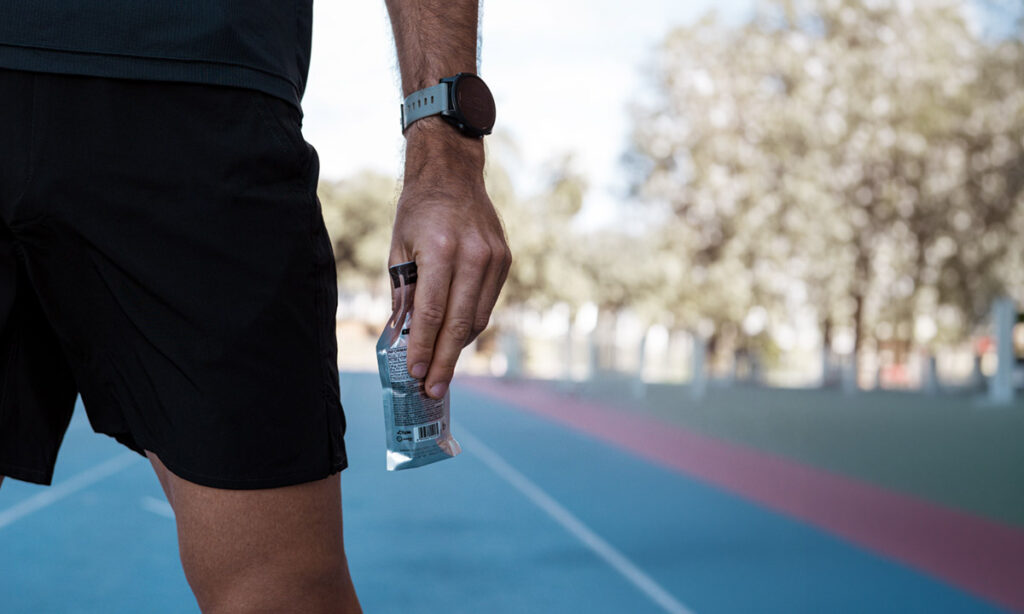
If your feed has been full of grainy race photos and an unfamiliar gel wrapper this summer, you’re not imagining it. Riders at the Tour de France, and the team behind Yomif Kejelcha’s world-record marathon debut, are both talking about the same ingredient. For decades, coaches blamed lactate for the burn in your legs and told athletes to buffer it, not eat it. Now two competing companies are selling it as fuel, and the pitch is showing up everywhere self-coached endurance athletes hang out online. Here’s what the research on lactate gels actually supports, separate from the hype around this summer’s headlines.
TL;DR: Lactate isn’t the villain your high school coach made it out to be. That part of the science is settled. Whether eating more of it during a race makes you faster is a much shakier claim, and the numbers behind this summer’s biggest headlines don’t line up quite as neatly as the marketing suggests.
Key Takeaways
- Lactate is a fuel your muscles, heart, and brain burn directly. It’s not a fatigue toxin, and that part isn’t up for debate.
- Two competing products, ExoLactate and Santamadre’s Lactate 60, are behind the current wave of lactate gel coverage.
- Published performance studies show mixed, mostly modest results, not the game-changer framing you’re seeing in the press.
- Both products are new enough that dosing guidance, pricing, and availability are still catching up to the headlines.
- For most recreational athletes, a proven carbohydrate strategy still matters more than an unproven new ingredient.
Wait, isn’t lactate supposed to be bad?
This is the part worth clearing up first, because it changes how you should read everything else in this post. What actually burns during a hard effort is hydrogen ions, not lactate. Lactate itself is a fuel. Research on the “lactate shuttle,” led by physiologist George Brooks, showed that muscle, heart, and brain tissue burn lactate directly for energy. It also acts as a signal that tells your body to shift toward burning carbohydrate as intensity rises. That work has been building for decades. It’s not new, and it’s not controversial.
What is new is the idea of eating it. An early lactate supplement from 2002 reportedly tasted close to inedible. Even Tadej Pogačar’s team reportedly tried and abandoned an early version. That’s the practical barrier lactate gels are trying to solve, not the underlying science.
Meet the two gels behind the hype
Most of the coverage this summer talks about “the” lactate gel, singular. There are actually two, from two unrelated companies, and it’s worth knowing which is which before you go looking for one.
ExoLactate, made by a company called From Lab to Field, comes from sport scientist Aitor Viribay, who spent three years with the INEOS Grenadiers cycling team and now works with Salomon’s endurance athletes. He built it with food scientists from the Basque Culinary Center. Tour de France rumours centre on this gel, along with reported use at ultra-races like Western States and the Zegama Aizkorri mountain marathon this year.
Santamadre, a separate Spanish sports nutrition brand, makes Lactate 60. This one connects to Yomif Kejelcha’s 1:59:41 marathon debut in London, where the company says lactate played a part in his fuelling strategy alongside the usual carbohydrate.
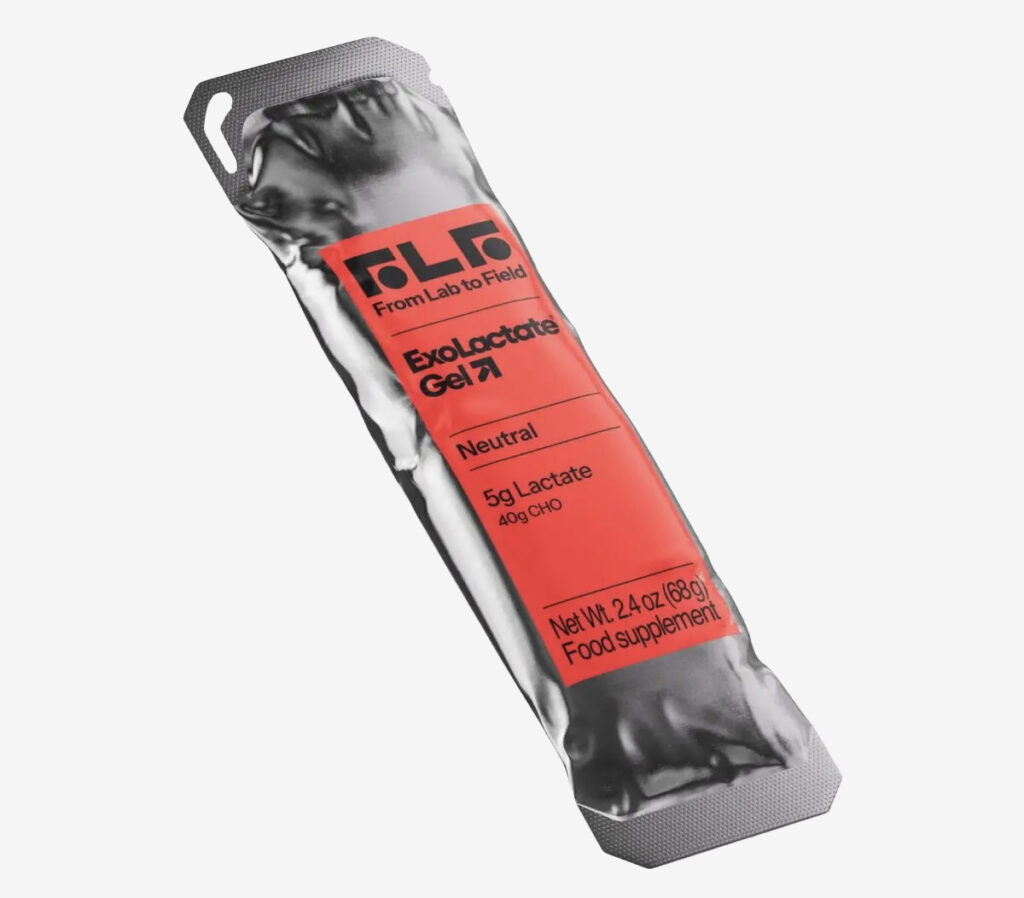
ExoLactate lactate energy gel packet (left) and Santamadre Lactate 60 gel packet (right). The blur on the right is Santamadre’s official product photo, not a rendering issue on our end.
Both companies lean on the same underlying idea: a different set of gut transporters, called MCTs, absorb lactate instead of the ones glucose and fructose use. That’s the same logic behind mixing carb types to push carbohydrate intake higher, just applied to a new molecule, a reasonable hypothesis, but not yet a proven one.
What the actual research shows, not the marketing
Here’s where it’s worth slowing down, because the studies that exist don’t match the confidence of the press coverage.
Researchers at Colorado State University ran a 2024 randomized, double-blind, placebo-controlled trial testing an oral lactate supplement in recreational exercisers. They found no change in VO2peak or lactate threshold, just a modest 4 percent increase in work rate during a 20-minute time trial. Sixteen trained cyclists took a comparable dose in a separate 2024 trial and got no time-trial benefit at all, though it did lower how hard the effort felt. From Lab to Field’s own pilot data claimed an average 8 percent improvement in time to exhaustion, but two outlier subjects out of a small sample drove that number, which tells you very little on its own.
Even Viribay, the scientist behind ExoLactate, has said publicly that real-world evidence is still scarce. He says the case for lactate right now rests mostly on mechanistic and metabolic reasoning, not on a stack of performance trials. That’s an honest thing to say, worth taking at face value.
The headline numbers don’t fully explain themselves
A couple of things are worth flagging here. Not as gotchas, but because the public numbers on both products raise questions nobody’s answered yet.
ExoLactate’s gel reportedly contains 40 grams of carbohydrate and 5 grams of lactate. Viribay has also said the target dose for meaningful effect is somewhere between 10 and 25 grams of lactate per hour. Getting to 20 grams would mean four gels an hour, which is 160 grams of carbohydrate alongside it, well above what most people can tolerate. Public reporting doesn’t explain how riders reach that dose in practice.
Santamadre specs Lactate 60 at 60 millimoles of lactate plus 40 grams of carbohydrate per gel, with instructions to take one every 40 minutes for longer efforts. Santamadre has also said Kejelcha’s race-day strategy involved a much higher lactate dose than that. Public breakdowns of his actual fuelling plan list specific carbohydrate and sodium numbers for several other Santamadre products by name, but don’t clearly show where the lactate fit in. That could just be an incomplete summary, not a contradiction. Treat his result as a proof of concept for the ingredient, not a guarantee of what one gel off the shelf will do for you.
Should you actually try one right now?
PProbably not yet, and not because the idea is bad. Neither product has doping concerns. Lactate isn’t on the WADA banned list, and both companies describe it as a food-grade ingredient. The honest issue is timing. These are brand new, availability outside Spain is limited, pricing isn’t settled, and the performance evidence so far is thin and mixed rather than convincing.
If you’re a self-coached triathlete or runner trying to decide where to spend your fuelling budget and attention this season, a well-tested carbohydrate strategy is still the higher-value move. Our Fuel Strategy Calculator will get you a real number for your race, based on your body weight and effort duration. That number doesn’t depend on a marathon that may or may not have actually used the product now selling off the back of it.
Lactate gels are worth watching. The physiology behind them is real. Just don’t let one good headline talk you into rebuilding a race plan around a product with one season of evidence behind it.
If you’d like to test carbs in a different format, a homemade carb drink is probably the cheapest experiment.
Related Posts
Deciding what to actually put in your flask or gel flasks this season? The 10 Best Energy Gels for Runners and Cyclists: Compared, Ranked, and Actually Tested.
If cramping is what’s sending you down the supplement rabbit hole in the first place, read: The Difference Between Bonking and Cramping (And How to Fix Both).
Wondering whether sodium belongs in this conversation at all? Read: How Much Sodium Do You Actually Need During a Race.
Sources / References
Brooks, G.A. (2018). The Science and Translation of Lactate Shuttle Theory. Cell Metabolism.
Ewell, T.R. et al. (2024). The Influence of Acute Oral Lactate Supplementation on Responses to Cycle Ergometer Exercise: A Randomized, Crossover Pilot Clinical Trial. Nutrients, 16(16), 2624.
Bordoli, C. et al. (2024). Oral lactate supplementation does not affect repeated sprint performance in well-trained cyclists. Medicine & Science in Sports & Exercise.
Company statements from From Lab to Field (ExoLactate) and Santamadre (Lactate 60), cited as company claims, not independent findings.