
You open your plan and it says “tempo run.” Your training partner’s plan says “threshold run.” You compare notes and realize you might be doing the same workout, or two completely different ones, and neither of you is sure. It gets worse when you read three articles and get three answers. The terms get thrown around loosely, sometimes as if they mean the same thing and sometimes as if they are miles apart. So let’s settle tempo vs threshold, and more importantly, figure out how to actually run each one.
TL;DR: Tempo and threshold are close cousins, not twins, and the real trap is that different training systems use the words to mean different efforts. Run the wrong one too hard and your “moderately hard” day quietly turns into a hard day you didn’t budget for. The fix isn’t memorizing a definition, it’s learning to read the effort behind the label.
Key takeaways
- Tempo and threshold are both efforts near your lactate threshold, but they sit at slightly different intensities.
- In Joe Friel’s triathlon system, tempo lives in zone 3, below threshold, which sits up around your lactate threshold heart rate.
- A lot of running plans flip this and use “tempo run” to mean what Friel calls threshold, which is where most of the confusion comes from.
- The most common mistake is running tempo too hard, so every quality session becomes a threshold grind and nothing gets easier.
- Your zones should be built off your lactate threshold, not a 220-minus-age max heart rate guess.
Tempo vs threshold: what’s actually different?
The honest answer to tempo vs threshold is that it depends whose plan you’re holding. But there’s a clean way to think about it once you know what’s going on underneath.
Your body has two useful tipping points, not one. The first, often called the first lactate threshold or LT1, is where lactate starts to climb above resting levels. The second, LT2, is the harder ceiling: the fastest effort you can hold while your body still clears lactate as quickly as it produces it. Joe Friel builds his training zones around these two points in The Triathlete’s Training Bible. Tempo and threshold both live in the space near that second ceiling, which is exactly why they get muddled.
How Joe Friel defines tempo and threshold
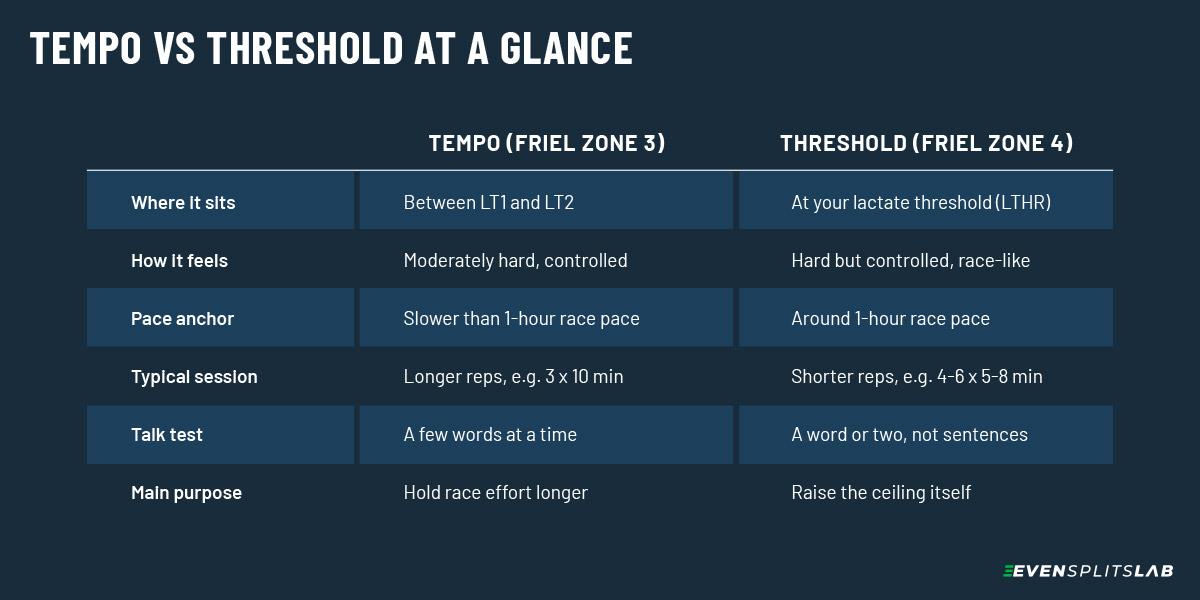
In Friel’s system, tempo is a moderately hard effort that sits in zone 3, between LT1 and LT2. It’s the comfortably uncomfortable pace: working, but nowhere near racing. Friel’s point is that tempo work earns its place mainly when you’re preparing for an event you’ll actually race at that intensity, because it trains your body to process oxygen and produce energy at race effort.
Threshold is the harder one. It sits up in zone 4, right around your lactate threshold heart rate, which for most people lines up with the pace you could hold for about an hour in a race. This is the lactate balance point, the edge before things start to fall apart.
So in Friel’s world the order is simple: tempo is the lighter effort, threshold is the heavier one. Hold that thought, because the running world is about to mess with it.
Why your marathon plan calls something different a “tempo”
Here’s where it falls apart. A lot of the running world, including Jack Daniels and the marathon plans built on his work, uses “tempo run” to mean threshold pace. So the thing Daniels calls a tempo is basically the thing Friel calls a threshold. Same word, harder effort.
This isn’t anyone being wrong. There has just never been a standard. One coach’s tempo is another coach’s threshold, and a third coach uses both words for the same session. I’ve stopped expecting the labels to agree.
The practical move is to ignore the name and read the pace. The reliable tell is your one-hour race pace, which is roughly your lactate threshold. If a plan’s “tempo” is pegged to that one-hour race effort, it’s threshold work in Friel’s terms, whatever the plan calls it. If the effort sits clearly below that, a notch easier, where you could keep going well past an hour, that’s tempo in the Friel sense. Match the pace anchor, not the vocabulary.
How to actually run each one
Friel builds both as muscular-endurance interval work, and he ties rep length to intensity: work intervals of roughly six to twenty minutes, with recoveries about a quarter of the work time. The rule is simple. The harder the effort, the shorter each rep.
For tempo, the lighter zone 3 effort, think controlled. You should finish feeling like you could have done a bit more. The talk test is a good check: you can get a few words out, but you wouldn’t want to hold a conversation. Friel’s go-to tempo session is around three reps of 10 minutes in zone 3 with short easy recoveries, though plenty of coaches run it as shorter reps, say five to eight minutes, as long as the effort stays in zone 3.
For threshold, the harder zone 4 effort, it’s sharper. This is hard but still in control, the pace you could just barely hold for an hour if you had to. The reps come down in length because the effort is higher, usually five to eight minutes, with short jogs between to bank more total time at the effort. What makes it threshold is the zone, not the clock. If the reps are only a minute or two and leave you gasping, that’s speed or VO2 work, not threshold, whatever the plan calls it.
The mistake I see most often isn’t doing too little. It’s running tempo at threshold effort, turning a moderately hard day into a genuinely hard one. Do that a few times a week and you end up living in the grey zone, that no man’s land where everything is medium-hard and nothing is recovering or improving. If your easy days have also crept up in pace, the problem compounds. Easy has to stay easy so the hard days can actually be hard.
Harder sessions only work if the easy days stay easy. Some of the common zone 2 myths push people the wrong way on that.
Tempo vs threshold for triathletes
If you race sprint or Olympic distance, threshold work earns its keep, because your race effort sits close to that ceiling. Getting comfortable holding threshold, especially off the bike, is most of the game. That’s where threshold efforts inside brick workouts pay off, since legs that feel fine on a fresh run feel very different after a hard ride. For long-course racing the balance shifts toward more aerobic and tempo work, because you’re racing well below threshold for hours and the limiter is fuel and durability, not your lactate ceiling.
Find your zones before you argue about labels
All of this hangs off one number: your lactate threshold. Without it, the zones are just guesses. Our HR Zone Finder builds your training zones from your lactate threshold heart rate in about a minute. Use the lactate threshold option rather than max heart rate, since that’s what Friel’s zones are based on, and because the old 220-minus-age formula misses for a lot of people anyway.
Quick questions
How long should a tempo run be?
Think in intervals, not one long block. A common tempo session is three reps of about 10 minutes in zone 3, or four to five reps of five to eight minutes, with short easy recoveries. Total work of 20 to 40 minutes is plenty for most runners. Quality over heroics.
Can beginners do threshold runs?
Yes, but keep them short and broken up. A few reps of three to five minutes at controlled threshold effort teach your body the feel without wrecking you. Build the aerobic base first, though. If you’re new, most of your running should still be easy, which is the whole point of zone 2 work.
How do I find these paces without a lab?
A simple field test gets you close. Run a hard, steady 30 minutes solo as if it were a race, and your average heart rate over the last 20 minutes is a decent estimate of your lactate threshold heart rate. Plug that into Our HR Zone Finder and your zones fall out from there.
Related posts
- New to heart rate training? Start with How to Read Your Heart Rate Zones.
- Still sorting out easy versus moderate effort? Read Zone 2 vs Zone 3 Training.
- Racing triathlon? See Brick Workouts Explained for where threshold work fits off the bike.