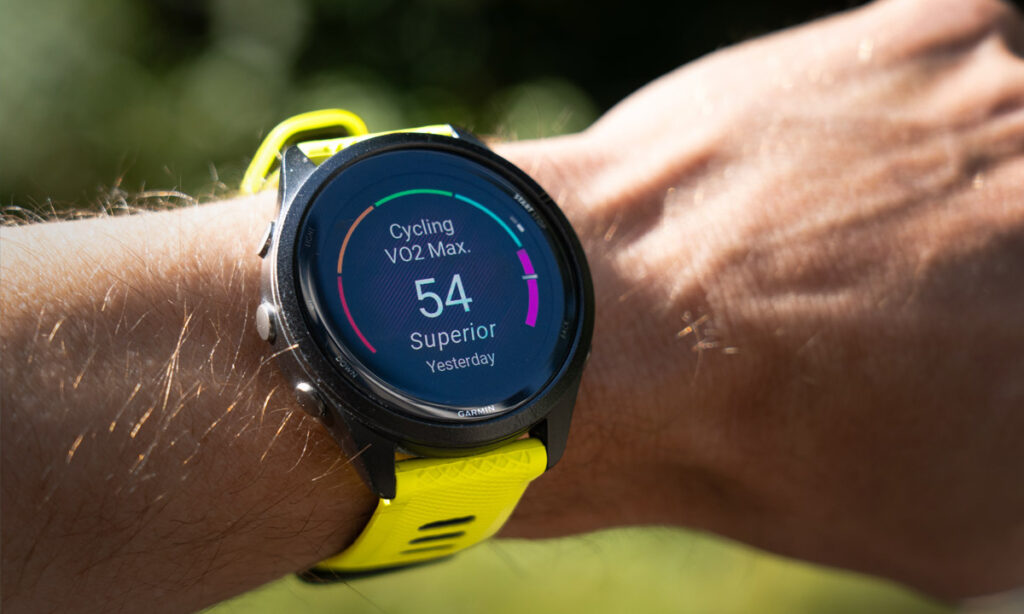
Your watch shows you a VO2 max number, and it feels weirdly official. Mine crept up over a training block and I wanted to believe it. But the watch never measured my oxygen. It made an educated guess off heart rate and pace. So the fair question, and the one worth answering before you get attached to the figure, is what watch VO2 max accuracy actually looks like once you hold it against a real lab test.
TL;DR
For most recreational runners the number is close enough to trust as a trend, and shaky as an exact score. A lab test is the real measurement. Your watch is running a smart estimate on top of limited data, and how good that estimate gets depends on a few things most people never check. Those are the interesting part.
Key Takeaways
- A lab test measures VO2 max directly by capturing the air you breathe out. Your watch never does this. It estimates.
- For steady outdoor running, most watch estimates land within roughly 5 to 10 per cent of a lab result. Good enough to work with, not exact.
- The estimate gets worse on the bike, on a treadmill, or when your watch is working off a guessed max heart rate.
- Track your own trend over weeks, not day to day. And it is not fixed: it drops when you stop training and climbs back when you get going again.
- Raising VO2 max is mostly aerobic base plus a bit of hard interval work. The intervals get the headlines. The base does the quiet work.
What VO2 max actually is
VO2 max is the most oxygen your body can take in and use when you are working flat out. More is better for endurance. That is basically it. The name sounds like a lab metric because it is one: V for volume, O2 for oxygen, max for max. Your muscles need oxygen to turn fuel into movement, and the ceiling on how much you can deliver and burn is a big part of why one person can hold a pace that leaves another gasping.
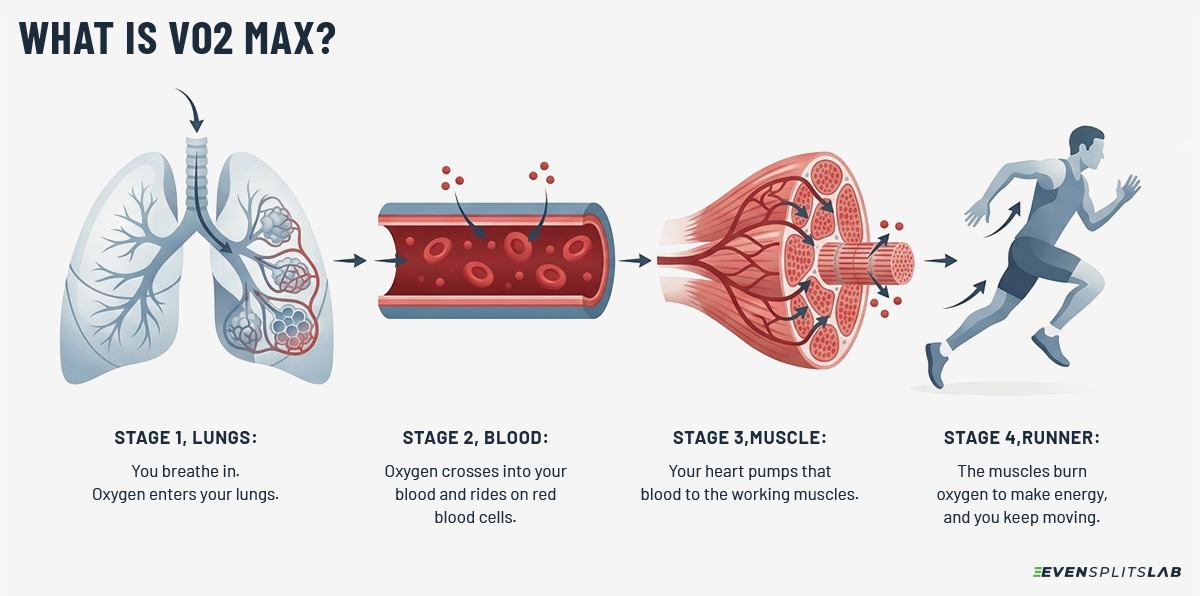
It is not the whole story of fitness. Running economy, your threshold, pacing and your head all matter too. But as a single number for the size of your aerobic engine, it is a good one. And here is the key bit for this post: when your watch reports a VO2 max, it is trying to estimate that ceiling without ever measuring your breath.
The gold standard is a proper lab test
The real way to get VO2 max is a lab test, and I did one. I booked it for the start of my season.
Here is how it went. Treadmill, plus a mask strapped over my nose and mouth to capture every breath. That mask is how the test actually measures VO2 max. It reads the oxygen going in and the carbon dioxide coming out, and works out how much oxygen my body is burning. I breathe through my mouth when I run, especially once I am past easy pace, so running hard with a sealed mask on my face was its own small event. The speed started gentle and the technician nudged it up in steps. Once things got serious it climbed every minute until I could not hold on, and that was the end.
There was also a needle. At a few points the technician pricked my finger for a blood sample. That part was not for VO2 max. It was a lactate threshold test running alongside it, which measures where your effort tips from sustainable to not. Different number, different tool. The mask gives you VO2 max, the blood gives you your threshold. If you ever book a lab test and you can add the threshold test alongside it, do it. For pacing and race day it is arguably the more useful of the two, and running both in one session saves you a second trip.
Honest note on the test itself. It was excellent, and it was not cheap. If I did it again I would test at the start of the season, like I did, and once more near my peak before an A race, so I could actually see the change. One data point is a photo. Two is a story.
So how accurate is the number on your watch?
Close, with caveats. For steady outdoor running, the estimate most watches produce usually lands within about 5 to 10 per cent of a lab value. A 2025 systematic review in Frontiers in Sports and Active Living pulled together 13 validation studies and found most wrist and chest strap estimates came in under 10 per cent error, good enough to call them valid for tracking. Firstbeat, whose algorithm sits inside Garmin watches, reports its own average error at around 3.5 ml/kg/min when you pair a chest strap (their white paper). Worth remembering that is the maker grading its own work, but independent reviews land in a similar zone.
The sharpest way I have seen it put: in one validation study the average error across the whole group was almost zero, but the spread for any single person still ran close to 10 points either way. So on average the watch is nearly bang on. For you, on your wrist, on a given day, it could be a few points high or low and you would never know. That is the honest tension. Great for a group, fuzzy for an individual.
Here is the catch worth knowing. All of that assumes the watch is getting clean data. Take away the chest strap and lean on wrist heart rate alone and the error widens, often into the 5 to 8 ml/kg/min range. The algorithm also leans on your max heart rate, and if it is using an age based guess that is off, the estimate drifts with it. That same Frontiers review noted that a max heart rate wrong by 15 beats can throw the VO2 max result off by roughly 7 to 9 per cent. Feed it the wrong ceiling, get the wrong number. If you have never checked what your watch thinks your zones are, start with your heart rate zones.
A few other limits worth knowing, because the watch does not spell them out:
- Running and cycling are separate estimates. Cycling needs a power meter, and without one most watches give you no number at all.
- Treadmill runs do not count. The watch needs GPS to calculate VO2 max, so it has to be an outdoor run.
- It tends to underestimate very fit athletes and overestimate very unfit ones, because the model is tuned around the middle.
- Optical wrist sensors can read less reliably on darker skin tones, which feeds straight into the estimate.
So where did mine land? My watch had me within about a point of the lab result. One point. Tempting to call that proof, but it is not. It is one runner, one test. What it does show is that when the conditions are good, consistent outdoor running with heart rate the watch could read cleanly, the estimate can land right where the research says it should for a recreational runner. That is the honest version. If you want to see how the current crop of watches compares on this and everything else, I went deeper in our guide to GPS watches for triathletes.
What about the at-home tests?
You can estimate VO2 max without a watch or a lab, using a field test. The Cooper 12 minute run, the 1.5 mile time trial, the beep test, the Rockport walk. They all work the same way: you do a set effort, then a formula turns your result into a VO2 max estimate.
Keep the word estimate front of mind. These are rougher than a watch and much rougher than a lab, because a formula is standing in for the gas mask. They are good for one thing: giving yourself a baseline, then repeating the exact same test later to see if the trend moved. As a hard score to wave at your training partner, they are not it. Same rule as the watch. Trust your own trend, ignore the decimal places.
Is your VO2 max any good? Chart by age and sex
A number on its own means nothing until you place it against your age and sex. VO2 max falls naturally as we age, very roughly 10 per cent a decade after 30 if you sit still, and women tend to sit a little lower than men at the same age for physiological reasons. So compare like with like: your bracket, not the raw figure.
The tables below come from the Cooper Institute normative data, the same reference set published in the ACSM’s Guidelines for Exercise Testing and Prescription. It is the standard your watch is quietly checking you against too. Find your age row, then read across. All values are in ml/kg/min.
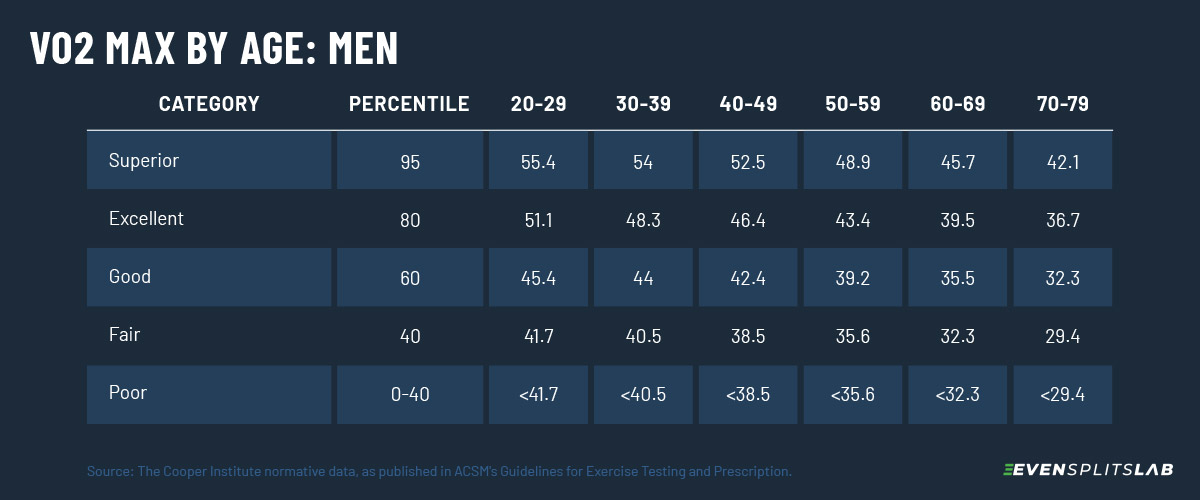
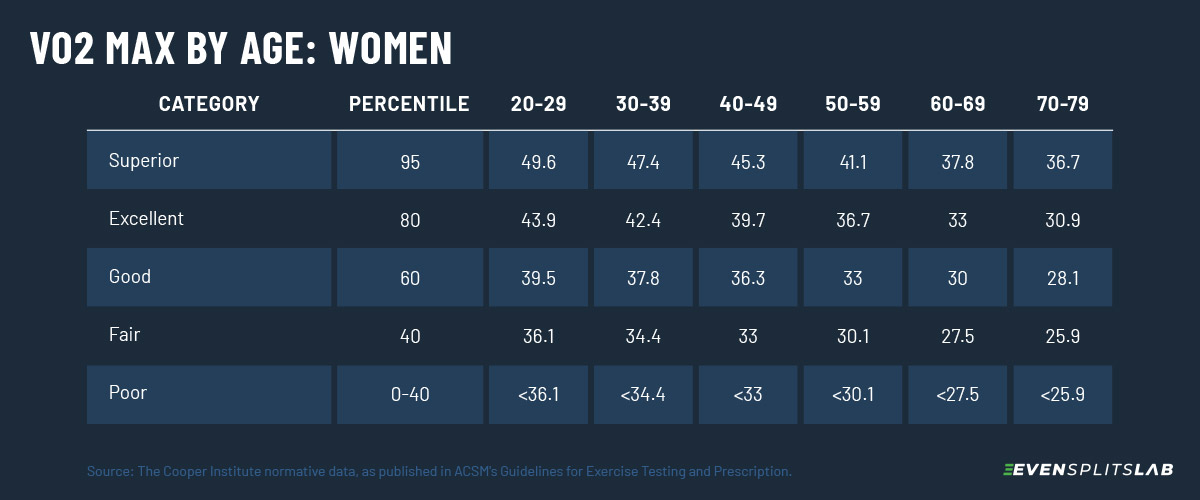
One thing this makes obvious: a 40 that reads as Fair for a 25 year old man is Good for a 55 year old man. Same number, different verdict. Which is exactly why chasing someone else’s figure is a waste of energy.
How to actually raise it (one run, one ride)
You raise VO2 max by spending time near the top of your aerobic range, then backing it up with easy volume. Both parts matter, and most people get the ratio backwards.
Start with the part that gets skipped. For most recreational athletes, the bigger gains come from aerobic base, the easy Zone 2 miles, not from smashing intervals twice a week. My own lab report said the same thing to me in plainer terms: build the base, and the ceiling follows. Intervals are the seasoning. Zone 2 is the meal. Do the hard sessions once, maybe twice a week, and let easy running fill the rest.
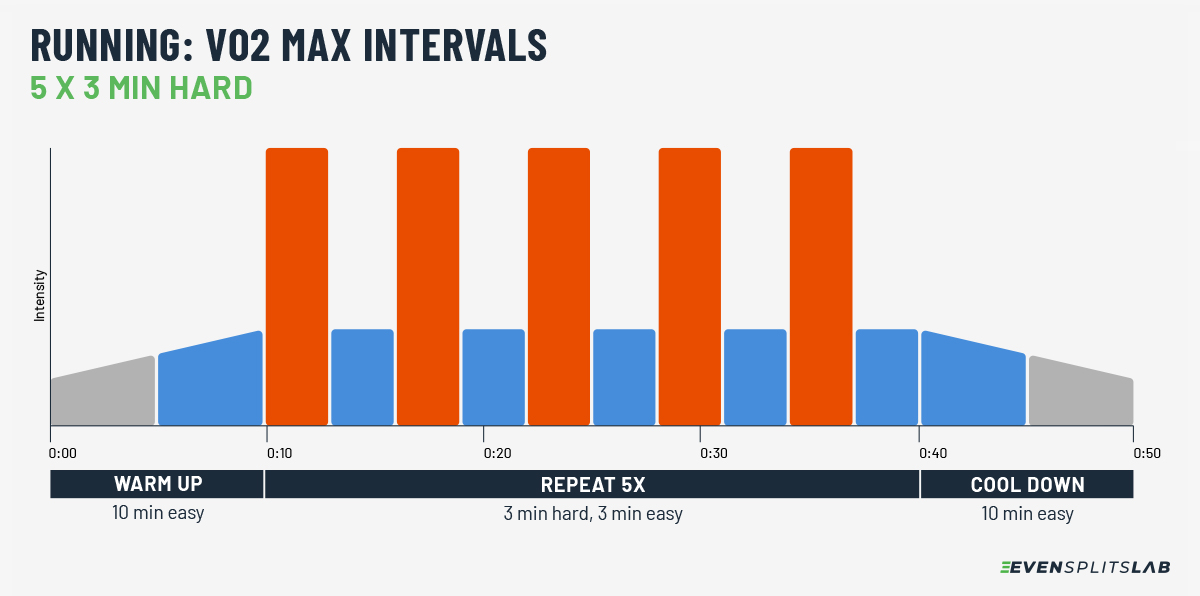
Running: VO2 max intervals
After a proper warm up, run 5 x 3 minutes hard, at an effort you could just about hold for a 3k race, with 3 minutes of easy jogging between each. That is your top zone, where holding a conversation is off the table. Cool down after. If five reps feels impossible at first, start with three or four and build up over a few weeks.
Cycling: 5 x 4 minutes hard
Same idea, slightly longer reps because the bike is lower impact. Ride 4 minutes at a hard, near maximal but steady effort, then spin easy for 4 minutes, five times through. A power meter makes this cleaner on the bike, but honest effort works fine if you do not have one.
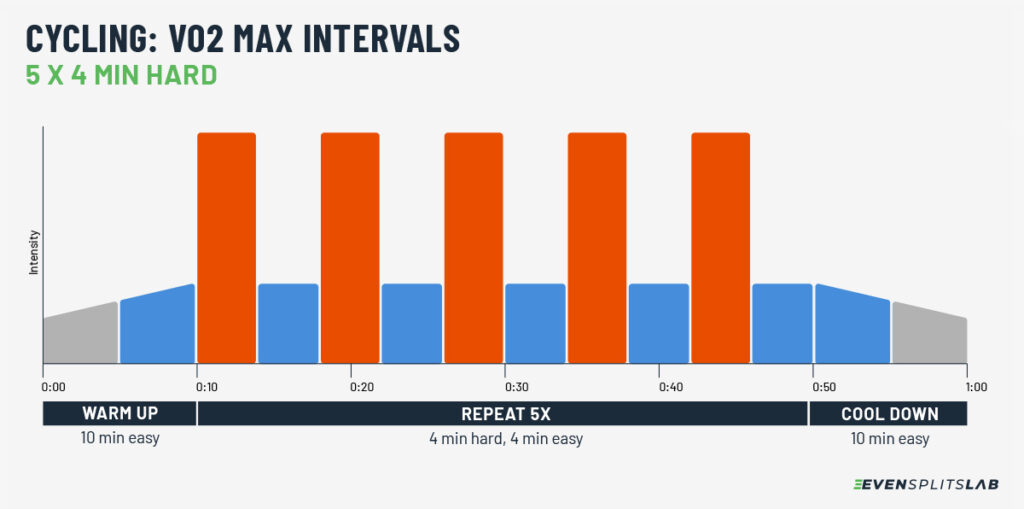
For both, the target zone is the thing that makes or breaks the session. Our HR Zone Finder will set your zones from your max or threshold heart rate, so you are actually training in the right band instead of just running hard and hoping.
A few quick questions
Why is my cycling VO2 max lower than my running one?
Because they are estimated from different efforts, and most people are simply more efficient runners than cyclists unless they ride a lot. Your watch also needs a power meter to estimate it on the bike. Track them as two separate numbers, each against itself over time, not against each other.
Does a chest strap really improve the estimate?
Usually, yes. Wrist heart rate is convenient but noisier, especially during hard intervals when your wrist is bouncing around. A chest strap gives the algorithm cleaner heart rate data, which is the single biggest input it works from. If you care about the number, wear one for your key sessions.
How much does the number move, and does it drop if I stop training?
Slowly, and yes it drops. Real VO2 max shifts over weeks and months, not days, so if your watch number jumps around a lot day to day, that is usually noisy data rather than your fitness swinging. It is also not a fixed number. Take a few weeks easy in the off season and it usually drifts down. Start training properly again and it climbs back up. That dip after a break is normal, so try not to read too much into it. Watch the multi week direction and ignore the wobble.
Sources
- Frontiers in Sports and Active Living (2025). Accuracy of wearables for determining VO2 max and lactate threshold: a qualitative systematic review.
- Firstbeat Technologies. Automated Fitness Level (VO2max) Estimation with Heart Rate and Speed Data. White paper.
- The Cooper Institute normative data, as published in the American College of Sports Medicine’s Guidelines for Exercise Testing and Prescription.