You buy a new saddle. Then a different saddle. Then better bibs, then chamois cream. Nothing quite kills the ache in your lower back or the hands that go numb after an hour. That was me for a while. I kept treating the symptoms and never looked at the thing causing them, which was how I sat on the bike. So is a bike fit worth it? After three of them, across two road bikes and a TT bike, here is my honest answer.
TL;DR
For most riders, yes. But the payoff is not the one the marketing sells you, and it is not the same for everyone. The fit that changed the most for me was not the one I expected, and it had nothing to do with watts.
Key Takeaways
- The reliable payoff of a fit is comfort and staying pain-free on long rides, not free speed.
- The biggest before-and-after is that you stop blaming, and buying, the wrong things: saddles, bibs, chamois cream.
- You cannot copy your road bike numbers onto a TT bike. Different geometry, saddle position, and often crank length.
- In Canada, if a registered physio does the fit, part of it may be claimable through extended health, depending on your plan.
- Not everyone needs a paid fit right now. It depends on your bike, your body, and how much you actually hurt.
What a bike fit actually involves
Mine were all done at a physiotherapy clinic by a registered physio, not at a bike shop. That matters more than I realized, and I will come back to it.
The first part has nothing to do with the bike. The physio checks how your body actually moves. Hip and ankle mobility, flexibility, whether one leg sits differently than the other, and any pain you have been quietly ignoring. If something is off in your body, he addresses that first. There is no point building a position around an imbalance you could fix.
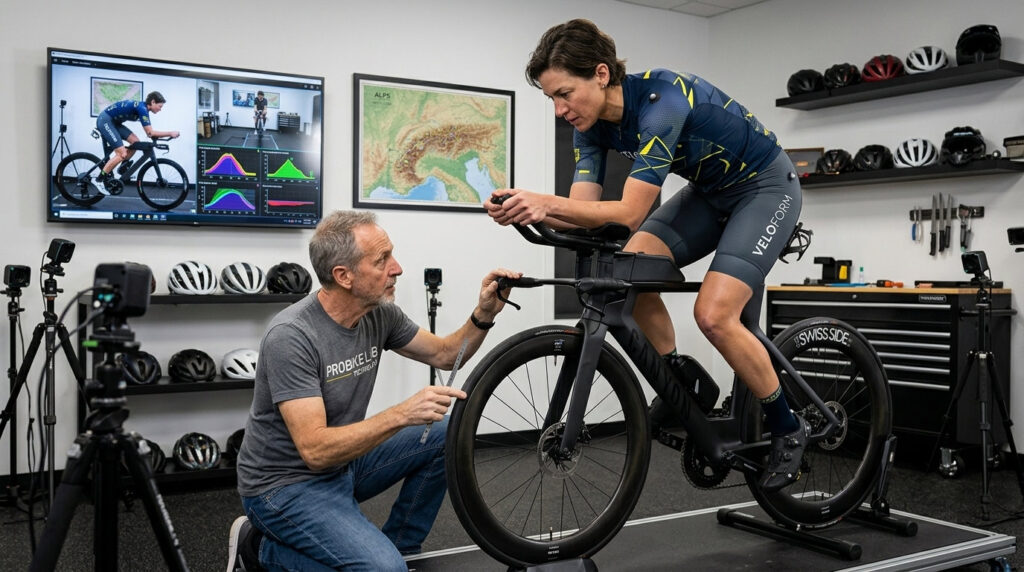
The second part is the fun bit. Your own bike goes on a trainer and you pedal while he measures everything. Mine used lasers to catch the side-to-side stuff you cannot feel yourself. Then the changes start. Saddle height, reach, saddle fore and aft, hip position, where you actually sit on the saddle, and how wide your sit bones are, which drives the saddle he recommends. It is fiddly, and a little humbling. You find out your ‘good’ position was mostly held together by compensation.
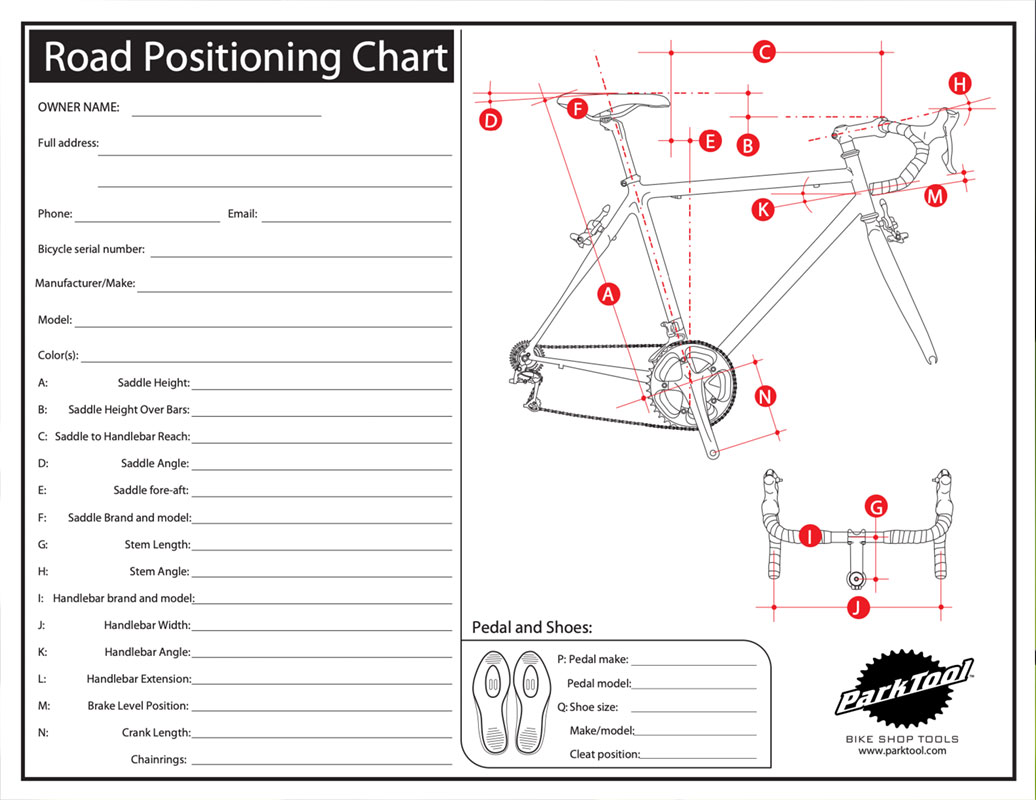
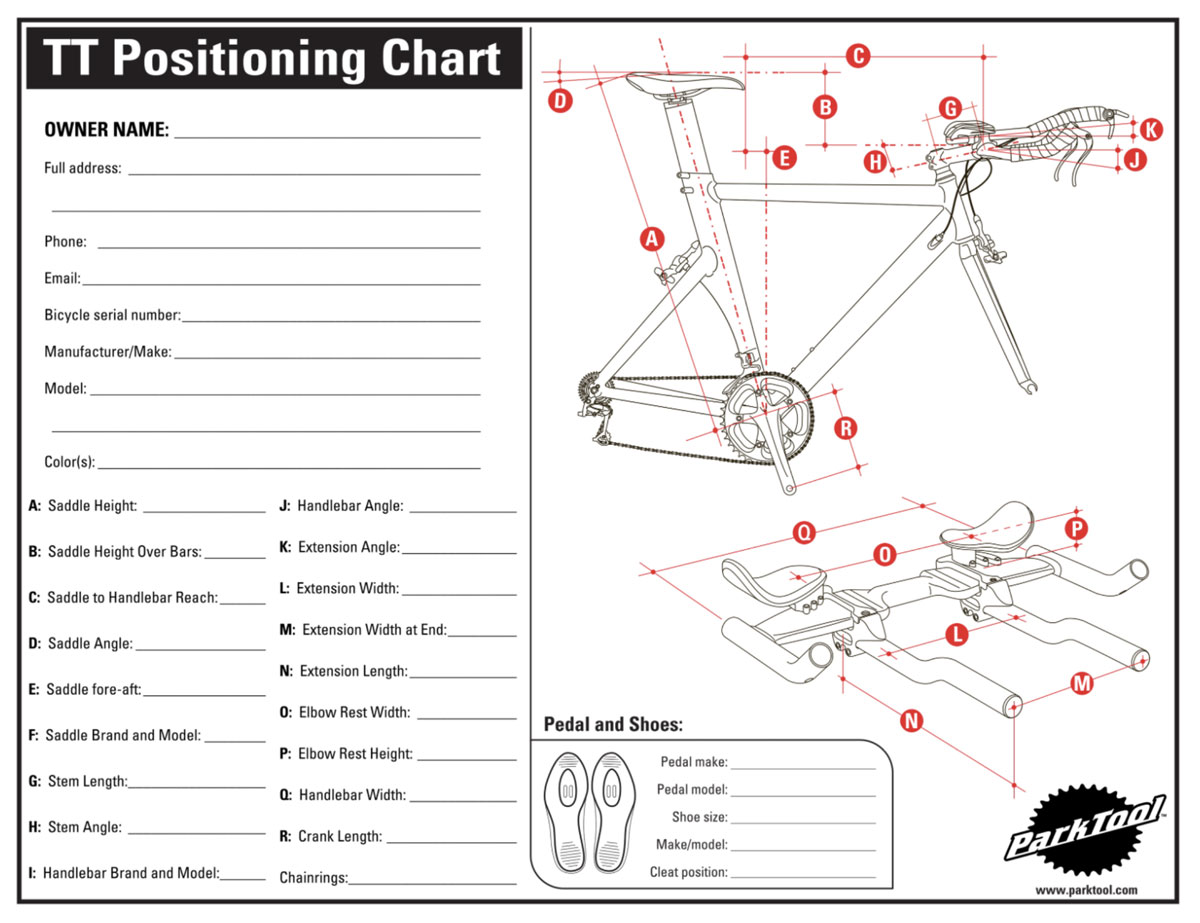
Road fit on the left, TT fit on the right. Look at how little carries over. Different contact points, different measurements, different sheet entirely. (Charts: Park Tool)
What changed on my bikes
My first road bike was used, and the fit flagged problems fast. The stem was too long, so I swapped it for a shorter one. The saddle was wrong for my sit bones, so that changed too. The bars were a touch wide for me. The rough guide is around shoulder width, though it varies, and mine were past that. I rode them anyway, because I was not about to buy a new handlebar that week.
My second road bike was new, with a one-piece cockpit, so there was less to swap. The handlebar width could still be adjusted, which saved me.
Here is the part that stings. Before any of this, I was convinced the problem was my saddle. Or my bibs. Or that I was using the wrong chamois cream. I spent real money chasing comfort in all the wrong places. The fit showed me it was none of them. It was how I was set up. If you are stuck in that same loop, buying parts and hoping one of them fixes the ache, read our take on where upgrade money actually goes first: Best Road Bike Upgrades (https://evensplitslab.com/road-bike-upgrades-bang-for-buck/). A fit is often the most important ‘upgrade’ on that list.
The TT bike didn’t play by the same rules
I bought a TT bike assuming I could copy my road numbers straight across. Save a fit, save some money. That is not how it works.
A TT bike puts you in a different position on a different frame with different geometry. The seat angle is steeper, roughly 76 to 78 degrees versus around 72 to 74 on a road bike, which rotates you forward and onto the nose of the saddle. Your weight comes off the bars and onto your forearms. My crank arms were also shorter, and that alone changes things, because shorter cranks meant the saddle had to come up to keep my leg extension right. The people who fit these for a living, like the team at Cyclingnews, describe TT fitting as a rabbit hole you never fully climb out of. After mine, I believe them.
Does a bike fit actually make you faster?
Sort of, sometimes, and less than you would hope.
The honest evidence is thin and mixed. One small 2025 study by Evan Hoyt and Gregory Ruegsegger, published in the International Journal of Exercise Science, put 12 recreational cyclists through a motion-capture fit and saw peak power rise about 8.6 percent, with lower perceived effort afterwards (the study is here). That sounds great until you notice it is twelve people and a one-off test, not proof you will bank free speed. Reviews of saddle-position research land in the same place: real gains for some riders, trivial for others, very individual.
So do not buy a fit expecting watts. If you want to actually measure whether your power changed, that is what a power meter is for, and we broke one down here: Favero Assioma RD-L review. The reliable win is comfort, and my own theory is that comfort is where any speed actually hides. When something hurts, the ride turns into an achy slog. You shift around, you sit up, you stop pushing. Take the pain away and you can put power down for the whole ride, not just the first hour. Your peak watts might not move, but the power you can hold does.
So do you actually need one?
This is where most ‘get a bike fit’ articles go soft and tell everyone yes. I will not.
You probably want one soon if:
- You are new to riding and something hurts. Knees, lower back, neck, hands going numb. That is usually position, not toughness.
- You just bought a bike, especially a used one or a TT bike. Used bikes come set up for a stranger. TT bikes are unforgiving when the position is off.
- You changed something big. New cranks, new saddle, a jump in weekly hours.
- The pain is cutting your rides short. If discomfort is why you bail early, fix it. If you are already sidelined, our guide on training around it is here: How to Keep Your Fitness While Injured.
You can probably wait if:
- You are comfortable, riding regularly, and nothing hurts. If it is not broken, do not pay someone to confirm it.
- You just bought a new bike from a good shop that sized you properly. That is not a full fit, but it is a decent starting point.
- You ride casually a few times a month. Your money is better spent elsewhere first. If you are still kitting out, start with the basics: Triathlon on a Budget.
What you can try yourself first
If you are on the fence, or just not ready to spend, you can chase a fair bit of this at home. The trick is discipline, not skill. Change one thing at a time, move it in small amounts (a few millimetres, not a fistful), then ride it two or three times before you decide. Change three things at once and you learn nothing, because you will not know which one helped.
Most common aches trace back to one lever. Here is a rough starting point, not a diagnosis:
| What you feel | First thing to try |
|---|---|
| Numb or tingling hands | Level the saddle first. A nose-down tilt slides you onto the bars. If it lingers, ease the saddle back a touch to take weight off your hands. Leave bar height alone for now. |
| Pain at the front of the knee | Saddle is often too low. Raise it a few millimetres. |
| Pain behind the knee | Saddle is often too high. Drop it a few millimetres. |
| Sore neck and shoulders | Usually the reach is too long or the bars too low. If your setup allows it, raise the bars or shorten the reach. |
| Saddle soreness or pressure | Check saddle tilt first. You may also be sitting on the wrong part of the saddle, so try moving it forward or back. If it hangs around, the saddle width may not suit your sit bones. |
What you cannot really DIY is the stuff a fitter is actually paid for: watching yourself pedal, catching a side-to-side imbalance you cannot feel, and anything to do with a TT position. If your home tweaks are not landing, that is your sign to book one.
What it costs, and a tip
Fits are not cheap. In BC you are usually looking at somewhere between $200 and $400, and often past $400 for a full motion-capture or TT fit. Prices swing by fitter and city, so treat that as a ballpark and check locally before you book.
Two things make the price easier to swallow. First, you are spreading it over years, and often more than one bike. Second, and this is the one people miss:
Tip: if you’re in Canada and a registered physiotherapist does your fit, the invoice may be claimable under your extended health benefits. It depends on your plan, so check your coverage before you book. It made mine noticeably cheaper.
That single detail is why I go to a physio rather than a shop. Same useful fit, plus a body assessment a shop will not do, and part of the cost can come back on my plan.
A few honest questions
How often should I get re-fitted?
Not often. After a big change (new bike, new cranks, an injury, a real shift in flexibility) or when new pain shows up. Otherwise a good fit holds for years.
Physio or bike shop?
A shop fit is fine, and often bundled with a new bike. A physio adds the body side, and in Canada the possible insurance claim. If you have nagging pain, I would lean physio.
So, do you need one?
Here is where I land. If something hurts, if you just bought a bike, or if you have been chasing comfort by buying parts, book the fit. You will stop paying for the wrong fixes and start enjoying the riding. If you are comfortable and nothing aches, you can wait, and you can work through the tweaks above in the meantime.
Would I do all three again? Yes, without thinking about it. Not because it made me fast, but because it made riding stop hurting. That, more than any new saddle, is what keeps you riding.