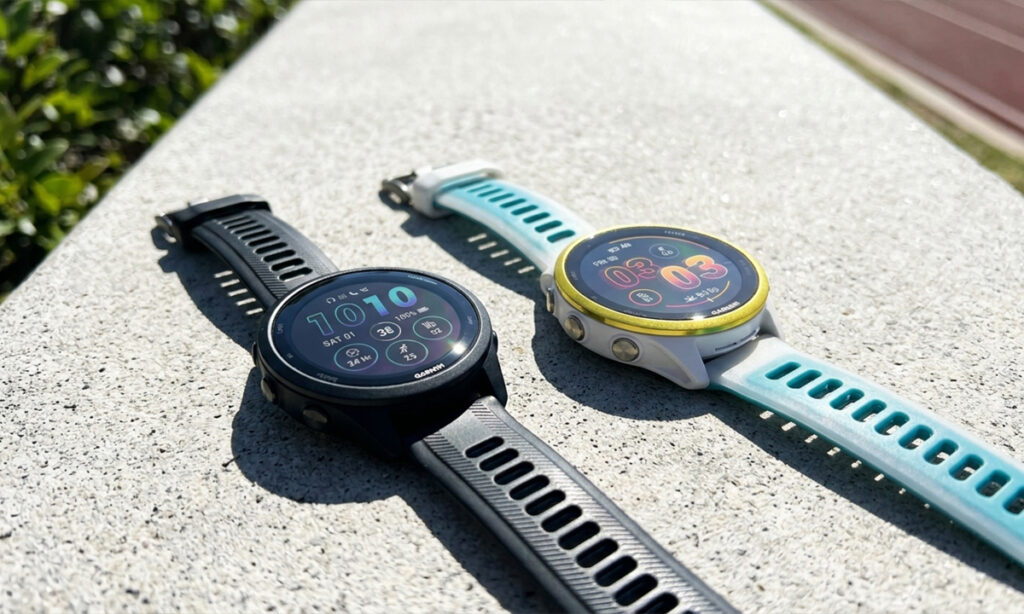
The Forerunner 265 is still a good watch. It now has a successor with a nicer screen, a speaker for phone calls and a higher price tag. If you own a 265, you’ve probably wondered whether your wrist is falling behind. If you’re shopping, you’re looking at two watches that look almost identical. Here’s the Garmin Forerunner 265 vs 570 breakdown, with the upgrade math included.
TL;DR
If you already own a 265, the 570 is usually a want, not a need. The GPS is the same on paper and most of the training tools carry over. What you’d be paying for is a short list of upgrades, and one of them can actually cost you something.
Key takeaways
- Both watches have multi-band GPS and Auto Select (SatIQ), so accuracy is close. The 570 has a slight edge in one published half marathon test.
- The 570 adds a bigger AMOLED screen, a newer heart rate sensor, a speaker and mic for calls, skin temperature and Triathlon Coach plans.
- The 265 lasts longer in smartwatch mode and on GPS-only workouts. The 570 lasts longer when you play music.
- Neither watch has offline maps or an ECG app. If you want those, look at the Forerunner 970.
- Most 265 owners can wait. If you’re buying new, the price gap should make the call.
What the Forerunner 265 and 570 Have in Common
Start here, because most people skip it. These two watches share more than they differ, and that’s why the upgrade question is hard. Here’s what carries over.
Both watches have
- GPSMulti-band GNSS with Auto Select (SatIQ)
- Screen typeAMOLED touchscreen plus buttons
- LensCorning Gorilla Glass 3
- CaseFibre-reinforced polymer, 12.9 mm thick
- Water rating5 ATM
- SensorsWrist heart rate, Pulse Ox, barometric altimeter, compass
- Training toolsTraining Readiness, HRV Status, Training Status, Morning Report
- Running metricsRunning power, cadence, stride length, VO2 max
- Music8 GB of offline storage, Spotify, Amazon Music and Deezer
- PaymentsGarmin Pay
- MultisportTriathlon, pool swim and open water swim profiles
- NavigationBreadcrumb trail
Neither hasOffline maps, ECG app
Some of this matters more than the rest. HRV Status is a good example, and if it’s new to you, our guide to HRV training explains how to use it. The VO2 max estimate is the same story. It’s a useful trend line, not a lab result, and we looked at how far to trust it in a separate post.
Two things aren’t on this list, and they matter. Neither watch has offline maps. Neither has an ECG app. If you were hoping the 570 fixed either one, it didn’t.
Garmin Forerunner 265 vs 570: What’s Actually New
Here’s where the 570 pulls ahead. The list is shorter than the marketing makes it sound.
| Feature | Forerunner 265 | Forerunner 570 |
|---|---|---|
| Screen | 1.3 inch (1.1 inch on the 265S) | 1.4 inch (1.2 inch on the 42 mm) |
| Bezel | Fibre-reinforced polymer | Aluminum |
| Weight | 47 g (39 g for the 265S) | 50 g (42 g for the 42 mm) |
| HR sensor | Elevate Gen 4 | Elevate Gen 5 |
| Calls | No | Speaker and mic for calls and voice commands |
| Skin temp | No | Yes |
| Triathlon | Triathlon mode | Triathlon mode, Triathlon Coach plans, structured multisport workouts |
| Reports | Morning Report | Morning Report and Evening Report |
Screen and build
Both screens are AMOLED, so this is a step up from something already good. Wareable found the 570’s display brighter and more vivid. It’s also a touch bigger, with a 1.4 inch screen on the 47 mm model against 1.3 inches on the 265. The domed edge on the 265’s display is gone, and the polymer bezel is now aluminum. All of that adds about 3 grams. You’ll notice the screen. You won’t notice the 3 grams.
Calls and voice commands
The 570 has a built-in speaker and microphone. You can take and place calls from the watch when your phone’s nearby, and use voice commands. It isn’t fully hands-free, because you still start voice input from the activity list. I’d call it a nice extra, not a reason to spend the money. Nobody takes a call in T2 anyway.
Triathlon Coach and multisport workouts
This is the one that matters if you swim, bike and run. Garmin lists Triathlon Coach plans and structured multisport workouts as new on the 570. The 265 already has a triathlon mode, but as far as I can tell it doesn’t get these extras out of the box. If you already have a coach or a plan you like, this matters less. If you want Garmin to build the plan, it matters more. We covered the wider picture in our roundup of the best GPS watches for triathletes.
Software extras
Garmin also added Evening Report, dynamic race time estimates and a pile of new sport profiles, including gravel bike and rucking. Garmin does push some software to older watches later. Check that a feature is actually exclusive before you pay for it.
GPS Accuracy: Is the 570 Better?
Not by much. Both watches have multi-band GPS and Auto Select (Garmin markets it as SatIQ), so the GPS is the same on paper. Wareable’s testing found “flawless and virtually identical” distance and route data from both.
Tom’s Guide ran a half marathon with both watches in multi-band mode. The 570 recorded 21.24 km. The 265 recorded 21.41 km. The course is 21.1 km. That’s about 0.7% long for the 570 and 1.5% long for the 265. The 265 ran wider on corners, and the author admits his own weaving may explain some of it. So the 570 gets a small nod, but a 170 m gap over 21 km won’t change how you pace. I wouldn’t upgrade for this alone.
Which GPS Mode Should You Use?
Both watches give you the same three options.
- GPS Only: Best battery life. Least accurate when you’re surrounded by buildings or trees.
- Auto Select (SatIQ): The watch switches modes for you. A sensible default.
- All + Multi-Band: Usually the most accurate in tricky spots. Hits the battery hardest.
Tall buildings, tunnels and dense tree cover are where multi-band helps. On open roads, most people won’t see a difference. It’s also why you wouldn’t just buy the cheaper Forerunner 170 instead. The 170 doesn’t have multi-band GPS. We compared it to the 70 in our Forerunner 70 vs 170 post.
Heart Rate Accuracy and Sensors
The 570 uses Garmin’s newer Elevate Gen 5 sensor. The 265 has Gen 4. Is it better? A bit.
Wareable found Gen 5 helped in cold, rainy weather and with consistency during intervals. Its verdict was that this alone doesn’t justify the upgrade. In Tom’s Guide’s half marathon, both watches sat within a beat or two of a chest strap once they settled. The 570 took a few minutes to lock on early in the race, and the author called it a tie.
If your 265’s wrist heart rate lags on intervals, a chest strap fixes that for far less than the price gap. Wareable suggests pairing a 265 with Garmin’s HRM 600 for lower latency. We broke down the trade-offs in wrist HR vs chest strap.
Skin temperature
The 570 adds a skin temperature sensor. It tracks overnight trends for sleep and recovery. It’s a nice data point, but I wouldn’t expect it to change how you train.
Battery Life: Where the 265 Fights Back
This is the one place the newer watch gives something back. As a smartwatch, Garmin rates the 265 for up to 13 days and the 570 for up to 11. With GPS on, it looks like this. These are Garmin’s own ratings for the larger sizes.
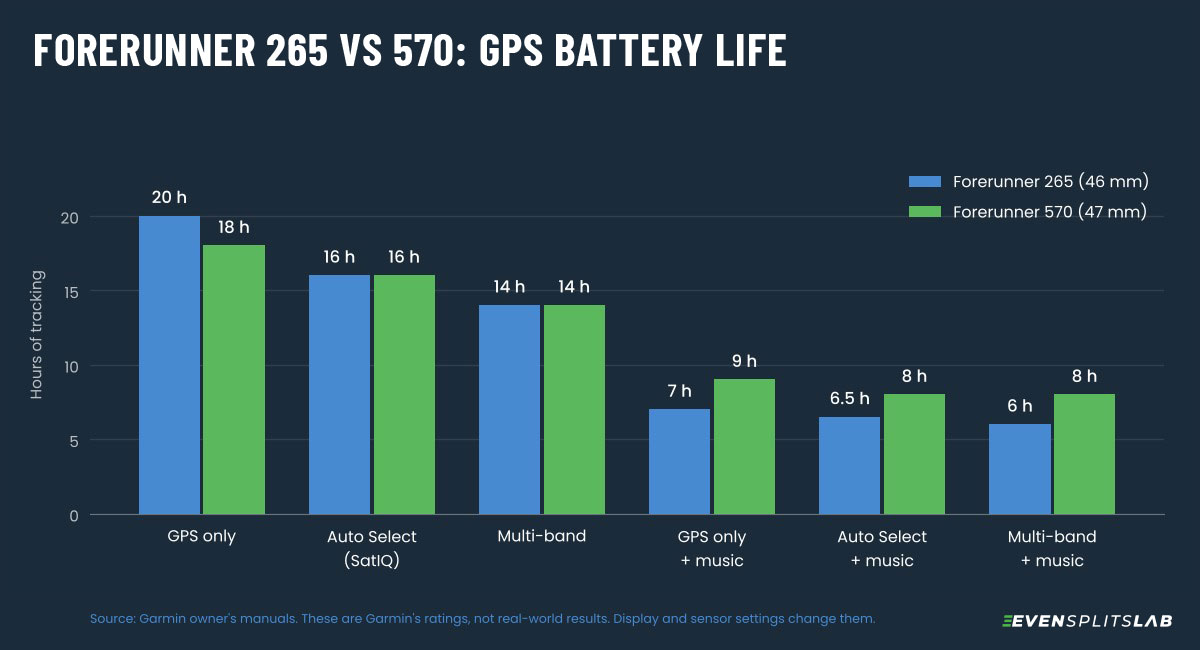
Ratings aren’t real life, so here’s what testers found. With the always-on display on, Wareable’s larger 265 lasted four to five days. Its smaller 570 lasted about three. In Tom’s Guide’s half marathon, the 570 used 6.86% of its battery per hour against 5.54% for the 265. That works out to roughly 14.6 hours versus 18 hours of tracking.
The music numbers flip. With offline music, the 570 gets roughly two more hours than the 265 in every GPS mode. If you run with a playlist most days, that’s a real point for the 570.
Long-course athletes, pay attention. Both watches are rated for up to 14 hours in full multi-band mode. A slower full Ironman can run past that. On either watch, Auto Select gets you up to 16 hours, and GPS only gets you up to 20 on the 265 or 18 on the 570. Pick your mode before race morning, not at kilometre 150.
Forerunner 265 vs 570 Price: What the Upgrade Costs
At list price, the 570 costs about CA$140 more.
Forerunner 265
About CA$660
About US$450
Forerunner 570
About CA$800
About US$550
Those are list prices from Canadian retailers and Garmin’s US launch pricing, so check before you buy. The 265 also gets discounted often, so the real gap is usually bigger. That’s where this gets interesting for upgraders.
If you want to see what the 570 costs today, check the current price on Amazon. That’s an affiliate link. As an Amazon Associate, I earn from qualifying purchases.
Say you sell your 265 for CA$250. That number is made up, so check your local listings. The real cost of the upgrade is then about CA$550. Is a bigger screen, call handling and Triathlon Coach plans worth CA$550 to you? For most people I’d say no. A chest strap and a new pair of shoes will probably do more for your running.
Which One Should You Get?
Should you upgrade from a 265?
For most people, no. Upgrade if two or more of these sound like you:
- You want to take calls or use voice commands from your wrist.
- You’re a triathlete and you want Garmin Triathlon Coach plans and multisport workouts.
- You run with offline music most days.
- You’d notice a brighter, bigger screen.
- Your 265’s battery has worn down and you’re replacing the watch anyway.
Hold onto the 265 if your main reason is GPS or heart rate accuracy. Those gaps are small.
Buying your first serious running watch?
Let the price gap decide. This is my rule of thumb, not a formula. If the gap is about CA$100 or less, get the 570. You get the newer sensor, the better screen and a watch on Garmin’s current software track. If the 265 is CA$200 or more cheaper, get the 265 and spend the difference on shoes or a chest strap. In between, it’s close. Battery life nudges it to the 265, and music nudges it to the 570.
If neither price works for you, check our roundup of the best budget running watches.
Want maps or ECG?
Then neither of these is your watch. Wareable points owners who want offline maps, better battery or deeper running insights to the Forerunner 970, and gives the older 965 a nod too. The 970 also has the ECG app the 570 dropped.
FAQ
The battery gap is bigger on the small sizes. Garmin rates the 265S for up to 24 hours GPS only and 15 days as a smartwatch. The 570 42 mm is rated for up to 18 hours and 10 days. The 570 42 mm has a slightly bigger screen, 1.2 inches against 1.1, and weighs 42 g against 39 g.
Maybe some of the software ones. Garmin does push features to older watches, but it doesn’t say in advance which. Hardware can’t be updated. The speaker and mic, the Gen 5 heart rate sensor and the skin temperature sensor stay exclusive to the 570.
It’s a bigger jump than 265 to 570. The 255 has an older screen type and no multi-band GPS. The 265 closes most of that gap for less money. The 570 adds the extras above. If the price gap is small, take the 570. If not, take the 265.
Sources
- Garmin Forerunner 570 owner’s manual: battery information
- Garmin Forerunner 265 series owner’s manual: battery information
- Wareable: Garmin Forerunner 570 vs. 265 comparison and upgrade guide
- Tom’s Guide: I ran a half marathon with the Garmin Forerunner 570 vs. Garmin Forerunner 265
- Garmin Rumors: Forerunner 570 vs 265 key differences