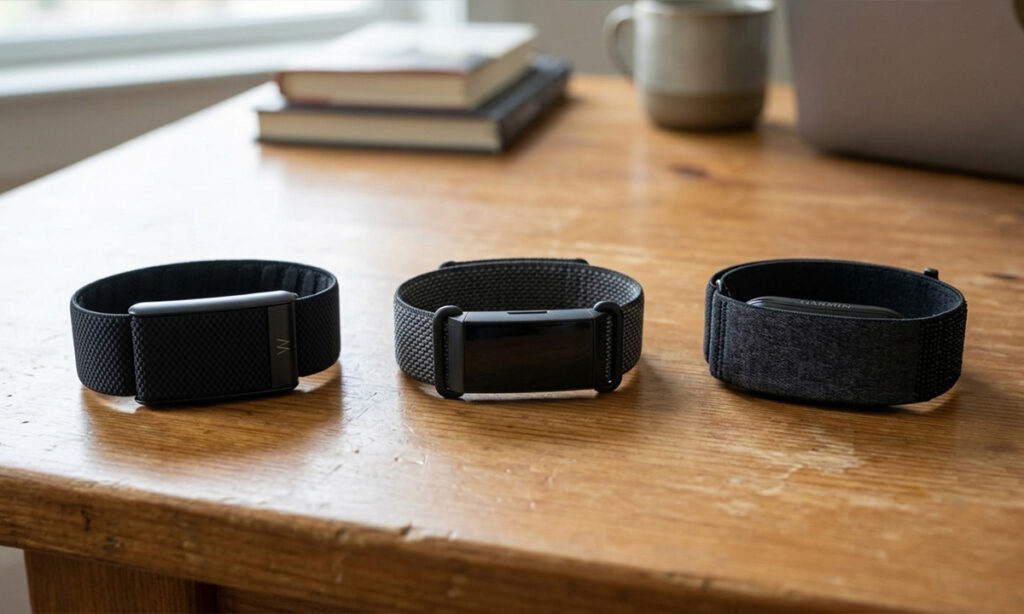
For years the screenless tracker category was basically one product with a subscription attached. That changed fast. Google launched the Fitbit Air in May 2026 at CA$129.99, and Garmin announced the CIRQA Smart Band on 21 July 2026 at CA$279.99, both of them subscription-optional. Whoop now has two direct competitors aimed squarely at the same wrist. For an endurance athlete already wearing a training watch, the useful question in Garmin CIRQA vs Whoop is not which band looks best, it is which one feeds usable data into the system already in use.
TL;DR
All three track continuous heart rate, sleep stages, HRV and a daily readiness score with no screen to look at. None of them have built-in GPS. The differences that matter show up in what the band can do during a workout rather than overnight, and in what the total bill looks like by year three.
Key takeaways
- CIRQA costs CA$279.99 once. Whoop costs CA$259 to CA$529 every year, with the hardware included in that price.
- Fitbit Air is the cheapest at CA$129.99 and the lightest at 12 g, but it is the most phone-dependent of the three.
- CIRQA and Whoop can both broadcast live heart rate to other devices. CIRQA does it over ANT+ and Bluetooth, Whoop over Bluetooth only.
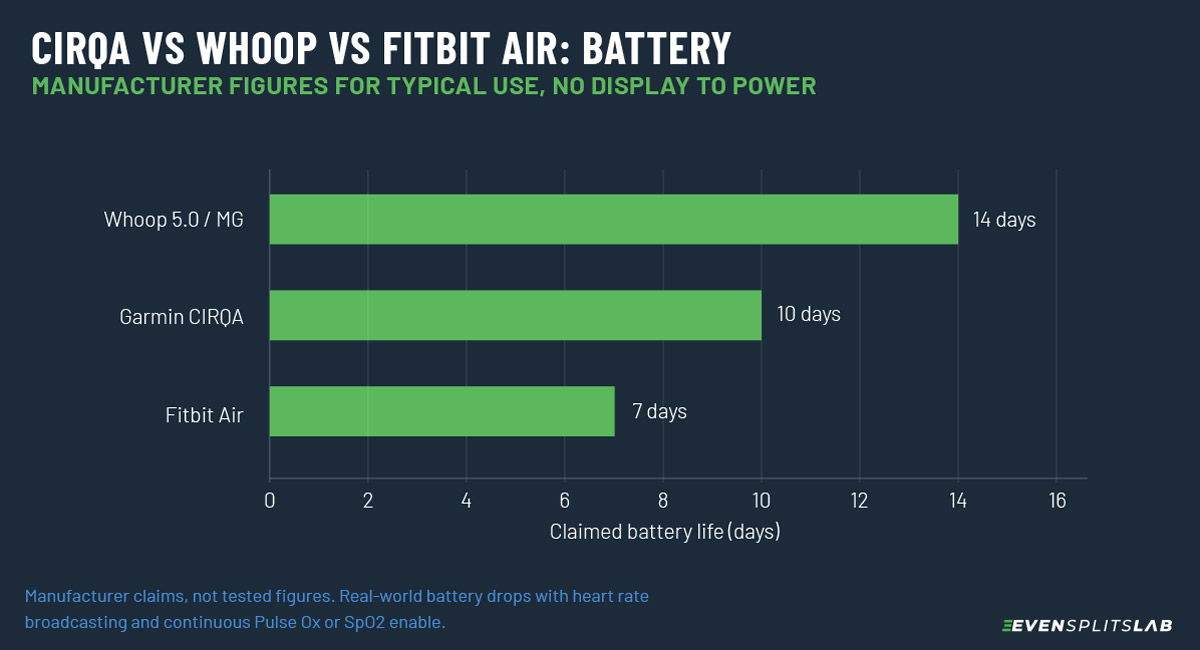
- Battery claims run 14 days for Whoop, 10 for CIRQA, 7 for Fitbit Air.
- None of these replaces a GPS watch. All three are designed to sit alongside one.
What a screenless band actually does
The pitch is the same across all three brands: wear it 24/7, including in bed, and let it build a continuous physiological record instead of the partial one a watch collects between charges. No display means no notifications, longer battery and a smaller module. It also means every number lives in a phone app.
What none of them do is record a route. There is no GPS chip in any of the three. Distance and pace come from the phone in a pocket, which works for a steady road run and works poorly for anything else. If distance and pace are the point, that is still a watch job, and the GPS watch comparison for triathletes covers the options there.
Garmin CIRQA at a glance
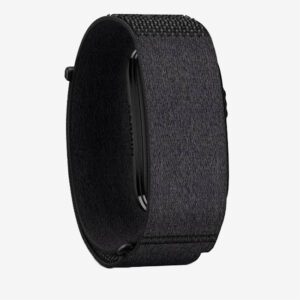
CIRQA is Garmin’s first screen-free band. A single side button, a multicolour LED and haptics handle everything on the wrist, with the rest living in Garmin Connect. The metrics will be familiar to any Garmin watch owner: Body Battery, HRV Status, sleep score with stages, Pulse Ox, stress, respiration, skin temperature, Training Readiness, Training Status and VO2 max estimates. At 20 g and rated 5 ATM, the module can sit on the wrist or move up to the upper arm on a separate accessory band. Orders open on 24 July.
Two details stand out. First, the optical sensor is Garmin’s Elevate Gen 4, not the Gen 5 array in its higher-end watches, which is why there is no ECG. Second, CIRQA broadcasts heart rate over both ANT+ and Bluetooth to third-party devices and apps, which is a bigger deal for triathletes than the spec sheet suggests.
Fitbit Air at a glance
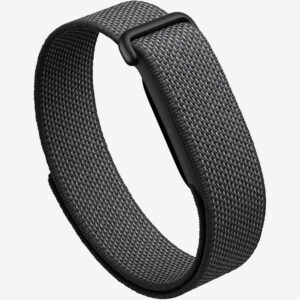
Fitbit Air is the smallest and cheapest of the three: a 5.2 g pod on an 18 mm band, 12 g all in, 5 ATM, up to seven days of battery and a five-minute charge that buys a day of use. It tracks 24/7 heart rate, SpO2, HRV, breathing rate, skin temperature variation, sleep stages with a sleep score, Cardio Load, a Readiness Score and AFib detection during stillness and sleep.
It has no buttons at all, which is elegant until a workout starts and there is nothing to press. Activity detection is automatic, and route data comes from the phone. Core tracking is free. The Gemini-powered Google Health Coach sits behind Google Health Premium, priced at CA$9.99 a month or CA$99 a year, with three months included.
Whoop 5.0 and MG at a glance
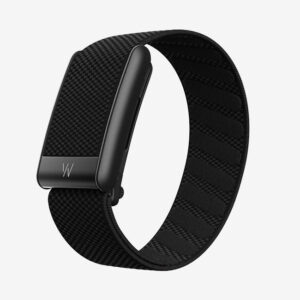
Whoop still sells a membership rather than a device. One is CA$259 a year and ships the 5.0 with a wired charger. Peak is CA$349 a year and adds Healthspan, Health Monitor, Stress Monitor and the wireless PowerPack. Life is CA$529 a year and ships the MG hardware with ECG and Blood Pressure Insights. The sensor samples 26 times a second, battery is rated at 14 or more days, and the pod is IP68 rated to 10 m for two hours.
The wear-anywhere ecosystem is the part competitors have not matched. Whoop Body apparel puts the same pod on a bicep, torso or calf, and the bicep position is generally more reliable for optical heart rate than the wrist during hard efforts.
Specs side by side
The full picture in one place, then the parts that actually change a training decision.
| Spec | Garmin CIRQA | Fitbit Air | Whoop 5.0 / MG |
|---|---|---|---|
| Price | CA$279.99 once | CA$129.99 once | Annual membership |
| Subscription | Optional (Connect+) | Optional (Premium) | Required |
| Battery | Up to 10 days | Up to 7 days | 14+ days |
| Water | 5 ATM | 5 ATM | IP68, 10 m / 2 hr |
| Weight | 20 g | 12 g with band | Not published |
| Accessories | Arm band sold separately | Bands from CA$64.99 | Whoop Body apparel |
| GPS | Phone only | Phone only | Phone only |
| HR sensor | Elevate Gen 4 | Optical + red/IR | 26 Hz sampling |
| Broadcast | ANT+ and BLE | No | BLE only |
| Controls | One side button | None | None |
| Wear sites | Wrist or upper arm | Wrist | Wrist, bicep, torso, calf |
| App | Garmin Connect | Google Health | Whoop |
One row from that table is worth pulling out. Battery life is the whole argument for a screenless band, because a tracker that comes off the wrist every second night is not collecting a continuous record of anything.
Heart rate: what an optical sensor can and cannot do
All three use wrist-based optical sensing, and all three inherit the same limitations. Optical heart rate is usually solid at rest and during steady aerobic work. It degrades when heart rate changes quickly, when cadence lands close to heart rate and the sensor locks onto the wrong signal, and in cold weather when peripheral blood flow drops. That is why an easy run can produce a heart rate trace nobody believes, which is covered in why your heart rate is so high on easy runs.
For zone work, the practical answer has not changed: a chest strap is still the reference for intervals, and these bands are for the other 23 hours. Getting the zones themselves right matters more than the sensor, which is where how to read your heart rate zones comes in.
CIRQA has been announced but not independently tested. Nobody has published accuracy data against a chest strap yet, and any launch-day claim about how it compares should be treated as unverified until that testing exists.
The feature that separates them
Heart rate broadcasting is the line in the sand. CIRQA transmits over ANT+ and Bluetooth, so it can feed a bike computer, a treadmill, Zwift or a Garmin watch directly. Whoop broadcasts over Bluetooth Low Energy only, to one receiver at a time, and getting it onto older ANT+ only equipment requires a third-party bridge. Fitbit Air does not offer heart rate broadcasting at all.
For a triathlete this decides the use case. A band that broadcasts can go on the upper arm during a ride and send live heart rate to an Edge while the wrist stays free. A band that does not broadcast is a recovery and sleep tool that happens to notice workouts afterwards.
Recovery metrics: three different dialects
Each platform turns the same raw inputs into a differently named daily number. Garmin gives Body Battery and Training Readiness. Whoop gives Recovery and Strain. Fitbit Air gives a Readiness Score and Cardio Load. The underlying signals overlap heavily: overnight HRV, resting heart rate, sleep duration and quality, recent training load.
The scores are not interchangeable, and comparing a Whoop Recovery of 62 to a Body Battery of 62 is meaningless. What matters is picking one and reading its trend over weeks, which is the same argument made in the HRV training guide for endurance athletes. Switching platforms resets the baseline and costs a month or two of useful data.
| Metric | Garmin CIRQA | Fitbit Air | Whoop 5.0 / MG |
|---|---|---|---|
| Sleep stages | Yes | Yes | Yes |
| HRV | HRV Status | HRV trends | Recovery score |
| Readiness | Training Readiness | Readiness Score | Recovery |
| Load | Training Status | Cardio Load | Strain |
| VO2 max | Yes | No | Yes |
| Blood oxygen | Pulse Ox | SpO2 | Yes |
| Skin temp | Yes | Yes | Yes |
| ECG | No | No | MG only |
| AFib alerts | No | Yes | MG only |
| Activities | 80+ | Auto detect | 145+ |
The cost math
This is where the comparison stops being close. CIRQA is a single CA$279.99 purchase that never asks for another dollar. Fitbit Air is CA$129.99, though the AI coaching most of its value rests on costs CA$99 a year on top. Whoop charges every year regardless, so the gap does not just persist, it widens, because the membership is the product.
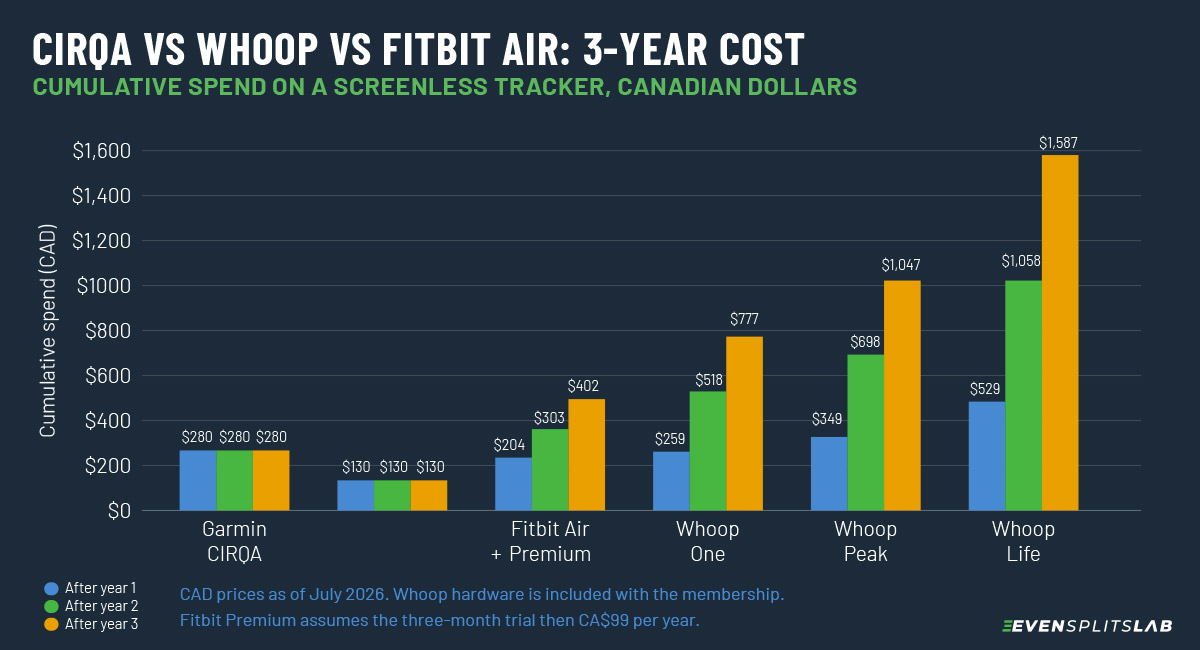
Figures are cumulative CAD. Google Health Premium assumes the three-month trial is used and the annual plan is kept at CA$99 afterwards. Garmin Connect+ is optional and excluded, since nothing in this comparison requires it.
A CIRQA costs less than fourteen months of the cheapest Whoop membership. By year three the same athlete has spent CA$280 on one and CA$777 on the other, for broadly the same overnight data. The Fitbit Air only stays cheap if the coaching subscription is dropped after the trial. Keep it and the Air passes the CIRQA during year two. All figures here are Canadian pricing. For reference, US buyers pay US$199.99 for CIRQA, US$99.99 for Fitbit Air, and US$199 to US$359 a year for Whoop.
Whoop’s defence is that membership includes hardware replacement and free upgrades, so the comparison is not purely device-versus-device. That is a real benefit for anyone who plans to stay for years. It is still true that cancelling a Whoop membership leaves a band that stops working, while a cancelled Garmin Connect+ subscription leaves a band that keeps doing everything it did on day one.
Which one suits which athlete
Already on Garmin: CIRQA is close to a default. Data lands in the same Connect account as the watch, Body Battery and Training Readiness stay continuous overnight instead of restarting each time the watch comes off, and there is no second app to check. The upper-arm option plus ANT+ broadcast also makes it genuinely useful during training, not just around it.
Deep in Whoop already: the case for switching is weaker than the price gap suggests. Years of baseline data, the apparel ecosystem and strength-training analysis do not transfer. The upgrade path is worth more than the CA$497 that switching to a CIRQA would save over three years to some people.
Neither, and mostly curious about sleep: Fitbit Air at CA$129.99 is the low-risk entry, as long as the coaching subscription gets cancelled at the end of the trial. Keep Premium and the three-year total reaches CA$402, which is more than a CIRQA costs outright. It is the most comfortable of the three and the least demanding. It is also the least useful during a workout, and anyone whose real problem is not having a training watch should probably start with the best budget running watches instead.
Working around an injury and training indoors: broadcast capability matters more than usual here, which pushes CIRQA or Whoop ahead. How to keep your fitness while injured covers the training side of that.
Where Each Band Fits
Garmin CIRQA vs Fitbit Air vs Whoop 5.0 / MG
Tap a band in the legend below to hide it and compare the rest
Scores are editorial judgement based on published specifications, scored 1 to 5. Not measured performance. Garmin CIRQA has not yet been independently accuracy tested.
evensplitslab.com
Scores are editorial judgement based on published specifications, not measured performance.
The short version
CIRQA is the best fit for athletes who already train with Garmin and want continuous data without a second ecosystem or a recurring bill. Whoop remains the deepest platform and the most flexible to wear, at a price that compounds every year. Fitbit Air is the most comfortable and cheapest way to answer basic questions about sleep and recovery, and the least capable once training starts. Independent accuracy testing on CIRQA will settle the rest, and that data is a few weeks away.
Sources
- Garmin, “Meet CIRQA Smart Band”, press release, 21 July 2026.
- Google, “Introducing the new Google Fitbit Air”, Google blog, May 2026.
- Whoop membership pages, One, Peak and Life tiers.
- Ray Maker, “Garmin Cirqa Hands-On”, DC Rainmaker, 21 July 2026.