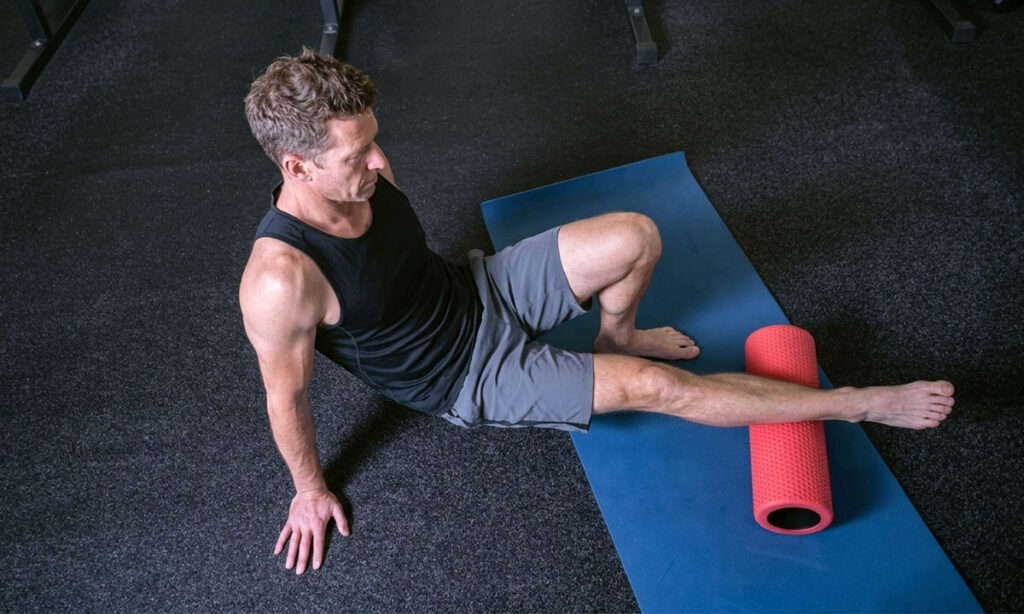
In my early 30s I could skip recovery work for weeks and barely notice. Missed the foam roller, skipped stretching, still hit my paces without much trouble. That doesn’t work anymore. I’m 41 now, training around 12 hours a week, and if I go more than a couple of days without dedicated recovery work, I feel it fast, tight hips, flat legs, easy sessions that suddenly feel laboured. That shift is what got me actually looking into why recovery after 40 works differently, instead of just assuming it does.
TL;DR
Recovery does slow down after 40, but not evenly. It hits hardest after high-intensity or eccentric efforts, not steady endurance work, and staying consistently trained blunts a good chunk of the slowdown. What that actually means for your routine is the more useful question.
Key Takeaways
- Why recovery slows more after hard or eccentric sessions than steady aerobic training
- Why staying consistently trained can blunt some of the age-related slowdown
- What’s actually happening physiologically, in plain terms, not jargon
- What foam rolling and massage guns can and can’t do for recovery, backed by real research
- Where bands and stretching fit before spending money on tools
Why Recovery Changes After 40
Recovery after 40 isn’t just a feeling. There’s real physiology behind it, though it’s less dramatic and more specific than most fitness content makes it sound. As we age, muscle fibres shrink and some are lost outright, and the satellite cells responsible for repairing muscle become slower to activate. Mitochondrial function, the machinery that produces energy inside muscle cells, also declines, and that decline has been linked to how long soreness sticks around. On top of that, anabolic hormone output drops, which affects how efficiently the body rebuilds tissue after training.
Researchers studying this area are upfront that isolating age itself is genuinely hard, since older athletes are also more likely to have gradually reduced their training load over the years, which muddies the picture. Worth keeping that hedge in the copy rather than stating this as settled fact.
It’s Not Even Across All Training
The slowdown isn’t uniform. It shows up clearly after high-intensity or eccentric efforts, think a hard brick session, hill repeats, or heavy strength work, but the research finds little age-related difference in recovery from steady, less damaging aerobic fatigue. Practically, that means an easy zone 2 ride doesn’t need much more recovery buffer at 41 than it did at 31. A hard interval session or a big strength day does.
Staying Trained Helps More Than You’d Think
This is the part that actually matters for a self-coached athlete reading this. Comparisons between trained and untrained middle-aged adults have found that staying consistently trained reduces exercise-induced muscle damage compared to being untrained at the same age. One small study on recreationally active middle-aged adults found they didn’t recover meaningfully slower than younger adults at all. In other words, a lot of what gets blamed on “getting older” may actually be a byproduct of training less, not aging itself. That’s not a free pass, the mechanisms above are real, but it’s a reason not to assume decline is inevitable just because a birthday happened.
What Recovery Actually Looks Like At 41
For me that means dedicated recovery work at least four days a week now. Foam rolling, the massage gun, stretching, bands, whatever the body’s asking for that day. In my early 30s this was optional, something I did when I remembered. At 41, training around 12 hours a week, skipping it isn’t really a choice anymore. My legs let me know within a day or two, and not gently.
None of that means everyone over 40 needs the exact same routine. It means recovery work stops being a nice-to-have and starts being part of the training plan itself, the same way a hard interval session is.
The Gear That Helps
This isn’t a roundup of a dozen products. It’s what I’ve actually used, bought over a few years of trial and error, and what changed when I upgraded.
The Massage Gun Upgrade
My first massage gun was an Aerlang, picked up for around $35 CAD. It’s not sold anymore, but it taught me what I didn’t want in a massage gun. It was clunky, awkward to hold at an angle, and the vibration travelled straight through the handle into my hand. Using it on my own back felt like fighting the device as much as using it.
I replaced it with the BOB AND BRAD Q2 Mini Massage Gun, $74.98 CAD / $62.99 USD. It’s noticeably smaller, which sounds like a downgrade until you’re trying to reach your own hamstring or low back and realise a compact head gets into awkward spots a full-size gun can’t. No hand vibration. Decent power for the size, and it’s small enough that it’s become my actual travel version, not a device I leave at home because packing it is a hassle.
The jump from $35 to $75 isn’t really about power. It’s about whether you’ll actually use the thing, and a device that vibrates your own hand numb is one you stop reaching for.
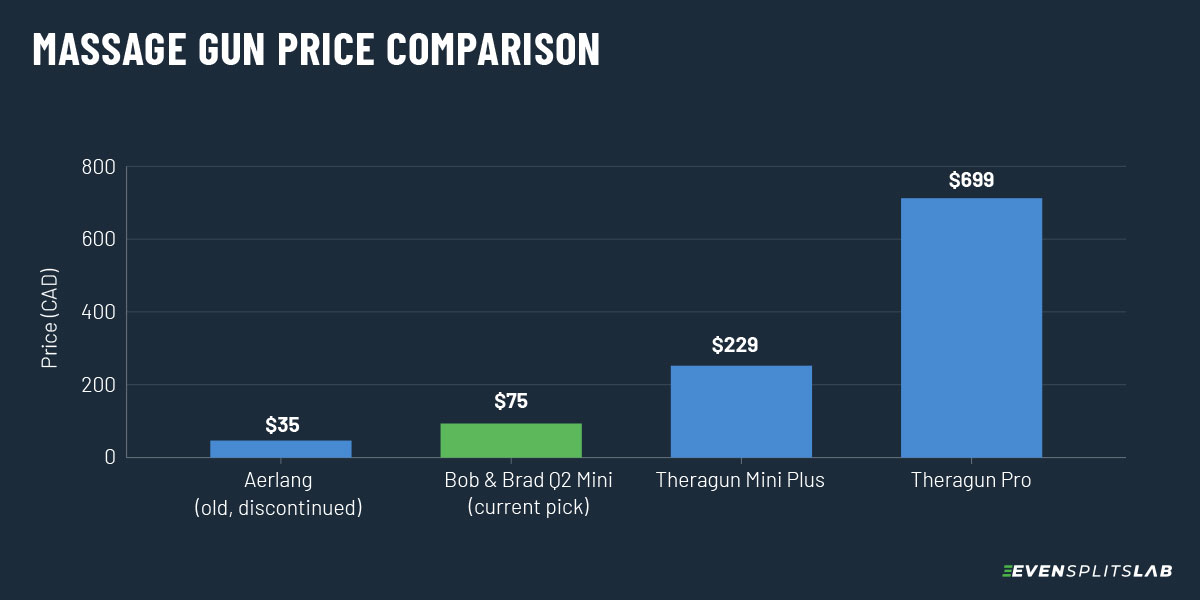
I haven’t used a Theragun, so I can’t tell you how it feels against the Q2 Mini firsthand. What I can tell you from digging through reviews: Theragun’s guns run $229 to $799 CAD depending on the model, they hit deeper amplitude, they’re quieter, and the battery lasts longer. But reviewers who’ve tested both ends of the price range keep landing on the same conclusion: the budget guns deliver most of the actual benefit. You’re paying extra for depth, quiet, and battery life, not a fundamentally better massage. That tracks with the recovery research above, more expensive doesn’t mean more effective, it means more comfortable to use.
Two Foam Rollers, Two Jobs
I use a textured roller and a smooth one, and they’re not interchangeable in practice.
The textured one has ridges built for trigger points, so it’s what I use on tight calves or a stubborn IT band where I want concentrated pressure. The smooth one is for broader passes, quads and lats, where I want even pressure across more surface area rather than digging into one spot. If you’re only buying one, the smooth roller is the more versatile starting point. The textured one is the upgrade once you know where your specific tight spots live.
What the Evidence Says About These Specific Tools
This is the part most product roundups skip, so it’s worth being specific instead of just saying “studies show recovery tools help.”
A 2025 randomized trial of 60 people (published in the Journal of Functional Morphology and Kinesiology) had participants use foam rolling, percussive massage, or just rest after a muscle fatigue protocol. Foam rolling significantly reduced muscle tone and stiffness, and it was the only one of the three that improved muscle elasticity. Percussive massage showed weaker effects on those same markers. Neither foam rolling nor the massage gun beat plain rest when it came to actual pain relief. Both helped the muscle recover its normal function faster. Neither made the soreness hurt less.
That’s a useful distinction. If you’re using these tools hoping they’ll numb the ache, the research doesn’t back that up much. If you’re using them to get your legs functionally recovered faster for the next session, foam rolling in particular has real support.
Massage gun research specifically is newer and more mixed. A few reviews report improvements in flexibility and DOMS with percussive therapy, but the effects on strength and performance are inconsistent across studies, and there’s less head-to-head comparison against foam rolling than you’d expect given how popular massage guns have become.
Practical read: foam rolling has the stronger evidence edge for actual tissue recovery. The massage gun’s real advantage isn’t superior science, it’s that it takes less effort and less time, which matters when the honest alternative is doing nothing.
Bands and Stretching: The Free Tier
Before any of this gear, there’s a cheaper baseline that matters more than either tool: a set of resistance bands and a daily stretching routine. Neither costs $75, and both are part of what I do every day regardless of which tool I reach for after a hard session. Foam rollers and massage guns are the “if you want to spend money” tier, not a replacement for actually moving and stretching consistently.
Foam Roller vs Massage Gun: Which One First
If you’re starting from nothing and past 40, buy the smooth foam roller first. It’s the cheapest entry point, it’s what the evidence favours, and it covers more of your body without needing to aim precisely.
Add a textured roller once you know your specific problem areas well enough to want concentrated pressure there.
Add a massage gun once convenience becomes the deciding factor, travel, limited time, or areas you genuinely can’t reach with a roller. Spend the extra $40 over the cheapest option on the road. A device that vibrates in your hand is one you’ll stop using within a month, and the whole point of a recovery tool is that you actually use it.
Related Posts
If you’re managing training around a setback, read: How to Keep Your Fitness While Injured.
Sources / References
- Fell, J. & Williams, A.D. The effect of aging on skeletal-muscle recovery from exercise: possible implications for aging athletes. Sports Medicine / PubMed.
- Age-Associated Differences in Recovery from Exercise-Induced Muscle Damage. Cells (MDPI), 2024.
- Journal of Functional Morphology and Kinesiology (2025). Foam Rolling or Percussive Massage for Muscle Recovery: Insights into Delayed-Onset Muscle Soreness (DOMS).
- Massage gun buyer’s guide and review roundup (2026) — budget vs premium massage gun comparison, cited for the Theragun price/performance context.