
Your friends head out for an easy run and chat their way through 5:30 kilometres. You try the same thing with a heart rate cap and end up at 7:00, watch beeping, feeling like you’re barely moving. It’s easy to assume your zones are broken, or your body is. Usually neither is true. There are a handful of specific reasons your Zone 2 pace is slow right now, and most of them have nothing to do with effort.
TL;DR: A slow Zone 2 pace is usually normal for your current fitness, and a friend’s easy pace tells you almost nothing about yours. Part of the gap is fitness, part is how the zones were built, and part is the day you’re having. One of those can be fixed in about five minutes.
Key takeaways
- A 90-second gap in Zone 2 pace usually reflects a big fitness gap, roughly six minutes over 5K.
- “Zone 2” means different heart rates depending on how the zones were set. A watch default can sit 20+ beats below a lab test.
- Your own Zone 2 pace moves with heat, hills, sleep and route, often by 20 seconds per km or more.
- The only comparison worth making is you against you: same loop, similar conditions, months apart.
- Aerobic progress often shows up first as a lower heart rate at the same pace.
Is a Slow Zone 2 Pace Normal?
Most of the time, yes. A slow Zone 2 pace is simply what Zone 2 looks like at your current fitness. Easy pace scales with how fast you can race. So the quickest sanity check is to compare your Zone 2 pace with your own 5K time, not with someone else’s easy run.
The table below uses Jack Daniels’ VDOT formulas from Daniels’ Running Formula. His easy-running range covers roughly 59 to 74 percent of VO2max, which is wide on purpose. The last column, the middle of that range, is a reasonable starting estimate if you’ve never tested your zones.
| 5K time | Zone 2 pace range | Middle of range |
|---|---|---|
| 20:00 | 4:54 to 5:53/km | 5:27/km |
| 22:00 | 5:22 to 6:26/km | 5:57/km |
| 24:00 | 5:50 to 6:58/km | 6:27/km |
| 26:00 | 6:17 to 7:30/km | 6:57/km |
| 28:00 | 6:44 to 8:01/km | 7:27/km |
| 30:00 | 7:11 to 8:32/km | 7:56/km |
| 32:00 | 7:37 to 9:03/km | 8:25/km |
| 35:00 | 8:17 to 9:48/km | 9:08/km |
Two things stand out. The ranges are wide, around 60 to 90 seconds per km, because easy running isn’t one pace. And every two minutes off your 5K moves the middle of the range by about 30 seconds per km. That adds up fast.
Here’s where I land. My BMO 8K this spring took 39:23, which works out to roughly a 24-minute 5K. The table puts my Zone 2 somewhere between 5:50 and 6:58. My actual Zone 2 runs, capped at a lab-tested 156 bpm, sit right around 5:50. That’s the fast edge, not the middle. I’ll come back to why, because it’s one of the seven reasons below.
7 Reasons Your Zone 2 Pace Is Slow
1. Your friend is fitter than you, and that’s most of the gap
Run the opening example through the table. A 5:30 Zone 2 pace lines up with roughly a 20-minute 5K. A 7:00 Zone 2 pace lines up with roughly 26 minutes. That’s a six-minute gap over 5K. Nobody expects those two runners to race side by side, so there’s no reason their easy runs should match either.
There’s a less comfortable possibility too. Your friend might not be in Zone 2 at all. Plenty of runners call any chatty run “Zone 2,” and a lot of those runs sit in Zone 3. If that sounds familiar, here are the signs your easy runs are too fast, and why the line between Zone 2 and Zone 3 matters more than it looks.
2. Their Zone 2 isn’t your Zone 2
“Zone 2” sounds like one thing. In practice it’s several, depending on how the zones were built. A watch default might use a percentage of max heart rate. Someone else uses heart rate reserve, which factors in resting heart rate. A coach might use lactate threshold heart rate. A lab test measures where your first threshold actually sits. Same label, different numbers.
My own numbers show how far apart these can be. The highest heart rate I’ve recorded recently is 184 bpm, at that 8K. Garmin’s default zones set Zone 2 at 60 to 70 percent of max, which would cap me at about 129 bpm. My lab test caps me at 156. That’s 27 beats of difference for the same person.
At 129 bpm, my Zone 2 would be a walk-jog. At 156, it’s around 5:50/km. That explains why I sit at the fast edge of the table. My measured ceiling is high relative to my max, so my Zone 2 pace is faster than a formula would predict.
This isn’t just my quirk. A 2020 study of 100 people found that fixed percentages of max heart rate line up poorly with where each person’s thresholds actually are. A more recent study in recreational runners put the first lactate threshold at around 80 percent of max heart rate on average, with a lot of spread between people. If you’re unsure how your zones were set, the heart rate zones guide covers the main methods, and a threshold field test gets you much closer than any formula.
3. Your max heart rate is a guess, or your sensor is
If your zones come from 220 minus your age, they’re built on a population average. For some people that formula is off by 10 to 20 beats in either direction. Set it too low, and every zone shrinks with it. Your “Zone 2” becomes a Zone 1 shuffle.
The sensor matters too. Wrist optical heart rate can lock onto your cadence and read high, especially early in a run or in cold weather. If your heart rate spikes for no reason and you slow down to chase it, your pace takes the hit. I compared both in the wrist HR vs chest strap test. For Zone 2 work, a chest strap is usually worth it.
4. Your aerobic engine is still under construction
This is the reason people want to hear, and it’s real. Here’s what more than two and a half years did to one loop of mine. Same route, nearly the same pace. February 2024 against October 2026.
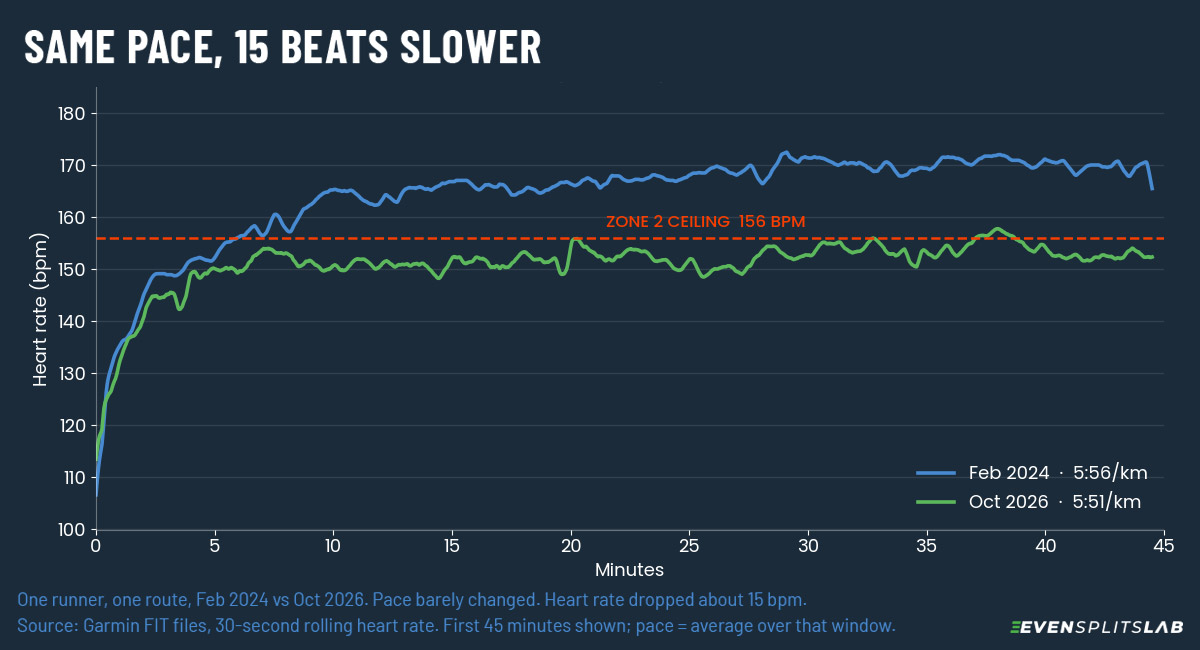
Over the first 45 minutes, the 2024 run averaged 5:56/km and the 2026 run 5:51/km. After the warm-up, heart rate averaged about 168 bpm in 2024 and about 153 in 2026. Roughly 15 beats lower, going slightly faster.
Narrow it down to every full kilometre run between 5:40 and 6:20/km on that loop, and the split gets even cleaner.
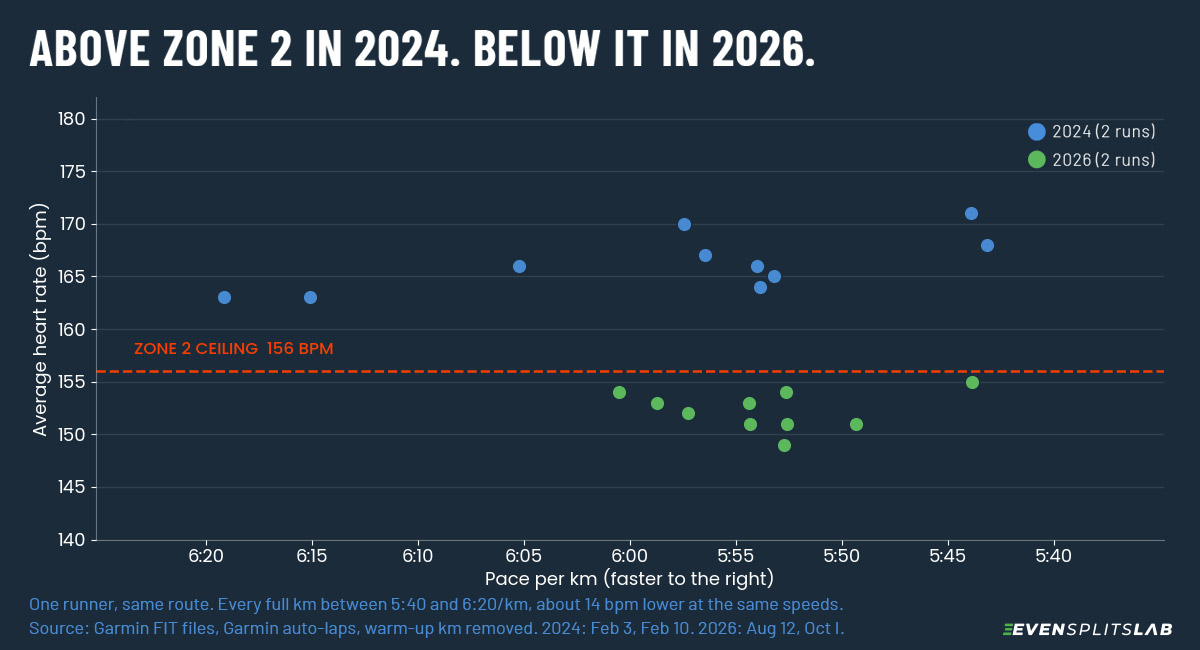
In 2024, not one full kilometre on that loop came in under 156 bpm. At matching paces, the gap averaged about 14 beats. Even at 6:19/km, my heart rate sat at 163. So my Zone 2 pace back then was somewhere slower than 6:20, probably a lot slower. None of these runs went slow enough to find out.
A couple of honest caveats. Two and a half years includes a lot of training, not just Zone 2. And the 2024 runs were in February, so cool weather was on their side. If anything, that makes the gap more convincing, not less. The practical point: aerobic progress showed up first as a lower heart rate at the same pace. The faster Zone 2 pace comes after.
How long it takes varies a lot. As the high heart rate on easy runs post covers, most people notice something within 6 to 12 weeks of consistent easy running. Mine was a much longer game than that.
5. Slow running is awkward running
Running slowly is its own skill. At 7:00/km a lot of people’s form falls apart. They overstride, slap their feet, and let cadence drop. That wastes energy, and wasted energy costs heartbeats. Newer runners usually feel this most. A moderate pace feels smooth, and anything slower feels clumsy.
In my case, this wasn’t the story. At matching paces, my cadence and ground contact time were nearly identical in 2024 and 2026, around 173 steps per minute and 260 milliseconds. The mechanics stayed about the same. The heart rate needed to drive them dropped. For a newer runner, though, economy can be a big piece of the gap. A short run-walk is a perfectly respectable fix.
6. Heat, hills and drift
Your Zone 2 pace isn’t a fixed number even for you. On a steady run, heart rate tends to creep up as you warm up and lose fluid. That’s cardiac drift. Heat and hills speed it up.
Fluid loss alone does more than most people expect. In one older lab study, losing about 1 percent of body weight in fluid raised heart rate by about 10 beats at the same workload. Losing about 3 percent raised it by about 18. That was in a mild 21°C room. Knowing your sweat rate helps on longer easy days.
My own files show how noisy single runs are. On August 12 I ran my usual loop at 5:55/km, averaging 150 bpm. On August 29, on a different route, I ran 5:27/km at 146 bpm. That’s nearly 30 seconds per km faster at a lower heart rate, less than three weeks apart. I can’t fully explain it. Different route, different time of day, different everything. That’s exactly why one run tells you very little.
7. You’re carrying fatigue
Yesterday’s intervals, a short night, a stressful week or a cold that hasn’t shown up yet. All of these can push heart rate up at the same pace, which drags your Zone 2 pace down. If your easy pace suddenly falls off for a few days, fatigue is the first suspect. A morning HRV trend can help you spot it before the run does.
How to Track Your Zone 2 Pace Without Fooling Yourself
Stop comparing with other people and start comparing with yourself. The setup that worked for my charts is simple.
Pick one loop that’s mostly flat and run it regularly. Try to run it at a similar time of day. Ignore the first 10 minutes, since heart rate is still settling. Then pick one of two measures and stick with it: your pace at your Zone 2 ceiling, or your heart rate at a fixed pace. The second one is easier because you don’t have to hold the ceiling exactly.
Look at months, not weeks. A two-week comparison mostly measures the weather.
When a Slow Zone 2 Pace Is Worth Questioning
Most of the time, a slow Zone 2 pace is just fitness plus conditions. A few patterns are worth a closer look. Your heart rate hits your Zone 2 ceiling while walking, run after run, even with a chest strap. Nothing has changed after three or four months of consistent easy running. Or your heart rate at your normal easy pace jumps suddenly and stays up.
In those cases, retest your zones first. If you get chest pain, dizziness, unusual breathlessness or a racing heartbeat that doesn’t settle, skip the troubleshooting and see a doctor.
Check your Zone 2 before you judge your pace
Our HR Zone Finder builds your zones from your real max heart rate or lactate threshold, not your age. It takes about a minute.
Questions People Also Ask
Is it OK to walk to stay in Zone 2?
Yes. If running at your Zone 2 ceiling isn’t possible yet, a run-walk keeps the effort where it should be. As your fitness improves, the walk breaks tend to shrink on their own.
Is my Zone 2 pace different on a treadmill?
It can be. There’s no wind or terrain, but heat builds up indoors and heart rate may drift more. Compare treadmill runs with treadmill runs, and outdoor runs with outdoor runs.
Is Zone 2 heart rate the same for cycling?
Usually not. Most people hold the same effort at a lower heart rate on the bike. Here’s why Zone 2 differs for running and cycling.
Sources
- Daniels, J. Daniels’ Running Formula. Human Kinetics. VDOT easy-pace ranges used for the 5K table.
- Iannetta D, et al. (2020). A critical evaluation of current methods for exercise prescription in women and men. Medicine & Science in Sports & Exercise, 52(2), 466 to 473. doi.org/10.1249/MSS.0000000000002147
- The accuracy of fixed intensity anchors to estimate lactate thresholds in recreational runners. PubMed Central
- Heaps CL, González-Alonso J, Coyle EF (1994). Hypohydration causes cardiovascular drift without reducing blood volume. International Journal of Sports Medicine, 15(2), 74 to 79. doi.org/10.1055/s-2007-1021023
- Garmin owner’s manual, heart rate zone calculations. garmin.com