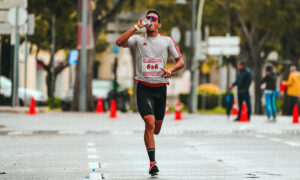
You’re somewhere on the run course. Your legs feel like wet cement, or maybe one calf just locked up so hard you had to stop moving. Either way, something has gone badly wrong. These are two of the most common ways a triathlon falls apart — bonking and cramping — and a lot of athletes either confuse them or treat them the same way. Understanding the difference between bonking and cramping is the first step to actually fixing the problem.
TL;DR
Bonking is a fuel problem. Your body has run out of available carbohydrates. Cramping is most likely a combination of fatigue and neuromuscular overload, possibly worsened by dehydration or electrolyte loss. They feel different, they have different causes, and they need different fixes.
Key Takeaways
- Bonking and cramping are not the same thing and require different responses
- Bonking is caused by depleted glycogen; cramping is caused by muscle fatigue and neuromuscular misfiring
- You can largely prevent bonking with a solid fuelling plan
- Cramping is harder to fully prevent, but pacing, fitness, and training load all play a role
- Knowing which one you’re dealing with mid-race helps you make better decisions on the spot
What Is Bonking?
Bonking (also called hitting the wall) happens when your body runs out of readily available carbohydrates to burn. Your muscles and your brain both run on glucose. When blood glucose drops and glycogen stores are depleted, things go sideways fast.
You won’t mistake it for anything else. Your legs feel hollow, your pace drops off a cliff, and your brain goes fuzzy in a way that’s hard to describe until you’ve been there. I’ve had it happen on the ride home after a long training session — nothing dramatic, just a sudden heaviness and a drop in energy that made the last few kilometres feel like the first time I’d ever been on a bike. It feels less like fatigue and more like someone turned the power off.
Bonking is most common in longer events (Olympic distance and above) but it can happen in a sprint if you went in underfuelled or pushed too hard on the bike. It’s almost entirely preventable with the right plan.
Why It Happens
Your body stores carbohydrate as glycogen in your muscles and liver. At race intensity, you burn through it faster than you might expect. A typical athlete has roughly 90 to 120 minutes of glycogen at moderate-to-hard effort before stores start running low. Add a hot day, a hard swim, or going out too fast on the bike, and you can hit that ceiling earlier.
Once glycogen runs low, your body has to rely more heavily on fat for fuel. Fat oxidation is slower and less efficient at race intensity, which is why your pace tanks rather than just gradually dropping.
How to Fix It Mid-Race
If you’re bonking mid-race, the fix is simple but slow: take in carbohydrates immediately. Gels, sports drink, cola at the aid station. Your body can’t instantly replenish depleted glycogen, so you won’t feel like yourself again for 10 to 15 minutes. The goal is to stop the freefall, not to reset to fresh legs.
Slow down. Reduce your effort enough that your body can use the incoming fuel more effectively. Pushing through a bonk without fuelling just makes it worse.
How to Prevent It
Start fuelling early, not when you feel like you need it. By the time you feel hungry or empty, you’re already behind. For anything over 60 to 75 minutes, you should be taking in carbohydrates from the first 20 to 30 minutes onward.
General guideline: 30 to 60g of carbohydrate per hour for most recreational athletes. Some people can train their gut to handle more. Figure out what works for you in training, not on race day.
What Is Cramping?
A cramp is an involuntary muscle contraction that won’t release. It can be a dull ache that builds over a few kilometres or a sudden, violent seize-up that stops you mid-stride. Calves and hamstrings are the most common culprits in triathlon, but any muscle under prolonged load is a candidate.
Cramping has been blamed on dehydration and electrolyte loss for decades. That explanation is probably incomplete. The more current thinking in sports science is that cramping is primarily a neuromuscular issue: the nerves controlling a fatigued muscle start misfiring. Dehydration and electrolyte loss may worsen the problem, but they’re not usually the root cause.
The short version: if you cramp, you probably went harder than your training prepared you for, or the muscle was already under too much cumulative stress.
Why It Happens
Muscle fatigue disrupts the normal balance between nerve signals that tell a muscle to contract and signals that tell it to relax. When that balance tips, especially late in a race or after a long climb, the muscle can lock into a contraction it can’t exit.
Contributing factors include high intensity relative to fitness level, unusual muscle demands (a hilly course when you trained flat), heat stress, poor pacing early in the race, and cumulative fatigue across the swim-bike-run.
Electrolyte depletion, particularly sodium, can lower the threshold at which this happens. It’s worth addressing, but adding salt tablets won’t reliably prevent cramping if the underlying issue is going out too hard.
How to Fix It Mid-Race
Slow down or stop briefly. Gently stretch the affected muscle. For a calf cramp, flex your foot upward. Don’t force it; forcing a full stretch on a cramping muscle can pull something.
Once the cramp releases, ease back into your pace gradually. The muscle will likely be sore and more cramp-prone for the rest of the race.
How to Prevent It
The most reliable prevention is race-specific fitness. If your race involves hills, train on hills. If your race is long, your long training sessions need to reflect that. Cramping late in a race is often your body sending feedback about training gaps.
Pacing is the other big lever. Most race-day cramping happens because athletes pushed too hard early. A conservative start on the bike preserves the muscle integrity you need for the run.
Stay on top of fluid and sodium intake throughout the race, particularly in heat. It won’t make you cramp-proof, but it removes one contributing variable.
How to Tell Them Apart
Here’s the honest difference between the two:
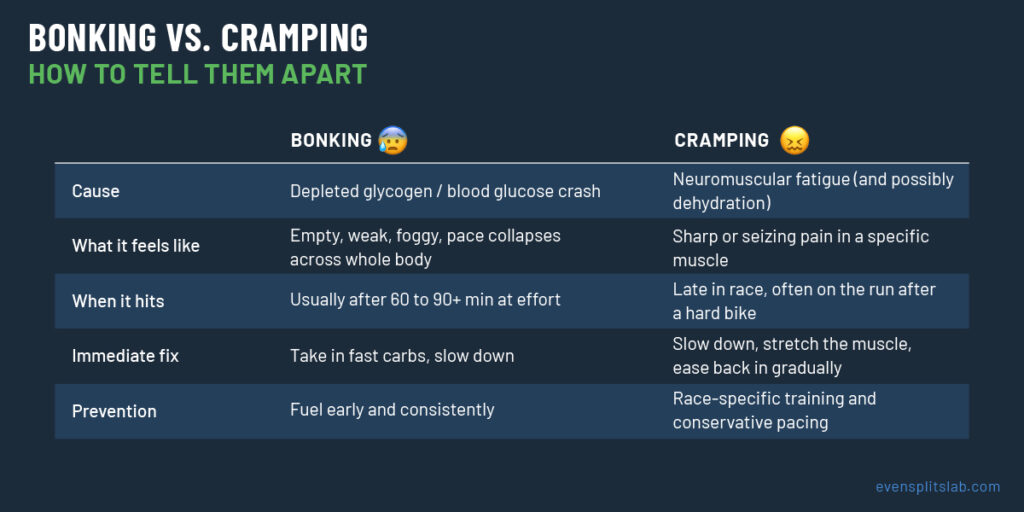
You can also have both in the same race, which is a special kind of fun. A bonk that causes you to slow dramatically can shift the muscular load in a way that triggers cramping. If everything is going wrong at once, address the fuel first. It’s the one you have more immediate control over.
The Bigger Picture
Both bonking and cramping are your body giving you information. Bonking usually means your fuelling plan was inadequate or your pacing was too aggressive. Cramping usually means your fitness wasn’t quite matched to what the race demanded.
Neither is a failure. Both are fixable. And the fix for each is different enough that it’s worth knowing which one you’re dealing with.
Race-day nutrition is where most people have the most immediate room to improve. If you’ve bonked before and aren’t sure where to start, the Fuel Strategy Calculator can give you a concrete starting point based on your event and finish time.
FAQ
A: Yes. A severe bonk that slows your pace drastically can shift muscular load in a way that triggers cramping, particularly in the calves and hamstrings. If both happen at once, address the fuel first. Eat or drink fast carbs, slow down, then deal with the cramp once your energy is stabilising.
A: Not usually. Current research points to neuromuscular fatigue as the primary cause: fatigued muscles begin misfiring rather than simply being low on fluids or electrolytes. Dehydration and low sodium can lower your cramp threshold, but they’re rarely the root cause on their own.
A: Bonking has a distinct quality. It’s a sudden, systemic collapse in power and mental clarity, not just general tiredness. If your legs feel empty and hollow across the board and your brain is foggy, that’s more likely a bonk. If one specific muscle is seizing or aching, that’s a cramp. General fatigue late in a race is neither; it’s just the race being hard.
A: There’s decent research supporting pickle juice as a fast-acting cramp remedy. It appears to work through the nervous system rather than electrolyte replenishment, triggering a reflex that reduces the misfiring signals to the cramping muscle. A small amount (roughly 50 to 75ml) seems to be enough.
A: The common guideline is 30 to 60g of carbohydrate per hour for most recreational athletes, starting in the first 20 to 30 minutes. For longer events, some athletes can train up to 90g/hr. Use the Even Splits Lab Fuel Strategy Calculator to build a plan specific to your distance and expected finish time.
Related Posts
If you’re working on your race-day fuelling, read: What to Eat Before your First Sprint Triathlon
For hydration specifics, read: How to Calculate Your Sweat Rate at Home
If you’re building your training base, read: How to Read Your Heart Rate Zones (and Why Most People Get Them Wrong)
Sources / References
- Miller KC, McDermott BP, Yeargin SW, Fiol A, Schwellnus MP. An Evidence-Based Review of the Pathophysiology, Treatment, and Prevention of Exercise-Associated Muscle Cramps. Journal of Athletic Training. 2022;57(1):5–15.
- Podlogar T, Wallis GA. New horizons in carbohydrate research and application for endurance sports. Sports Medicine. 2022;52(Suppl 1):5–23.
- Berjisian E et al. Carbohydrates and Endurance Exercise: A Narrative Review of a Food First Approach. Nutrients. 2023;15(6):1367.
- Shang G, Collins M, Schwellnus MP. Factors associated with a self-reported history of exercise-associated muscle cramps in Ironman triathletes: a case-control study. Clinical Journal of Sport Medicine. 2011;21(3):204–10.