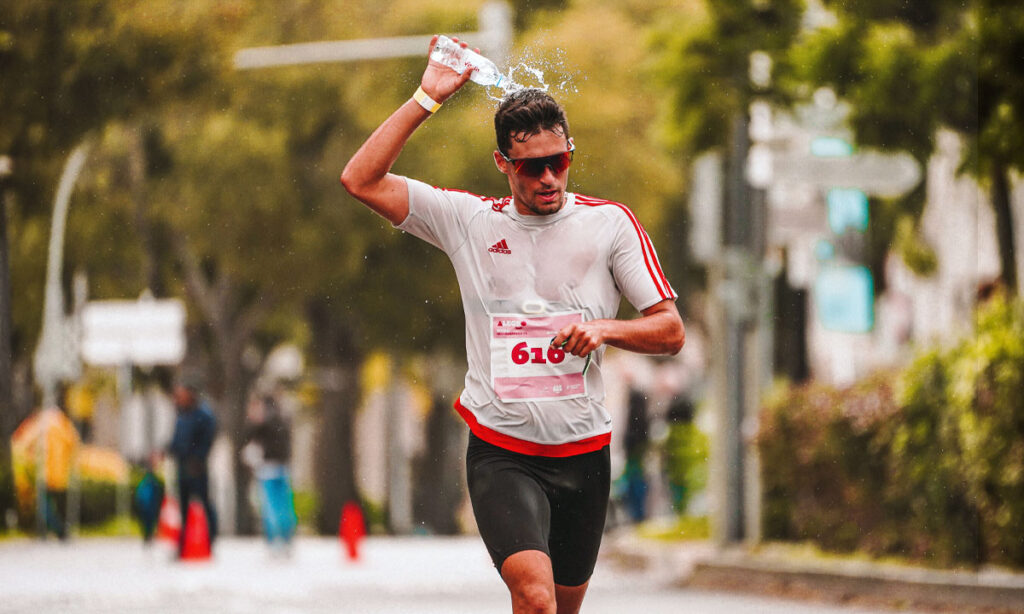
You trained through the winter, locked in your pacing targets, built your nutrition plan, and have a finishing time in your head. Then race day arrives and it’s 30 degrees before 9am. None of the numbers you planned around work anymore. The effort feels wrong, your stomach is less cooperative than usual, and you’re burning through fluid faster than you can replace it. This isn’t a fitness problem. It’s a hot weather triathlon nutrition and pacing problem. It has specific solutions.
TL;DR
Heat forces your body to work harder at the same pace, burns through carbohydrates faster, and makes digestion less reliable. You need more fluid, more sodium, and a more conservative early effort. You also need to front-load your nutrition before gut function drops off later in the race. Adjust your plan before the gun, not after you’re already struggling.
Key Takeaways
- Heart rate will climb at your normal training pace. That’s normal, not a sign to push harder.
- Your body burns carbs faster in the heat, which means bonking risk goes up even if you’re eating the same as always.
- Sweat rate increases significantly. Your usual fluid intake probably won’t cover it.
- Digestion slows in hot conditions. Eat early and often, rather than waiting until you’re hungry.
- RPE (how hard it feels) is a more reliable guide than pace or heart rate when it’s hot.
Why Heat Makes Everything Harder
The short version: your body is doing two jobs at once. It’s trying to power your race and cool itself down at the same time. Those two jobs compete for the same resources.
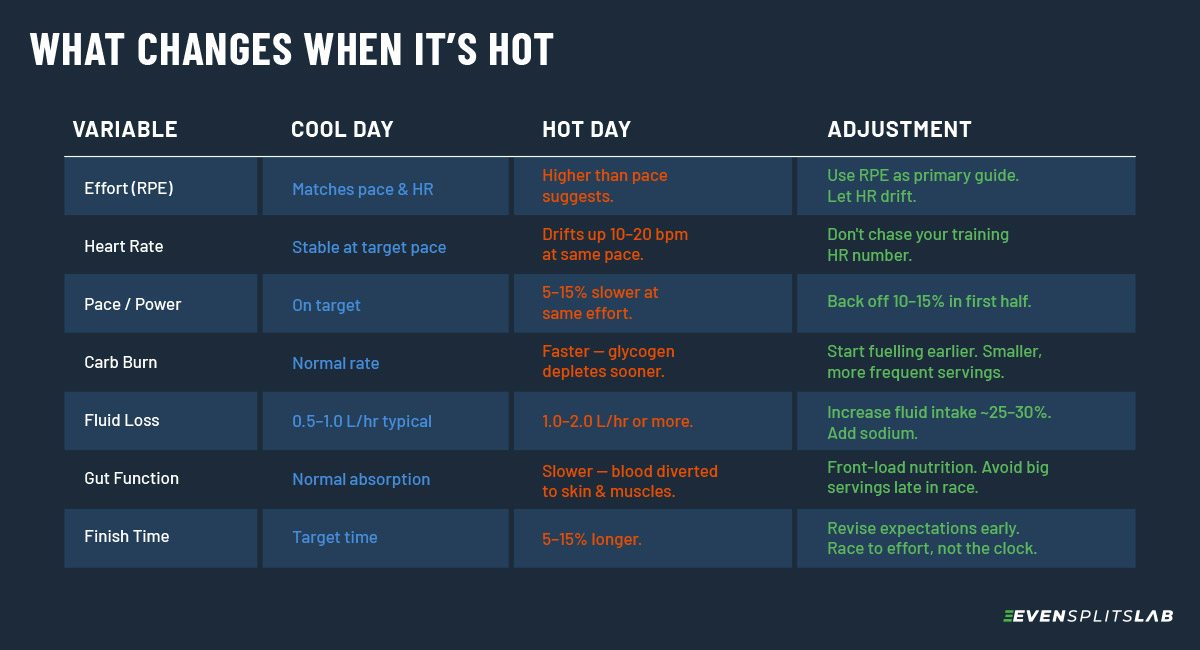
When your core temperature rises, your body routes more blood to the skin to release heat through sweat. That’s less blood going to your working muscles. Your heart has to beat faster to compensate, even if your pace stays exactly the same. This is called cardiac drift, and it happens to everyone in the heat. Your heart rate climbs, your perceived effort rises, and if you’re using power or pace to guide your effort, the numbers stop reflecting what’s actually happening inside your body.
The practical problem: if you’re targeting a specific heart rate zone, it’ll feel harder to stay there. If you’re targeting pace, holding it will cost you more than it should. Either way, you end up working harder than your race plan intended. That has downstream effects on your nutrition.
A useful reference for understanding this: the post on heart rate zones explains how zones shift with effort and fatigue. In the heat, the same concept applies: your zones don’t change, but reaching them takes less work than usual.
What Heat Does to Your Fuel
Here’s the part that trips people up: heat doesn’t just make you sweat more. It changes how your body burns fuel.
A 2025 meta-analysis from Loughborough University found that exercising in hot conditions increases carbohydrate oxidation compared to exercising in temperate conditions. In plain terms: your body burns through its carbohydrate stores faster when it’s hot, even at the same pace. That raises the bonking risk significantly, especially in longer events.
At the same time, blood gets diverted away from your digestive system to help with cooling. Your gut becomes less efficient at absorbing what you’re eating. The practical result is that you need more fuel but your body is less able to process it. This is especially true later in the race when heat stress compounds.
The adjustment: eat earlier than you normally would, and keep portions smaller and more frequent. Don’t wait until you feel hungry. By the time hunger hits in the heat, you’re usually already behind.
For more on what happens when fuelling goes wrong, the post on bonking vs. cramping covers the difference between the two and how to identify which one you’re dealing with mid-race.
What Heat Does to Your Hydration
Sweat rate varies a lot between individuals. Genetics, fitness level, heat acclimatisation, and body size all play a role. But the direction is consistent: hot conditions push sweat rate up, sometimes dramatically.
Here’s a personal example. Earlier this year, a trip to Brazil in midsummer (27 degrees Celsius at 6am) made every run feel like a different sport entirely. Keeping heart rate in Zone 2 on an easy day was a genuine struggle. A 10k race there was a different experience from a 10k PB in cold, rainy Vancouver a few months earlier. Same fitness. Completely different physiological demand. Most of the difference came down to fluid loss and the effort required just to keep core temperature in check.
The general guidance is to limit body mass loss from sweat to under 2% if possible. But you can’t track that mid-race. What you can do is know your sweat rate going in and build a hydration plan around it.
Sodium: More Important, Not a Magic Fix
When you sweat more, you lose more sodium. Replacing it matters because sodium helps your body hold on to the fluid you’re drinking rather than just passing it through. The glucose-sodium cotransport mechanism is also why sports drinks contain sugar: the two are absorbed together more efficiently than water alone.
That said, sodium isn’t a cramp cure. The current weight of evidence points to neuromuscular fatigue as the main driver of exercise-associated cramps, not electrolyte deficiency. Adding sodium to your race plan is about fluid retention and absorption, not cramping prevention.
The post on sodium intake during a race goes into the specifics of how much sodium most athletes need and when to take it.
How to Adjust Your Race Plan
The key mistake is trying to hold your planned pace or power targets and adjusting nutrition around the consequences. It works better the other way: adjust effort first, then manage nutrition for the conditions.
Adjust Effort, Not Just Numbers
On a hot day, use RPE (rate of perceived exertion) as your primary guide rather than pace or heart rate alone. Heart rate will drift upward even at constant effort. That’s cardiac drift, not a sign you’re going too easy. If your effort feels like a 5 out of 10 and your heart rate is 10 beats higher than expected, the answer isn’t to slow down to hit the old number. The answer is to trust the feeling and let the numbers be what they are.
The athletes who hold up best in heat are usually the ones who back off in the first half. Going out conservatively by 10–15% feels wrong when you’ve trained for a specific target. It also usually means you finish stronger than the people who chased their cool-weather splits and fell apart by the run.
Front-Load Your Nutrition
Hot conditions reduce gut function progressively as the race goes on. Your stomach handles food reasonably well early in the bike leg. By the second half of a long run, it’s much less cooperative. The adjustment is to eat earlier and more consistently rather than trying to catch up later.
Smaller amounts more often also helps. If your normal strategy is a gel every 45 minutes, try every 30 in the heat. Less per serving, more frequent. It keeps blood sugar more stable and puts less demand on a digestive system that’s already being asked to share resources with your cooling system.
Increase Fluid Intake: Don’t Overdo It
More fluid is usually the right call in hot conditions, but the goal isn’t to drink as much as possible. Overdrinking, particularly plain water without sodium, can dilute blood sodium levels and cause hyponatraemia. It’s rare in short races but worth knowing about in longer events.
A reasonable starting point: increase fluid intake by around 25–30% compared to your normal plan if conditions are significantly hotter than your training environment. Pair that fluid with sodium: either through an electrolyte drink, tabs, or salt capsules, to improve absorption and retention.
Accept That Your Finish Time Will Change
This is the hard part. If you trained for a 5:30 half-IM and race day is 35 degrees, 5:30 is probably off the table. That doesn’t mean you’re less fit. It means the conditions added physiological load that your training didn’t account for. Chasing the original target anyway usually means a deteriorating run split and a miserable finish. Adjusting expectations early and racing to effort instead usually means a better experience and, often, a faster actual time than if you’d gone out too hard.
A useful mental reframe: in hot conditions, your goal shifts from hitting a time to managing your resources well enough to finish strong. Pacing and nutrition become the race, not just support for it.
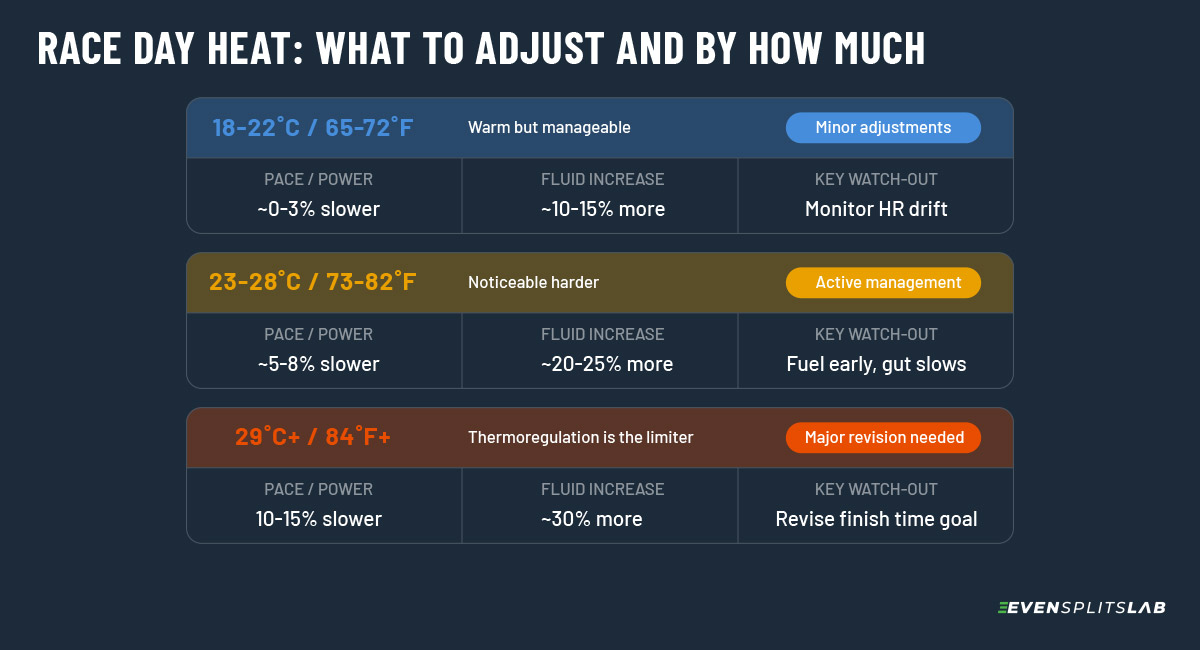
Quick Reference: Hot Weather Adjustments
Fluid: Increase intake by ~25–30% vs. normal conditions. Pair with sodium.
Sodium: Increase to account for higher sweat losses. Use electrolyte drinks or tabs rather than plain water.
Carbohydrates: Same or slightly higher intake than normal, but front-loaded. Start earlier, keep portions smaller.
Effort: Use RPE over pace or heart rate. Back off by 10–15% in the first half.
Finish time: Expect it to be 5–15% longer than your cool-weather target, depending on how hot and whether you’re acclimatized.
FAQ
It depends on how hot, how humid, and how well acclimatised you are. A rough guideline: for every 5 degrees above your usual training temperature, expect 3–5% slower pace at the same effort. At 30 degrees Celsius for someone who usually trains in 15, that can add 10–15 minutes to a half-IM run split alone. Humidity compounds the effect because sweat evaporation drops, which means your body cools less efficiently even if you’re sweating just as much.
Yes. Hot conditions accelerate glycogen use and reduce gut efficiency later in the race. Start eating earlier than your normal schedule — 15–20 minutes into the bike rather than waiting until you’re hungry — and keep serving sizes smaller. Every 25–30 minutes is a reasonable target instead of every 40–45.
The current evidence points to neuromuscular fatigue as the primary cause of exercise-associated cramps, not sodium or dehydration. Heat increases overall fatigue, which raises cramp risk. The fix is pacing and rest, not loading up on salt. That said, replacing sodium is still important in the heat — just for fluid retention, not cramp prevention.
An electrolyte drink rather than plain water for most of your fluid intake. Plain water is fine to supplement, particularly when you’re also taking in gels or other carbohydrates, but it shouldn’t be your only source of fluid in hot conditions. The sodium in electrolyte drinks helps your body actually retain what you’re drinking rather than excreting it.
Yes, and ideally in conditions that are similar to the race. A sweat test done on a cool morning tells you your cool-weather sweat rate — which isn’t what you need to know. If possible, do a test session in the heat, or at a similar effort and temperature, to get a number that’s actually relevant to race day.
Related Posts
Working on race day fuelling more broadly? Read: What to Eat Before Your First Sprint Triathlon (and What to Avoid)
Not sure how hard to push in training? Read: How to Read Your Heart Rate Zones (and Why Most People Get Them Wrong)
Want to understand the difference between running out of fuel and cramping? Read: The Difference Between Bonking and Cramping (And How to Fix Both)
Learn More
Mougin et al. (2025). The Effect of Heat Stress and Dehydration on Carbohydrate Use During Endurance Exercise: A Systematic Review and Meta-Analysis. NCBI / PubMed
Gatorade Sports Science Institute. Hydration and Nutrition Considerations for Endurance Cycling Exercise in the Heat. GSSI
McCubbin, Irwin & Costa (2024). Nourishing Physical Productivity and Performance on a Warming Planet. NCBI / Sports Medicine Open