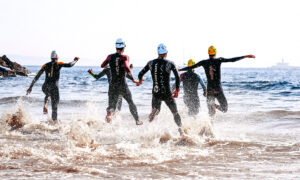
You sign up for your first triathlon, feeling pretty good about it, and then someone in the group chat starts talking about their T1, whether the swim is wetsuit-legal, and how they bonked on the run. Suddenly it sounds like a different sport with its own secret language. It isn’t. Most of the jargon is just shorthand that takes about thirty seconds to learn, and once you know it the whole thing feels a lot less intimidating. This is a plain-English glossary of the triathlon terms for beginners you will actually run into, from the swim start to the finish line.
TL;DR
Triathlon has its own vocabulary, and most of it sounds more complicated than it is. This glossary covers the terms you will actually hear as a beginner, grouped by swim, bike, run, transitions, training, nutrition, and race day. If you only learn a handful to start, the transition and fuelling words are where first-timers tend to come unstuck.
Key Takeaways
- The jargon is shorthand, not gatekeeping. Learn about ten terms and you will follow most of the race-morning chatter.
- Transitions (T1 and T2) are basically their own discipline, and knowing the words helps you stay calm in the spot where beginners lose the most time.
- “Brick” and “bonk” sound dramatic but describe simple, fixable things.
- A cramp is not a sign you need more salt. We will get to why.
- Most of the physiology terms matter far less on race one than simply pacing it well and finishing.
Triathlon terms for beginners: how to use this glossary
Here are the triathlon terms for beginners worth knowing, grouped by where you will meet them: the swim, the bike, the run, transitions, training, nutrition, and race day. You do not need to memorise all of them. Skim for the ones that keep coming up in your training group or your race briefing, and come back when a new word trips you up. The race-day and transition terms are the ones worth learning first.
Swim terms
Open water. Swimming in a lake, river, or ocean instead of a pool. No walls to push off, no black line to follow, and the water is often murky. It is a different skill from pool swimming, which is why it is worth practising in open water before race day.
Wetsuit / wetsuit-legal. A wetsuit adds warmth and buoyancy, which is basically free speed. A race is “wetsuit-legal” when the water is below a set temperature, usually around 24.5 degrees C for age-groupers. Warmer than that and you swim without one.
Sighting. Lifting your eyes to spot a buoy or landmark so you swim straight. Skip it and you will add distance zig-zagging across the course. Most beginners under-sight and then wonder why their swim came out 200m longer than advertised.
Mass start / wave start. A mass start sends everyone off at once, which is chaotic and full of contact. A wave start releases groups by age or category a few minutes apart, which is calmer. Rolling starts, where you go one or two at a time, are common now too.
Drafting (swim). Swimming just behind or beside someone to ride their slipstream and save energy. It’s legal in the swim, and honestly it feels like cheating the first time you try it. It isn’t.
Catch. The part of your stroke where your hand and forearm grab the water to pull you forward. “Improve your catch” is coach-speak for “stop slipping through the water.”
Bilateral breathing. Breathing on both sides, usually every three strokes. Handy in open water when chop or sun is on one side and you would rather not breathe straight into a wave.
Bike terms
Cadence. How many pedal revolutions you turn per minute (rpm). Most riders settle around 85 to 95. Spinning a lighter gear faster is usually easier on your legs than grinding a big one.
Aero / aero bars. Short for aerodynamic. Aero bars let you rest your forearms and tuck low to cut wind resistance, which is where most of your effort goes on the bike. Position matters more than your bike’s price tag.
Draft-legal vs non-drafting. In most age-group races, drafting on the bike is banned and you have to keep a gap (often 10 to 12m) from the rider ahead. Draft-legal racing, mostly elites and some short-course events, allows packs. As a beginner, assume non-drafting unless the rules say otherwise.
Power / watts / power meter. Power measures how hard you are actually pushing, in watts, regardless of hills or wind. A power meter reads it directly. It is the most honest pacing tool on the bike, though you can race plenty of triathlons without one.
FTP. Functional Threshold Power. Roughly the highest power you can hold for about an hour. Training zones get built from it. You do not need to know yours to finish a sprint, but you will hear it constantly.
Mount / dismount line. The painted line at transition where you are allowed to get on or off the bike. Cross it the wrong way and you can pick up a penalty. Run your bike to the line, then mount.
Run terms
Brick legs / jelly legs. That heavy, wobbly feeling when you start running straight off the bike. Your legs have been pushing circles for an hour and now you are asking them to do something completely different. It fades after a few minutes, and training for it has a name: the brick workout.
Cadence (run). Steps per minute. A lot of runners drift toward a quicker, lighter turnover to avoid overstriding, but the “right” number is individual. Chasing a magic figure off a chart usually backfires.
Negative split. Running the second half faster than the first. It is the smart way to pace almost any race. The opposite, fading badly in the back half, is a positive split.
Even split. Covering each half of a race at roughly the same pace. Boring on paper, very effective in practice, and a sign you paced it well. The site is named after the idea for a reason.
Transition terms
Transition area (T1, T2). The fenced zone where you switch disciplines. T1 is swim-to-bike, T2 is bike-to-run. It is where beginners lose the most free time, so it pays to practise your transitions before the race.
Racking. Hanging your bike on your assigned rack spot in transition, usually the morning of (or the day before for longer races). Find your spot early so you are not hunting for your bike in a panic after the swim.
Flying mount / dismount. Hopping onto a moving bike with your shoes already clipped to the pedals, and the reverse at the finish of the bike leg. It looks slick, takes real practice, and is completely optional for your first race.
Training terms
Brick. A workout that stacks two disciplines back to back, almost always bike then run, to teach your legs the transition. The name supposedly comes from how your legs feel doing it. More on why bricks matter and how to start.
Heart rate zones. Effort bands based on your heart rate, from easy to all-out. They help you train at the right intensity instead of going hard every single day. Worth reading how to actually read your zones, because most people set them wrong.
Zone 2. Easy, conversational aerobic effort. The unglamorous pace that builds most of your endurance base, and the one beginners skip because it feels too slow. Here is the case for Zone 2 versus Zone 3.
RPE. Rate of Perceived Exertion. A simple 1 to 10 scale of how hard something feels. Free, always available, and surprisingly accurate once you have calibrated it against a few harder sessions.
Threshold. Roughly the hardest steady effort you can hold for a long stretch before things fall apart. A lot of training is organised around it because it tracks race fitness well.
VO2 max. The most oxygen your body can use at full effort, which acts as a rough ceiling for aerobic fitness. Interesting to track. Not something to obsess over as a beginner.
HRV. Heart Rate Variability, the tiny variations in time between heartbeats, used as a rough readiness signal. Higher than usual for you tends to mean recovered; lower tends to mean tired or stressed. Here is how to use HRV in training.
Taper. Cutting back your training volume in the week or two before a race so you arrive fresh. It is hard to do because it feels like you are losing fitness. You are not.
Base / build / peak. The broad phases of a training plan: build an aerobic base, add intensity, then sharpen up for the race. Most plans move through them in that order.
Nutrition and hydration terms
Bonk / hitting the wall. Running low on usable carbohydrate mid-effort. Your legs turn to concrete, your brain goes foggy, and your pace falls off a cliff. It is a fuelling problem, which means it is preventable. Here is the difference between bonking and cramping.
Cramp. A sudden, involuntary muscle seizure, usually late in a race. Despite the popular myth, cramps are neuromuscular: they come from overworked, fatigued muscles, not from “low salt.” Sodium helps you hold onto fluid and absorb your drink, but it is not a cramp cure. More on what actually causes cramps.
Carb loading. Topping up the carbohydrate stored in your muscles by eating more carbs in the days before a long race. Useful for longer events. Mostly overkill for a sprint.
Energy gel. A small packet of concentrated carbohydrate you take mid-race for quick fuel. Easy to carry, easy to overdo. Practise with them in training first. See the best energy gels compared.
Electrolytes. Minerals you lose in sweat, mainly sodium plus some potassium and magnesium. They matter most for fluid balance and absorption, not as a magic cramp fix. Here is electrolyte powder versus a sports drink.
Sweat rate. How much fluid you lose per hour of exercise, which tells you roughly how much to drink. It is wildly individual, so a generic “drink X per hour” guideline is close to useless. You can work out your own sweat rate at home in one session.
Sodium. The main electrolyte in sweat. Its real jobs are helping you retain fluid and absorb what you drink. How much you need depends on how salty and how heavy a sweater you are. Here is how much sodium you actually need during a race.
GI distress / gut training. The stomach trouble that shows up when you try to fuel hard while working hard. “Gut training” means practising your race fuelling so your stomach learns to handle it. Yes, that is a real thing you can train.
Race day and general terms
Sprint / Olympic / 70.3 / Ironman. The standard distances, shortest to longest. A sprint is the usual first race; 70.3 (the half) and the full Ironman (140.6 miles) are the long-course events. Here is the full breakdown of triathlon distances.
Age group (AG). The amateur categories, sorted by age and sex, like M35-39. It is how recreational athletes get ranked, and where almost everyone you race is competing.
DNF / DNS / DQ. Did Not Finish, Did Not Start, Disqualified. The three you would rather not see next to your name, though a DNF is sometimes the smart and grown-up call.
PB / PR. Personal Best or Personal Record. Your own fastest time at a given distance. For most age-groupers it is the only result that really matters.
Chip timing. A small transponder on your ankle or bib that records your time as you cross timing mats, including splits for each leg and both transitions. Which is exactly how you find out your transitions cost you four minutes.
Cutoff time. The time limit for reaching a checkpoint or the finish line. Mostly a concern in long-course racing. Rarely an issue in a sprint.
Pacing. Spreading your effort so you do not blow up early. It is the single biggest lever a beginner has, and the cheapest one. See negative split, above.
Put a couple of these to work
Two of the terms above are easier to understand once you see your own numbers. Find out how much you lose with the Even Splits Lab Sweat Rate Calculator, then build a simple plan with the Fuel Strategy Calculator. Both take a couple of minutes.
Related posts
- New to the sport and not sure where to start: Sprint vs Olympic vs Half vs Full: Triathlon Distances Explained
- Worried about the swim-to-bike-to-run swaps: Transition Tips: How to Save 5 Minutes Without Training Harder
- Still confused by “brick”: Brick Workouts Explained: Why They Matter and How to Start