
Type “how to find zone 2” into any search bar and you’ll get four different formulas within the first five results, each claiming to be the correct one. One site tells you to subtract your age from 220 and take 60 to 70 percent. Another swears by 180 minus your age. A third wants you hooked up to a lactate analyzer. A fourth just says you should be able to hold a conversation. None of them agree with each other, and depending on which one you pick, your actual training pace can swing by a lot more than most people realize. This guide compares the four common ways to find your zone 2 heart rate so you can see exactly how much they disagree, and pick the one worth building your training around.
TL;DR
The %MHR formula (220 minus age) is the least accurate and easiest to overshoot. MAF (180 minus age) is simple and consistent but not personalized to your fitness. LTHR-based zones, calculated from a real threshold test, are the most accurate but require actual data. The talk test is a useful sanity check, not a training system. If you only do one thing, get a threshold number and build your zones from that.
Key Takeaways
- The four common zone 2 methods can produce heart rate ranges that differ by 10 to 15 beats per minute for the same person.
- Age-based formulas (%MHR, MAF) ignore your actual fitness level and can be off by a wide margin in either direction.
- LTHR-based zones, calculated from a real threshold test, are the most personalized and reliable option.
- The talk test is a fast field check, not a replacement for real data.
- Your zone 2 range will drift as your fitness changes, so any method needs the occasional refresh.
The Four Ways People Find Zone 2
Before comparing numbers, it helps to know what each method is actually measuring. Some are built around a rough estimate of your maximum heart rate. Others are built around your lactate or ventilatory threshold, which is a much better predictor of how your body is actually working at a given intensity. A couple aren’t measuring anything at all, they’re just asking how you feel. That distinction matters more than the formula itself.
Method 1: The Percent of Max Heart Rate Formula
This is the one most people learn first, usually from a gym poster or a fitness app default setting. You estimate your max heart rate using 220 minus your age, then take zone 2 as roughly 60 to 70 percent of that number.
For a 35-year-old, that works out to a max heart rate of 185 and a zone 2 range of about 111 to 130 beats per minute.
The problem is the formula itself. The 220-minus-age estimate has a standard deviation of plus or minus 10 to 12 beats per minute across the general population, which means for a meaningful chunk of athletes, the starting number is already wrong before you even calculate a zone off it. Two 35-year-olds with genuinely different max heart rates get told to train in the exact same range. If your real max heart rate runs high for your age, which is common in trained endurance athletes, this formula will systematically undershoot your zone 2, and you’ll spend your easy runs going slower than you actually need to.
This method is fine as a rough starting point if you have nothing else to work with. It’s not something to build a season of training around.
Method 2: The MAF Method (180 Minus Age)
Popularized by Phil Maffetone, this method takes 180 minus your age as a baseline, then adjusts up or down a few beats depending on training history, illness, or injury status.
For that same 35-year-old with no adjustments, MAF (Maximum Aerobic Function) lands at 145 beats per minute as a single target rather than a range, with some versions allowing a window of a few beats below that number.
MAF is easy to remember and doesn’t require any equipment, which is exactly why it’s stuck around for decades. The downside is the same one the %MHR formula has: it’s based on age, not on your actual aerobic fitness. Two athletes of the same age with very different training backgrounds get the same number. A well-trained athlete following MAF strictly can end up training well below what their body could actually sustain aerobically, which slows down long runs and rides for no real benefit.
Where MAF earns its keep is consistency. Because the number doesn’t move, it’s a decent tool for tracking fitness over time. If your pace at that fixed heart rate improves over a few months, that’s a real signal your aerobic engine is getting stronger, even if the absolute number itself was never perfectly calibrated to you.
Method 3: LTHR-Based Zones
This is the method built around actual physiology instead of age. You run or ride a threshold test, a sustained hard effort, commonly 20 to 30 minutes, or a step test with lactate or ventilatory markers, get a lactate threshold heart rate (LTHR), and calculate zone 2 as a percentage below that number, typically somewhere in the 70 to 80 percent range depending on which zone model you’re using.
You don’t need a lab for a rough version of this. A hard, sustained 20 to 30 minute effort, run at the fastest pace you can hold for the whole thing without blowing up, gives you an average heart rate that lands close enough to your real threshold to work with. It’s not as precise as a lactate or ventilatory test, but it’s a reasonable starting point you can do on your own with just a watch. From there, zone 2 is roughly 70 to 80 percent of that number.
A 2025 expert consensus paper reviewing zone 2 training reached agreement that the intensity should sit just below the first lactate or ventilatory threshold, not below a percentage of max heart rate. That’s a meaningful distinction. Threshold is where your body’s ability to clear lactate as fast as it’s produced starts to break down. Everything below that point is aerobic. Everything above it starts pulling more on anaerobic systems. Age has nothing to do with where that line sits for you.
The tradeoff is obvious: this method needs real data. You either need a proper threshold test or a decent field test estimate. It’s more work upfront than typing your age into a calculator. But it’s also the only one of these four methods that’s actually built from your physiology rather than a population average.
Method 4: The Talk Test and RPE
The simplest method of all: if you can hold a full conversation without gasping for air, you’re in zone 2. If you can only get out short sentences, you’ve drifted into zone 3.
The talk test isn’t nothing. It’s a genuinely useful sanity check, especially on days when your heart rate is running high for reasons that have nothing to do with fitness: heat, dehydration, poor sleep, stress. If your watch says zone 2 but you can’t string a sentence together, trust the talk test and back off.
Where it falls short is precision and consistency. Comfortable means something different to every athlete, and it changes for the same athlete depending on the day. It’s a good backstop, not a training plan.
How Much These Methods Actually Disagree
Here’s where it gets useful. Take a hypothetical 35-year-old triathlete with a threshold heart rate of 168, established from a real test, not a formula, and run all four methods side by side.
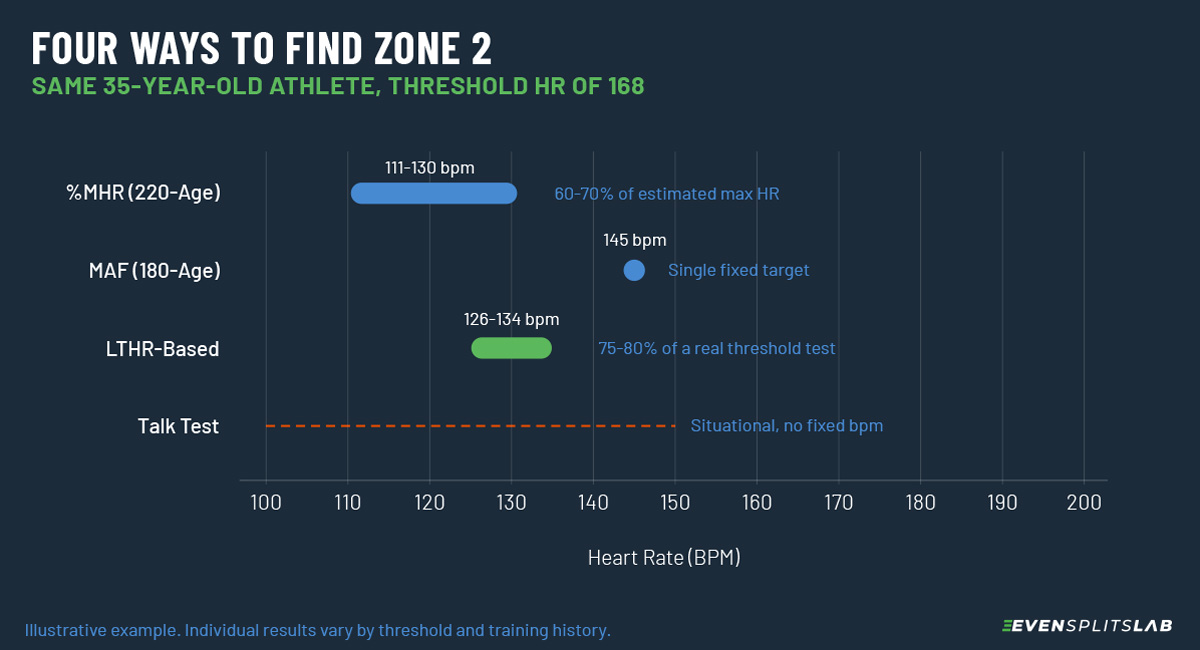
| Method | Zone 2 Result | Basis |
|---|---|---|
| %MHR | 111–130 bpm | 220-age, 60-70% |
| MAF | 145 bpm target | 180-age formula |
| LTHR-based | 126–134 bpm | 75-80% of 168 |
| Talk test | No fixed number | Situational |
The LTHR-based range and the top end of the %MHR range happen to land close together here, which is mostly coincidence. The gap between the bottom of the %MHR range and the LTHR range is real and sizable, over 20 beats per minute at the low end. That’s not a rounding error. That’s the difference between a genuinely easy aerobic effort and a session that’s noticeably more conservative than it needs to be, run after run, week after week.
This is illustrative, not a claim about any specific athlete. Your own numbers will land differently depending on your actual threshold and training history. If you’ve done a threshold test recently, plug your real LTHR into the math above and compare it to what the age-based formulas would have told you. The gap is usually the point.
Which Method Should You Actually Use
If you have to pick one, base your zone 2 off a real threshold number. It’s the only method on this list that’s actually about your fitness instead of your age. A field test or a structured threshold session gets you there without a lab visit.
Use MAF if you want a simple, no-equipment number to track over months. It’s not precisely calibrated, but it’s consistent, and consistency is what makes it useful for spotting fitness trends.
Use the %MHR formula only if you genuinely have nothing else, and treat it as a rough floor, not a target.
Use the talk test every single day, regardless of which formula you’re using. It’s the fastest check you have against a heart rate number that’s being thrown off by heat, stress, or a bad night’s sleep. Heart rate accuracy also depends on your monitor: if your numbers have been jumping around unpredictably, it’s worth ruling out a hardware issue before you blame the zone.
And if zone 2 already feels too controlled for where you’re at fitness-wise, our zone 2 vs. zone 3 training comparison covers when it’s actually worth pushing into the next zone.
FAQ
Is zone 2 the same as MAF heart rate?
Not exactly. MAF gives you a single fixed number based on your age. Zone 2 is a range, usually calculated as a percentage below your lactate threshold, and it moves as your fitness changes. They often land close together, but they’re calculated differently.
Why does my zone 2 feel too easy?
If you calculated it using an age-based formula and you’re a well-trained athlete, it’s genuinely possible the number is too conservative for you. This is one of the most common complaints about the %MHR method specifically.
How often should I retest my zone 2?
Every 8 to 12 weeks during a build phase, or any time your easy pace at your current zone 2 heart rate has clearly improved. Fitness changes, your zones should too.
Can I use power instead of heart rate for zone 2?
Yes, for cycling especially. Power-based zones calculated from FTP avoid the lag and drift issues heart rate has, though heart rate is still useful for tracking effort and fatigue day to day.
Does zone 2 mean the same thing for running and cycling?
The underlying physiology is the same, but your heart rate response differs between the two due to muscle mass involved and body position. Don’t assume your running zone 2 number transfers directly to the bike.
Related Posts
If you’re deciding between training zones for an upcoming block, read: Zone 2 vs. Zone 3 Training. For the test that gives you the most accurate zone 2 number, read: Threshold Testing for Triathletes. And if your heart rate readings have been inconsistent while you’ve been trying to nail down your zones, read: Wrist HR vs. Chest Strap.
Sources
Sitko, S. et al. “What Is ‘Zone 2 Training’? Experts’ Viewpoint on Definition, Training Methods, and Expected Adaptations.” International Journal of Sports Physiology and Performance, 2025. pubmed.ncbi.nlm.nih.gov/40010355
Maffetone, P. “The MAF 180 Formula: Heart-Rate Monitoring for Real Aerobic Training.” philmaffetone.com/180-formula