Most people sign up for a sprint triathlon before they’re ready. That’s fine. That’s how it should work. The trouble starts when they look for a plan and find either something built for athletes already training 10 hours a week, or a patchwork of Reddit advice. This is a free 12-week sprint triathlon training plan for beginners, built on Joe Friel’s periodization method for people who can already swim, bike, and run a little but have never put all three together.
TL;DR
This plan runs 12 weeks and builds from about 3 hours of training a week to just under 5. Week 1 isn’t a training week at all, which turns out to be the thing that makes the other 11 work.
Key Takeaways
- You should already be able to swim 400m, ride for 30 minutes, and run for 20 minutes before week 1.
- Week 1 is three field tests. They set your heart rate zones and your swim pace, so nothing after them is guesswork.
- Training peaks at 5 hours in week 10, the hardest week of the plan.
- Brick workouts start in week 9, after an easy ride, and the first one has a 5-minute run.
- The full week-by-week plan is a free PDF download.
I built this plan for the version of me who signed up for a first sprint triathlon with no idea what to do next. I’ve since raced sprint, Olympic, and 70.3. The structure follows Joe Friel’s periodization rather than anything I invented, and every session has a reason behind it.
Who This Plan Is For
This plan assumes a baseline of fitness. Before week 1, you should be able to do each of these, not all on the same day:
- Swim 400m with rest breaks
- Ride a bike for 30 minutes
- Run for 20 minutes
If you’re not there yet, spend a few weeks building up first. Stacking 12 weeks of structured training on zero base is a reliable way to get hurt or burn out by week 4.
It’s also not for people already training across all three sports. If you’re logging 6+ hours a week, you’ve outgrown it.
What Is a Sprint Triathlon?
Sprint triathlon distances vary slightly between events, but the standard format is:
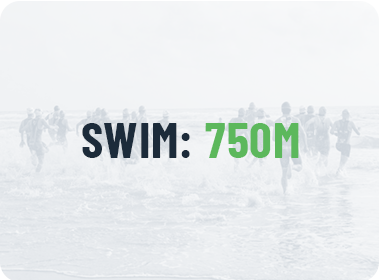
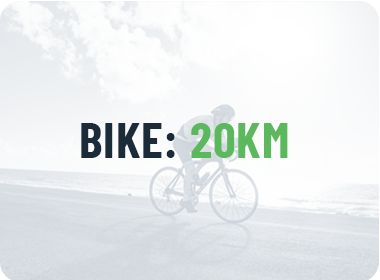
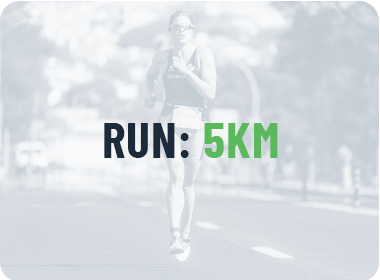
Most beginners finish in 1:15 to 1:45. That’s very achievable after 12 weeks of consistent training, which is exactly why it’s the right first race. If you’re still deciding where to start, our guide to triathlon distances compares them all.
The Method Behind This Plan
Joe Friel has coached endurance athletes since 1980 and wrote The Triathlete’s Training Bible. If you’ve ever seen a training plan split into Base, Build, and Peak, there’s a good chance his work was somewhere in its family tree.
Two ideas from his method shape this plan.
Train to train before you train to race
Friel splits a season into periods. In the Base period, the job is getting your body ready for harder work later, not rehearsing the race. He’s blunt about athletes doing race-style sessions too early. In his words, Base is when you train to train. Race-like sessions come later, in the Build period.
Beginners work on the basics first
Friel describes a handful of abilities an endurance athlete can train. For newcomers, he focuses on the basic ones: aerobic endurance, technique, and force, which just means pushing against resistance, like a hill. Longer, harder efforts come in once that base is in place. He’s cautious with all-out interval work for novices, because the injury and burnout risk usually outweighs the payoff.
That’s the biggest change from the first version of this plan, which had Zone 5 run intervals in the last few weeks. They’re gone. For a sprint, the trade makes sense anyway. Most beginners racing for 75 to 105 minutes spend it somewhere between tempo and threshold, not at max effort.
One clarification: this isn’t Friel’s own plan, and he hasn’t reviewed it. It’s an original plan built on principles he’s published. If you want his version, it’s in his book Your First Triathlon.
Week 1 Is a Test Week
Most beginner plans start with an easy week. This one starts with three tests: the bike on Monday, the swim on Tuesday, the run on Thursday, with easy sessions filling the rest.
The reasoning is simple. An easy first week is only useful if you know what easy means. Without a test, “Zone 2” is a number from an age formula, and those are rough at best. One week of testing means every session in the other 11 has a real number behind it.
The tests get repeated in week 8, so you can see what nine weeks of training actually did. For most people, the run number moves the most.
The bike and run test
Both use Friel’s 20-minute protocol. After a warm-up, ride or run for 20 minutes on your own at the hardest steady effort you can hold for the whole time. Take your average heart rate for those 20 minutes and subtract 5%. That’s your threshold heart rate.
Start a little conservatively. Friel suggests holding back for the first five minutes, then deciding every five minutes whether you can go slightly harder. Most people go out too fast and crawl to the finish, which makes the number close to useless.
Test the bike and the run on different days. Run heart rate usually sits a bit higher than bike heart rate at the same effort, so one number won’t cover both. If you have a power meter, the same bike test gives you FTP: average power for the 20 minutes, minus 5%. Most beginners won’t have one, and the plan doesn’t need it. For more on how these tests work, read our guide to threshold testing.
The swim test, and what CSS means
Swimming doesn’t work the same way. Heart rate at the wrist is unreliable in the water, and effort in the pool is hard to judge when you’re new. So the swim uses pace instead.
Critical swim speed, or CSS, is roughly your threshold pace per 100m. You find it with two time trials: swim 400m for time, rest 5 to 10 minutes, then swim 200m for time. Subtract the 200m time from the 400m time and divide by two.
Say you swim 8:00 for the 400m and 3:50 for the 200m. That’s 480 seconds minus 230, divided by 2, which gives 125 seconds. Your CSS is 2:05 per 100m.
Short stops at the wall during that first 400m are fine, as long as you keep the clock running. It’ll make the number slightly conservative, which is not a problem for week 1. By the retest in week 8 you’ll have swum 500m continuously in training, so try it without stopping then.
Every swim set in the plan is then written relative to that pace:
| Written as | Pace | Used for |
|---|---|---|
| Easy | CSS +20 sec or slower | Warm-ups, cool-downs, drills, recovery swims. |
| Steady | CSS +10 to +15 sec | Most Base main sets. |
| CSS +5 | 5 sec slower than CSS | Build main sets. |
| CSS | Your CSS pace | Peak and race-effort sets. |
Training Zones
Once you have your threshold heart rate, these are the bike and run ranges the plan uses. They’re Friel’s widely published threshold-based bands.
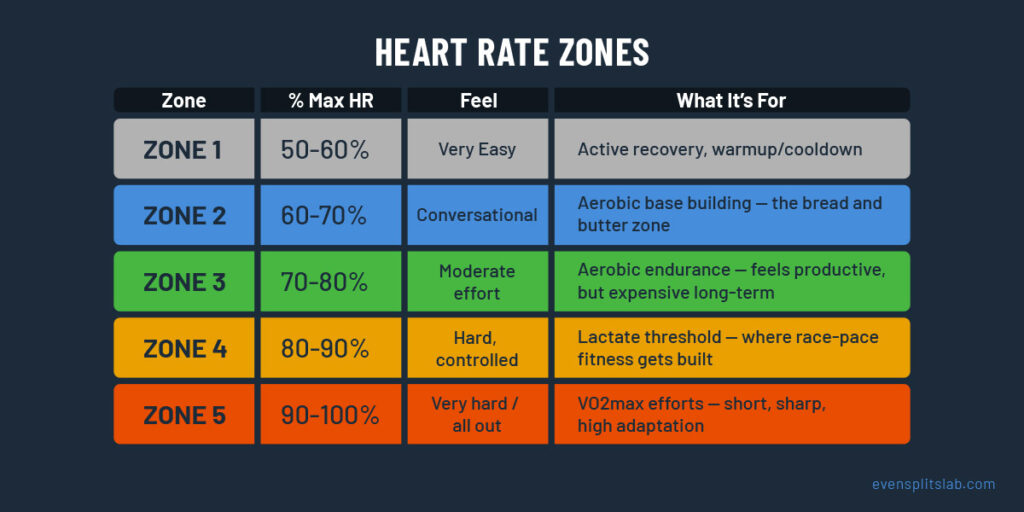
Friel’s system has two more zones above 5a. This plan doesn’t use them.
No heart rate monitor? The plan still works. Skip the bike and run tests and go by the How it feels column. A monitor is still worth having, mostly because almost everyone runs their easy sessions too hard without one. And if your watch shows different zones, it’s probably using max heart rate instead of threshold. Our heart rate zones guide covers that approach. Either system works. Just pick one and stick with it for all 12 weeks.
How the Plan Is Structured
Friel’s full model runs across a whole season, and the Base period alone often lasts around 12 weeks. A first sprint doesn’t need that much. This plan keeps his order and squeezes it into 12 weeks, which is plenty of time for training for a sprint triathlon from a basic level of fitness.
It’s six sessions a week throughout: two swims, two rides, and two runs. Monday is always rest. Tuesday is the key bike session, Thursday the key run, Saturday the long run, and Sunday the long ride or brick. What changes is what’s inside those sessions.
Base 1 (Weeks 2–3)
Almost everything is easy, conversational effort. Every swim includes drills, and runs finish with a few short strides. Week 3 adds seated hill climbs on the bike, which is Friel-style force work without a gym. Most beginners rush this block. Don’t.
Recovery (Week 4)
Short, easy sessions and no testing. The fitness from the previous weeks shows up here, not during them. Resist the urge to add anything because you feel good.
Base 2 (Weeks 5–7)
This is where effort starts to register. Zone 3 tempo blocks appear on the bike, then on the run, and they get a little longer each week. The long run builds to 50 minutes and the long ride to 75.
Recovery and Retests (Week 8)
Four easy days, then the three retests: bike Friday, swim Saturday, run Sunday. This week also has your first open water swim. If that part makes you nervous, read our open water tips for beginners first.
Build (Weeks 9–10)
Training starts to look like racing: Zone 4 intervals on the bike and run, CSS-paced swim sets, and open water every weekend. Week 10 is the hardest week of the plan.
Peak (Week 11)
Volume drops by about 20% and the intensity stays. Race-effort work moves into the standalone bike and run sessions, so nothing gets stacked on top of the brick.
Race Week (Week 12)
A taper. Two short sharpening sessions early in the week, then easy rides and runs on the race course if you can get to it, a full rest day Saturday, and the race on Sunday.
Week-by-Week Summary
Here’s how the 12 weeks are laid out. The full daily sessions are in the PDF.
| Week | Period | Hours | Focus |
|---|---|---|---|
| 1 | Test Week | 3:18 | Bike, swim, and run field tests. Everything else easy. |
| 2 | Base 1 | 3:17 | Cadence drills, strides, drill-heavy swims. |
| 3 | Base 1 | 3:52 | First seated hill climbs. Long run 35 min. |
| 4 | Recovery | 2:45 | Short and easy. No testing. |
| 5 | Base 2 | 3:56 | First Zone 3 tempo on the bike. Long run 40 min. |
| 6 | Base 2 | 4:29 | First tempo run. Long run 45 min. |
| 7 | Base 2 | 4:44 | 500m continuous swim. Long run 50 min. 75 min ride. |
| 8 | Recovery + Retests | 3:20 | First open water. Bike, swim, and run retests. |
| 9 | Build | 4:40 | Zone 4 intervals. CSS-paced swims. First brick. |
| 10 | Build | 5:00 | Hardest week. 750m continuous swim. 15 min brick run. |
| 11 | Peak | 3:55 | Race-effort bike and run. Longest brick run. |
| 12 | Race Week | 2:15 | Taper. Course previews. Race Sunday. |
What Week 1 Looks Like vs. Week 10
Here’s where the plan starts and where it peaks. Both are pulled straight from the PDF.
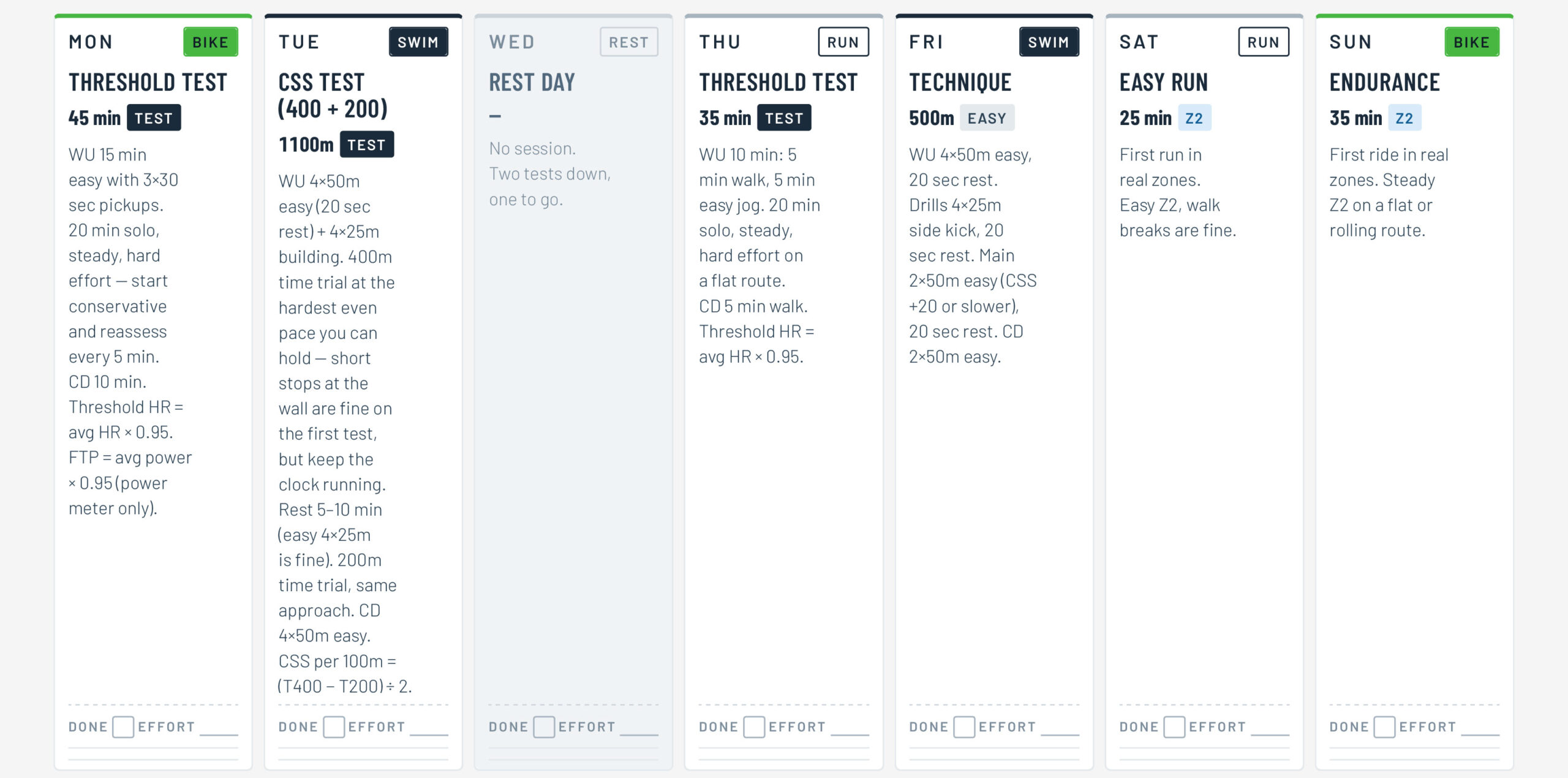
Week 1: Test Week, 3:18
Monday is the bike test. Tuesday is the swim test. Thursday is the run test. Friday is a 500m technique swim, then an easy 25-minute run and a 35-minute ride over the weekend. By Sunday you have three numbers and no real training stress.
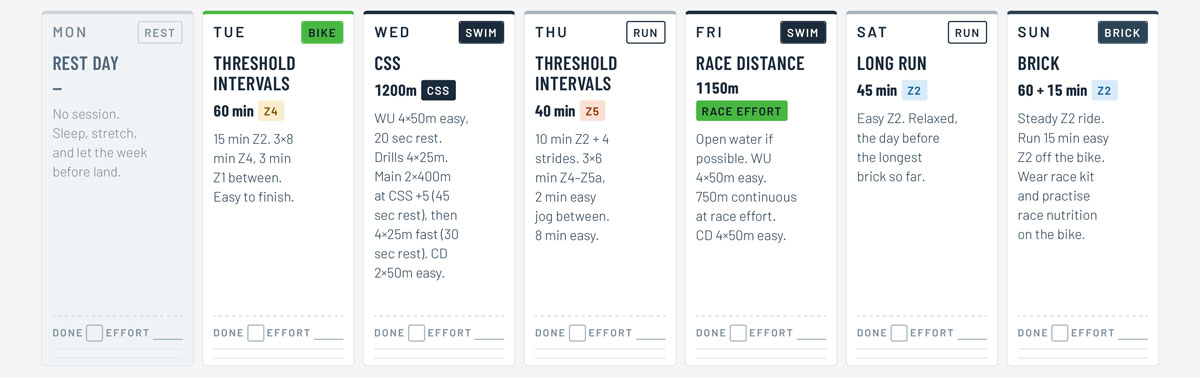
Week 10: Build, 5:00
By week 10, you’re doing something very different. Tuesday is a 60-minute ride with three 8-minute Zone 4 intervals. Thursday is a 40-minute run with three 6-minute efforts at Zone 4 to 5a. Friday is 750m of continuous open water at race effort, the full race distance. Sunday is an hour on the bike into a 15-minute run.
Nine weeks after week 1, and not a single all-out interval to get there.
Brick Workouts: What to Expect
A brick is a ride followed immediately by a run. No break, no shower, no sitting down. Running after cycling feels strange because your legs have spent the last hour working in a completely different pattern. The first few minutes feel like running in wet concrete.
In this plan, bricks don’t start until week 9. There’s a reason for that. A brick’s job is teaching your legs to run on cycling legs, and that lesson lands in the first five minutes. Beyond that you’re just adding fatigue, which is the last thing a beginner needs in the Base weeks.
So the runs are short and they build slowly: 5 minutes in week 9, 15 in week 10, 20 in week 11. Every one comes after an easy Zone 2 ride, not a hard one. The hard bike work stays in Tuesday’s session, where it belongs.
That’s also why there’s no brick in race week. Bricks are training, not a warm-up for the race. Use them to rehearse your changeover instead, and keep our transition tips in mind. If you want the longer version, we’ve written about what bricks actually do.
What About Strength Training?
Friel includes strength work in his approach, and it’s an optional add-on in his beginner plans. With newcomers, he keeps the loads light and the reps high, often just body weight or an empty bar, with the focus on technique.
This plan leaves it out. The goal was keeping it under five hours a week, and for most beginners, that time is probably better spent swimming, cycling, and running in the first 12 weeks.
If you do have time, two short bodyweight sessions a week during the base weeks is a reasonable addition. Think squats, lunges, glute bridges, and planks. Keep them on easy days, away from the key sessions, and cut back to one session or none once the Build weeks start.
Fuelling for Training
For sessions under an hour, water is usually enough. Once rides and bricks push past the hour mark in weeks 7 and 10, take in some carbs around the 45-minute mark. Skip that often enough and you’ll find out what bonking feels like the hard way. Knowing the difference between bonking and cramping helps when something goes wrong.
Your long bricks are the place to rehearse race nutrition. If you plan to take a gel on the bike, try it in training first. Race morning is not the time for experiments. For the morning itself, here’s what to eat before a sprint triathlon.
Our Sweat Rate Calculator gives you a personal fluid target, and our Fuel Strategy Calculator turns that into a race-day carb and fluid plan.
Print it, keep it on your phone, or copy the sessions into TrainingPeaks or your watch app. At some point life will get in the way. If you miss a day, don’t double up. Pick up where you left off.
FAQ
Yes. This plan assumes you can swim 400m with rest breaks. If you’re a non-swimmer, you’ll need to sort out basic technique before starting. Otherwise the swim sessions will be unsafe and miserable. Even a few lessons before week 1 will make a big difference.
A bike, a helmet, goggles, and running shoes. That’s the minimum. A heart rate monitor is strongly recommended since this plan is zone-based. For everything else, read Triathlon on a Budget: The Minimum Gear You Actually Need
Yes. The plan is written with Monday rest and Saturday/Sunday as your longer sessions. Adjust to fit your life, but try to keep hard sessions separated by at least one easy day. Don’t do two hard sessions back to back.
Skip it and continue from where you are. Don’t try to cram a missed week into the next one. The volume ramp-up is deliberate. Trying to compress it is how injuries happen.
For the beginner this plan is designed for: yes. You won’t be fast. But you’ll finish comfortably and feel prepared. Sprint triathlons are designed to be achievable. That’s the whole point of them.