
You pull your bike out of the travel case at the hotel and something’s off. Shifting hesitates, a hanger looks bent, or there’s a clunk that wasn’t there on your last ride at home. A mechanical during race week feels different from one during training. There’s no home shop with your maintenance history on file, no spare bike in the garage, and the race is already on the calendar. It happens more often than people expect, usually from baggage handling rather than anything you did wrong, which is exactly why knowing what to do if your bike breaks before race day matters more than trying to prevent every possible failure.
TL;DR
A bike problem discovered during race week isn’t automatically a race-ending problem. The first move is figuring out what you’re actually dealing with, since most of what goes wrong in transit is fixable if you know who to call and what to ask. What trips people up isn’t the mechanical itself, it’s assuming a race expo tent can fix anything.
Key takeaways
- Most race-week mechanicals are shifting or alignment issues, not structural damage.
- Run a quick triage sequence before touching anything or calling anyone.
- Race expo mechanic tents are built for tune-ups, not stocking your specific parts.
- A phone call before you drive over saves more time than a walk-in visit.
- Decide on a backup plan (rental, loaner, local contact) before you actually need one.
Don’t Panic. Do This First
Before diagnosing anything or calling a shop, run through this sequence. It won’t fix the problem, but it stops a manageable issue from turning into a worse one.
- Stop riding the bike until you know what’s actually wrong. Riding on a hidden crack or a compromised brake turns an inconvenience into a real injury risk.
- Take photos of anything visibly damaged, useful both for a mechanic and for a travel insurance claim if it happened in transit.
- Note whether the issue showed up right after unpacking or only after a ride. That’s the first clue to whether it’s transit damage or a fresh mechanical.
- Don’t start adjusting limit screws or swapping parts on a guess. Guessing usually turns one problem into two.
- If there’s any doubt about structural damage, get it in front of a mechanic before doing anything else.
Why This Happens More Often Than You’d Think
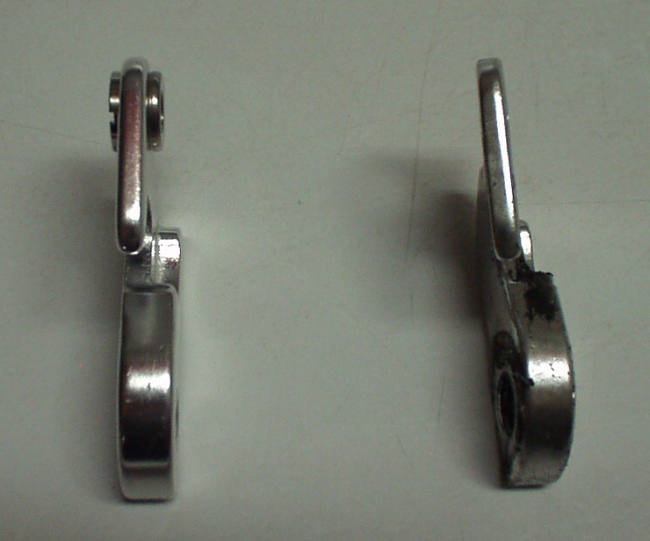
Airlines aren’t gentle with bike cases, and baggage handlers aren’t checking for tri bike geometry before stacking a suitcase on top. The most common failure point usually isn’t the frame, it’s the rear derailleur hanger, a small piece of metal that’s deliberately designed to bend before your frame does. A bent hanger throws off shifting completely, and it’s easy to blame the derailleur when the hanger is the actual culprit. Park Tool’s own repair guide shows what a bent hanger actually looks like next to a straight one, worth a glance so it’s recognizable on sight.
One precaution worth considering: removing the rear derailleur entirely before packing, rather than just wrapping it in place. It adds a few minutes to disassembly and means re-indexing the gears on the other end, but it takes the derailleur and the hanger out of the list of things baggage handling can damage. Not everyone bothers with this, and for a lot of trips it’s genuinely unnecessary. For anyone who’s had a hanger bent in transit once, though, it tends to stop being optional.
Step One: Figure Out What You’re Actually Dealing With
Put the bike on a stand or flip it upside down on a towel and actually test it. Spin the cranks and shift through the full range, front and rear. Spin each wheel and watch for wobble or rubbing. Squeeze the brakes and check for full lever travel before the pads contact the rim or rotor.
Most transit damage shows up as a shifting problem: skipping, hesitating, or refusing certain gears. That’s usually a bent hanger, a shifted limit screw, or a cable that moved, not a structural issue. Those are annoying, but fixable. A different category of problem needs a mechanic’s eyes before the bike goes anywhere near the road again.
Stop riding and get it inspected if you notice:
- A crack in the frame or fork
- Carbon damage, crushing, or delamination
- A wheel with significant structural damage
- A brake that won’t reliably stop the bike
- A loose or damaged cockpit component that affects steering
- Anything that feels structurally unsafe, even if it’s hard to describe why
Everything outside that list is probably fixable, it’s just a question of how fast.
What Race Expo Mechanic Tents Can (and Can’t) Do
Most big races have a mechanic tent at the expo, usually run by a sponsor brand. Here’s a realistic breakdown of what to expect from one:
| Task | Usually yes | Usually no |
|---|---|---|
| Tune-ups | Yes | — |
| Cables | Standard cables | Rare or internal routing |
| Brake bleed | If fluid matches | Wrong fluid type |
| Spare hanger | Common ones | Frame-specific ones |
| Electronics | Rarely | Most cases |
| Wheel truing | Yes | — |
| Frame damage | No | Always needs a specialist |
None of this is about one brand being better than another, it’s about parts availability. Hydraulic brakes use different fluid types depending on the manufacturer, and a shop without the correct fluid can’t safely bleed them on the spot. Electronic groupset components tend to be more specialized than mechanical ones, so a small-town shop or an expo tent is less likely to have a compatible part sitting in a drawer. A fix, if one is needed, is more likely to require ordering a part than borrowing one.
Finding Real Help Fast
A phone call beats a walk-in almost every time. Call ahead and ask specifically: do you have this part in stock, can you look at it today, and how long the fix will actually take. A shop that’s upfront about a one-to-two-week repair backlog during race season, which is common in bigger cities, is doing a favour by saying so early. It means moving on to a backup plan right away instead of losing a day waiting for an answer.
Local triathlon and cycling clubs are usually a faster source of good information than a general search. A quick post in the host city’s tri club Facebook group, or a question in the race’s own athlete group, often surfaces someone who knows exactly which shop to trust and which one to skip.
Don’t Make These Race-Week Mistakes
A few habits turn a manageable mechanical into a real problem. Skip these:
- Don’t keep riding a bike that might have structural damage, even if it seems to shift fine for now.
- Don’t start replacing parts before confirming what’s actually broken.
- Don’t assume the expo mechanic has your exact groupset in stock.
- Don’t wait until the day before the race to look for a shop. By then, every other athlete in town has had the same idea.
- Don’t accept a rental or loaner bike without checking fit, brakes, shifting, and pedals first.
- Don’t make major fit changes just because it’s a backup bike. A slightly imperfect setup you already know beats guessing at a new one mid-race.
- Don’t adjust five things at once when only one might be wrong. It makes it harder to tell what actually fixed it.
Your Backup Plan If It Can’t Be Fixed in Time
Sometimes the honest answer is that the part isn’t available before race day. At that point, the options are a rental or loaner bike from a local shop, a spare bike from a training partner or local contact close in fit, or in rare cases, a backup component brought along just in case (a second wheel, an older derailleur). None of these are ideal, but showing up on a compromise setup beats not showing up at all, and it’s worth deciding this in advance rather than sorting it out two days out. The same logic, packing spares and knowing a fallback before it’s needed, is exactly why it’s worth reviewing what actually belongs in a beginner triathlete’s kit before travel, not just once something’s already wrong.
The 48-Hour-Out Checklist
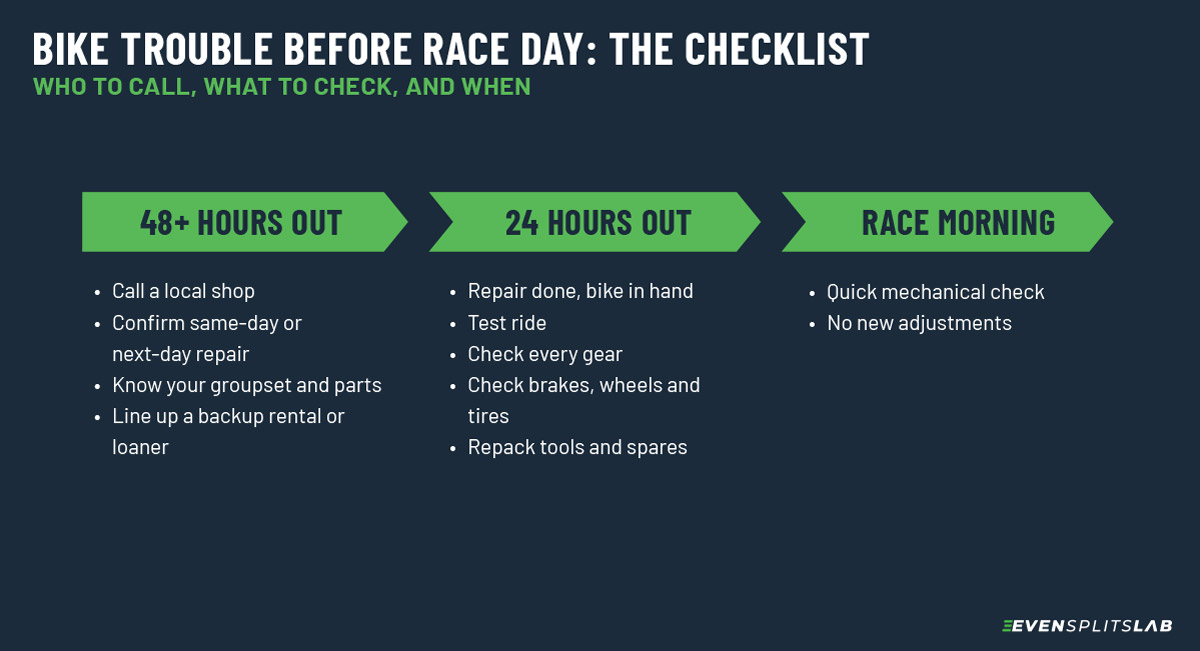
A short timeline helps more than a long list of things to worry about. Here’s roughly how it should break down.
Bring only the small spares and tools that are actually practical and permitted at the venue. This pairs naturally with the broader transition-morning routine, since the same principle, nothing left to figure out on the fly, applies there too.
Fuel Your Race, Not Just Your Bike
Race week isn’t only about keeping the bike running. Use our Fuel Strategy Calculator to lock in your on-course nutrition plan before things get any more hectic.