Fuelling seems simple until you train for longer distances. Then it becomes part of the training. Ninety grams of carbs an hour sounds like a nice round number, until you have to fit about 250g of sugar on a bike built to carry as little as possible. Then your stomach has to take it all in while you’re folded over the aerobars at race effort. This is how to make 90g carbs per hour cycling actually work in a race: what to carry, where it goes, and how to build up to it.
TL;DR: Hitting 90g an hour on the bike is less about which product you pick and more about where the carbs live: in a bottle, in gels, or split between the two. One setup is much cheaper and easier to adjust than the others. The catch is that your gut has to be trained for it, and even then race day can go sideways. Mine did.
Key takeaways
- 90g an hour is mainly for long races like 70.3 and full distance. Shorter races rarely need it.
- Past about 60g an hour you need glucose and fructose together, not just more of the same sugar.
- Regular sports drinks are too dilute to deliver 90g unless you drink around 1.5 litres an hour.
- Keep carbs and plain water in separate bottles so you can drink to thirst without changing your fuelling.
- Build up gradually in training, and go into the race with a fallback plan.
Who actually needs 90g of carbs per hour?
Fewer people than Instagram would suggest. The 90g figure comes from sports science on events lasting about 2.5 hours or more. Asker Jeukendrup’s summary for GSSI puts it plainly: for long events, aim for around 90g an hour of mixed carbs.
In practice, it breaks down roughly like this:
- Sprint: you can usually get away with a gel or nothing at all.
- Olympic: most age-groupers do fine with 40 to 60g an hour on the bike.
- 70.3: 60 to 90g an hour on the bike is where higher intakes start to pay off.
- Full distance: the same range, for a lot longer. This is where 90g matters most.
Body size and effort matter too. A bigger athlete riding hard burns more carbs than a smaller one cruising at the back of their age group. More isn’t endlessly better either. In one cycling study by King and colleagues, 90g an hour of glucose plus fructose gave the best time trial, and pushing to 112.5g didn’t improve on it. So treat 90 as a target to train toward, not a minimum you’ve failed if you miss it.
Why 90g needs two kinds of sugar
Your gut absorbs glucose through one route, and that route tops out at around 60g an hour. Maltodextrin counts as glucose here. Fructose uses a different route, so adding it lets you absorb another 30g or so on top.
That’s why the classic ratio is 2:1: 60g of glucose or maltodextrin to 30g of fructose. Some newer work uses closer to 1:0.8 at very high intakes. I went deeper on this in the glucose to fructose ratio post.
The practical bit: check your labels. A lot of cheaper gels are glucose only. That’s fine at 60g an hour. At 90g, stacking more of them mostly means more sugar sitting in your stomach.
Practical combinations for 60g, 75g and 90g carbs per hour cycling
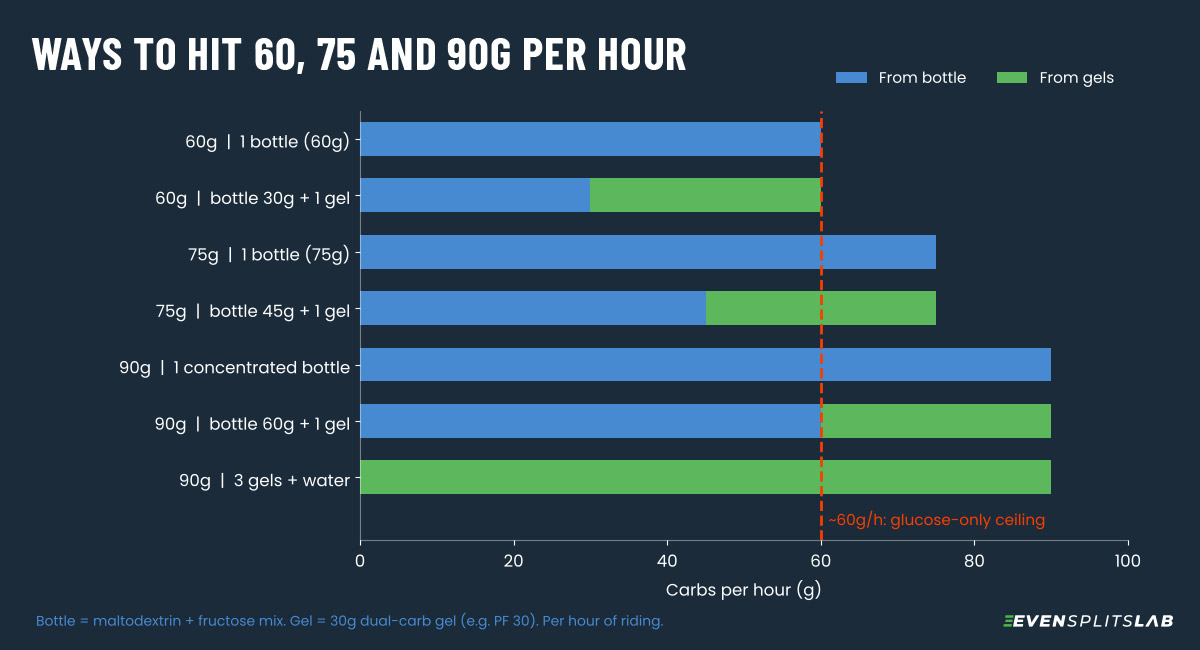
Here are the setups I’d actually use. “Bottle” means a homemade mix of maltodextrin and fructose. “Gel” means a 30g dual-carb gel like the Precision Fuel PF 30.
60g per hour
- One bottle with 40g maltodextrin and 20g fructose.
- One bottle with 30g of mix, plus one gel.
- Two gels and water.
75g per hour
- One bottle with 50g maltodextrin and 25g fructose.
- One bottle with 45g of mix (30g malto, 15g fructose), plus one gel.
90g per hour
- One bottle with 60g maltodextrin and 30g fructose. This is my usual mix, plus an LMNT sachet for sodium.
- One bottle with 60g of mix, plus one gel.
- Three gels and water.
For a whole 70.3 bike split, multiply by hours. Two hours 45 minutes at 90g is roughly 250g of carbs. That fits in two bottles of about 125g each, with water coming from the course. The full recipe and mixing tips are in my homemade carb drink post.
Concentrated bottles vs regular sports drinks
A regular sports drink is around 6% carbs. Gatorade Thirst Quencher, for example, has 36g in a 591ml bottle. To get 90g out of that, you’d need to drink close to 1.5 litres an hour. On a cool day that’s a lot of fluid you don’t need, and probably a few extra stops.
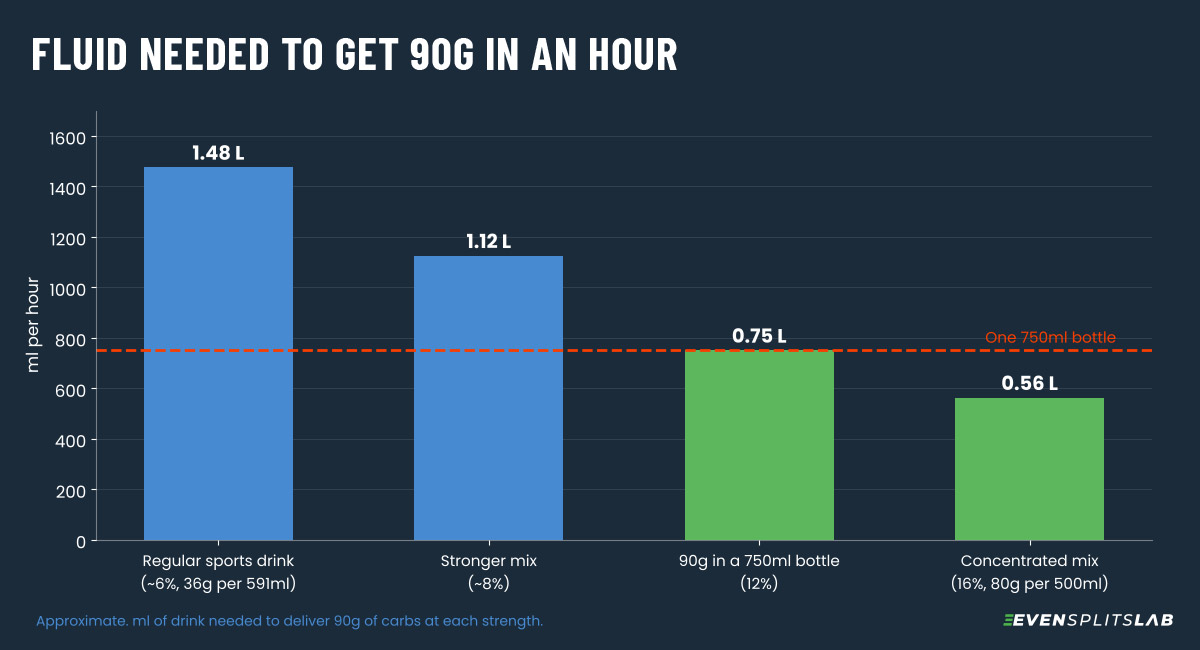
A concentrated bottle flips that. Maurten’s Drink Mix 320 packs 80g into 500ml, which is about 16%. My 90g-in-750ml mix sits around 12%. You get the carbs without being forced to drink a set amount of fluid.
The trade-offs are real, though:
- Strong mixes are thick and very sweet. After two hours in the sun, a warm concentrated bottle is not a treat.
- Very sugary drinks tend to leave the stomach more slowly, so most people need plain water alongside. Sip both.
- If you drop or lose the bottle, you’ve lost an hour or more of fuel in one go.
Regular sports drinks still have a place. On a hot day, when you’re drinking a lot anyway, a more dilute mix gets carbs and fluid in together without the syrup factor. More on that in hot weather triathlon nutrition.
Bottles vs gels: head-to-head
Neither is better in every situation. Here’s how they compare on the things that actually matter mid-race.
| Concentrated bottle | Gels | |
|---|---|---|
| Cost (90g/h) | About $1.20 DIY | About $13 for three 30g gels |
| Tracking | Mark hourly lines on the bottle with tape | Easy. Count the wrappers |
| Adjusting | Sip a little more or less | In 30g steps |
| Hot days | Warms up and gets sickly | Fine, but need water |
| Cold days | Fine | Thicken and are hard to open in gloves |
| Race prep | Mix the night before | Grab and go |
| Aid stations | Course gives water only | Course has 25g gels |
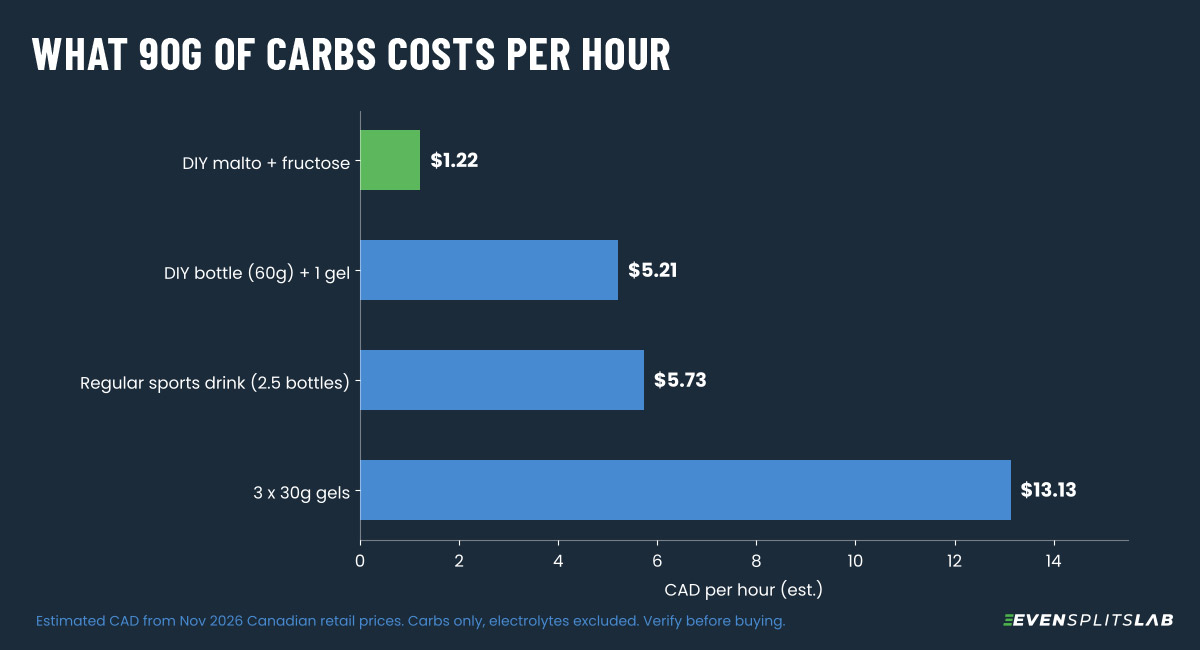
The cost gap is the bit that surprised me. Doing every long ride at 90g an hour on gels alone gets expensive fast. Three gels an hour for three hours is also nine gels. That’s a lot of wrappers and a lot of sticky fingers.
My take: use a bottle as the base and gels for top-ups and backup. If you’re picking gels, the best energy gels post compares the main options.
Where it all goes on a tri bike
Bottle capacity
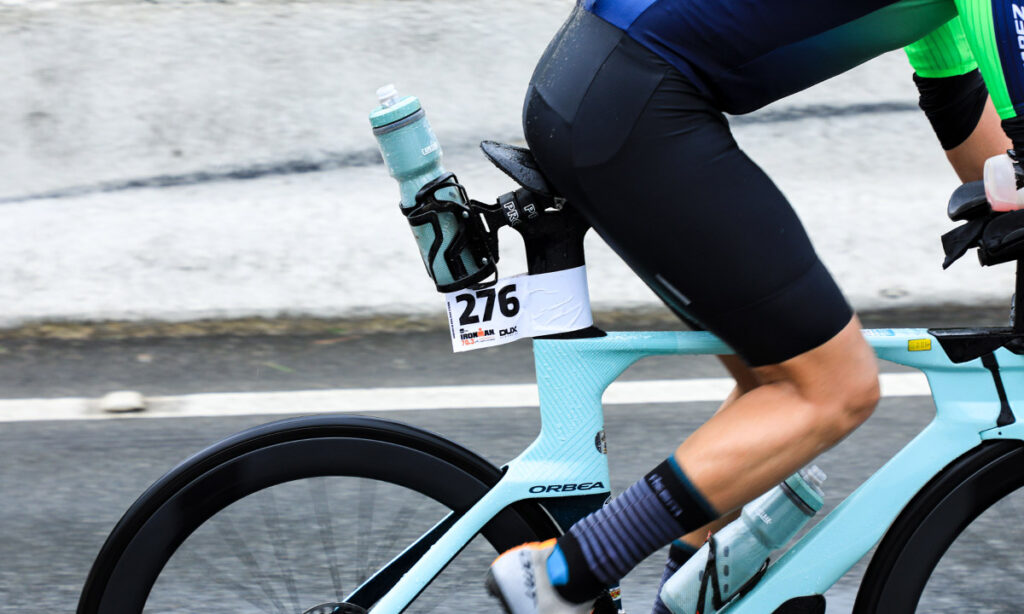
Most cages take bottles from about 500 to 750ml, and large bottles go up to around 950ml. On a tri bike you usually have three spots: between the arms, on the frame, and behind the saddle.
Weight adds up. Every litre of fluid is roughly a kilo. Gustav Iden makes the same point in his Maurten interview. It’s one more reason concentrated bottles make sense: same carbs, less to haul up the hills.
Gels and flasks
- Top-tube bag: the easiest place to reach gels in the aero position.
- Taped to the top tube: cheap and fast. Tape near the tear tab so the gel rips open as you pull it off.
- Gel flask: squeeze several gels into one flask and skip the wrappers. Maurten’s 150ml flask holds five of their 25g gels.
- Tri suit pockets: fine for one or two gels. Not for your whole plan.
Most races penalise littering outside the aid station zones, so wrappers either go back in your bag or into the bins at aid stations.
A sample 70.3 setup
- Between the arms: plain water, refilled at aid stations.
- Frame cage: concentrated bottle one.
- Rear cage: concentrated bottle two.
- Top-tube bag: two or three gels as backup.
Aid stations changed in 2026
If you’re racing IRONMAN-branded events, the on-course drink is no longer a carb source. From 2026, Precision Fuel & Hydration’s PH 1000 is the official on-course hydration at all IRONMAN and 70.3 races. It’s a low-calorie electrolyte drink built around roughly 1,000mg of sodium per litre.
Carbs on course come from Maurten, mainly the Gel 100, which has 25g. Getting 90g an hour from course gels alone means three or four gels an hour, every hour, from whatever’s on the table.
So plan your carbs as something you carry. Treat the course as water, electrolytes and backup gels. Check your race’s athlete guide for aid station spacing and exactly what’s handed out, since non-IRONMAN races all do their own thing.
Managing sodium and fluid separately
This is the part most fuelling plans get wrong. Carbs, fluid and sodium are three different needs, and they don’t move together.
- Carbs go on a schedule. Your hourly target doesn’t change much with the weather.
- Fluid depends on heat and how much you sweat. You might need twice as much on a hot day.
- Sodium goes with fluid. It helps you hold on to what you drink.
If everything is in one bottle, drinking more because it’s hot also means eating more sugar. That’s how people end up with a sloshing, overloaded stomach by the second hour.
In my 70.3, I put the carbs and an LMNT sachet (1,000mg of sodium) in the same bottle and kept plain water separate. That locks sodium to the clock, which is simple and works well on a mild day. The other option is to put sodium in the water bottle, so it scales with how much you drink. That makes more sense on a hot day.
How much sodium you need varies a lot from person to person. Start with your sweat rate and then read how much sodium to take during a race. One clarification: sodium is about fluid balance, not cramps. That’s covered in bonking vs cramping.
What to practise before trying higher carb intakes
Your gut can be trained, a bit like your legs. In a study by Miall and colleagues, runners who took 90g an hour during daily runs for two weeks had fewer stomach symptoms and absorbed their carbs better afterwards. An older study of cyclists by Cox and colleagues found that four weeks of training with plenty of carbs increased how much of a sports drink their bodies actually used.
Here’s what I’d practise:
- Build up in steps. Go from 60 to 70 to 80 to 90g over several weeks of long rides, not in one jump.
- Practise at race effort. Your gut copes differently at an easy spin than at 70.3 power. Match your race pacing.
- Practise in the aero position. Being folded over changes how a full stomach feels.
- Use the exact race products and concentration. Same mix, same gel, same bottle.
- Practise the logistics. Grabbing bottles at speed, opening gels, refilling the water bottle without stopping.
- Practise the day before, too. Treat the dinner and breakfast before long sessions as part of the test.
- Run off the bike. A brick tells you how 90g on the bike feels once you start running.
Set a reminder while you’re at it. Garmin Edge units have built-in eat and drink alerts. On other head units, a repeating 15 or 20 minute timer does the job.
What happened when I tried 90g in my 70.3
I aimed for 90g an hour on the bike. I got about 60.
Partway through the bike my stomach started complaining, and I backed off. I’d trained my gut for this. Long rides at 90g, same mix, same products. It still wasn’t enough. My best guesses are something I ate the day before, or just race-day nerves. Honestly, I don’t know which.
The lesson isn’t that gut training doesn’t work. It raises your ceiling. It doesn’t guarantee you’ll hit it on the day. So go in with a plan B:
- Drop to water and small sips of the carb bottle until things settle.
- Aim for something like 60g rather than stopping completely. Some fuel is far better than none.
- Don’t try to catch up all at once later. That usually makes it worse.
Sixty grams an hour is still a solid number for most age-groupers. If your stomach is the issue on the run as well, stomach issues during a run goes through the usual causes.
Find your own carb target
Our Fuel Calculator estimates how many carbs per hour you need for your race distance and finish time.
Quick questions
Yes. It’s an easy way to raise a bottle’s carbs without buying powder. Just check the gels are dual-carb, and shake it well. A powder mix is still much cheaper, as covered in the homemade carb drink post.
Usually not. Most people can’t take in as much while running because of the bouncing. The bike is where you can eat most easily, so that’s where the bulk of your carbs should go.
Some lab work shows trained cyclists can handle 120g an hour with a 1:0.8 ratio, and some pros go well beyond that. For most age-groupers, getting 90g to work reliably is the bigger win. Nail that first.