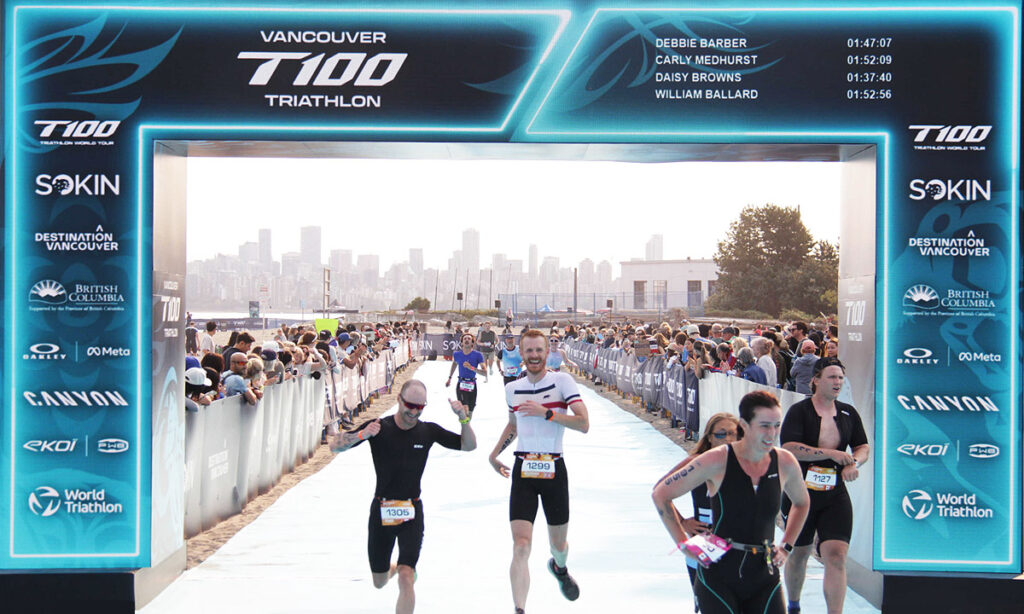
Search T100 Vancouver and most of what comes up is written for the 100km distance: the pros, the broadcast schedule, the Age Group World Championship qualifiers. If you’re actually trying to figure out whether the Olympic distance is worth your race weekend, none of that helps much. I raced it myself in August 2026 with a heart rate strap and power meter running the whole way, so this is a real T100 Vancouver Olympic distance review, not a recycled press release.
TL;DR
Short version: T100 Vancouver’s Olympic race is a legitimate, well-run event with a course that changes almost every year and drafting rules that actually get enforced. It’s also a bigger, more intense day than the local Olympic-distance race down the road, which changes who I’d point toward it.
Key Takeaways
- The bike course only crosses the construction detour once, at the end of the third lap, and there’s no aid station on the Olympic bike leg, so plan your bottles accordingly
- A shuttle delay and a pump problem meant I hit the water with zero time to acclimatize. Build in more buffer than you think you need
- Non-drafting rules aren’t just posted at registration, they’re enforced on course with motorcycle officials
- My run pace held in a tight band for 10km even after a hard bike leg and some early cramping
- Whether this suits a first-timer depends mostly on how you feel about open water, not fitness
The Course This Year
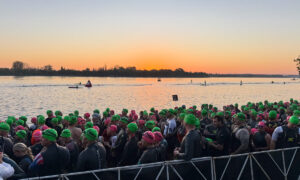
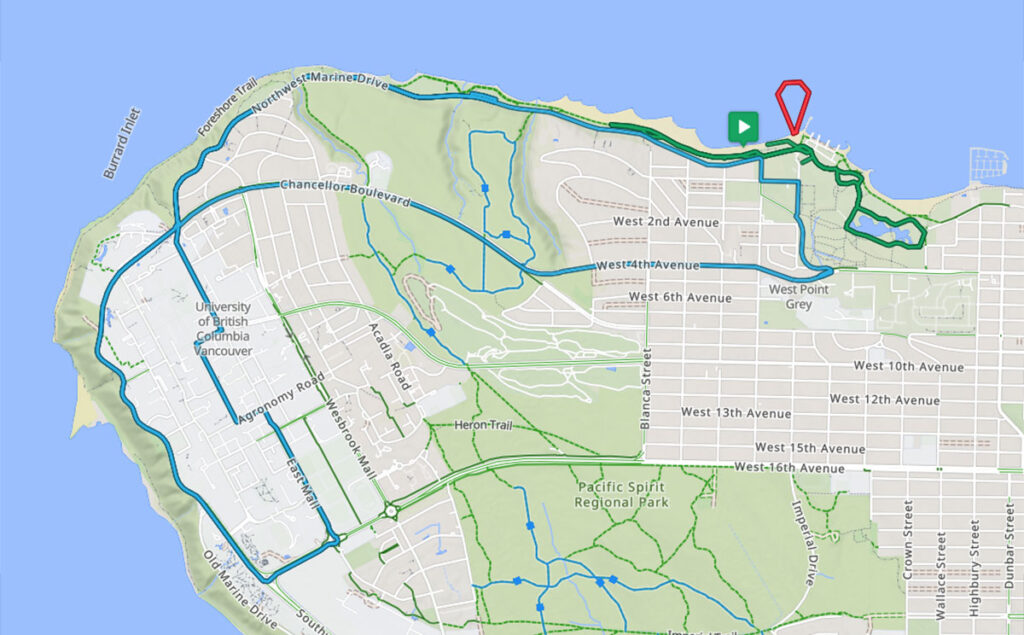
Swim is two 750m laps off Locarno Beach, with an Aussie exit between them (you run up the beach and back in, which sounds harmless until your legs remind you they were built for running, not sprinting on sand).
Bike climbs up NW Marine Drive and West 4th to UBC on the way out, then it’s three laps of a loop that climbs back up the same hill each time, roughly 90m up, back down, repeat. This isn’t a flat course. The construction detour near Spanish Banks Hill only comes into play once, right at the end of the third lap: a gravel-covered ramp for about 30 metres, with reduced speed and no overtaking enforced through that stretch. Well marked, not a big deal in practice, just don’t expect an old course map to match what you actually ride.
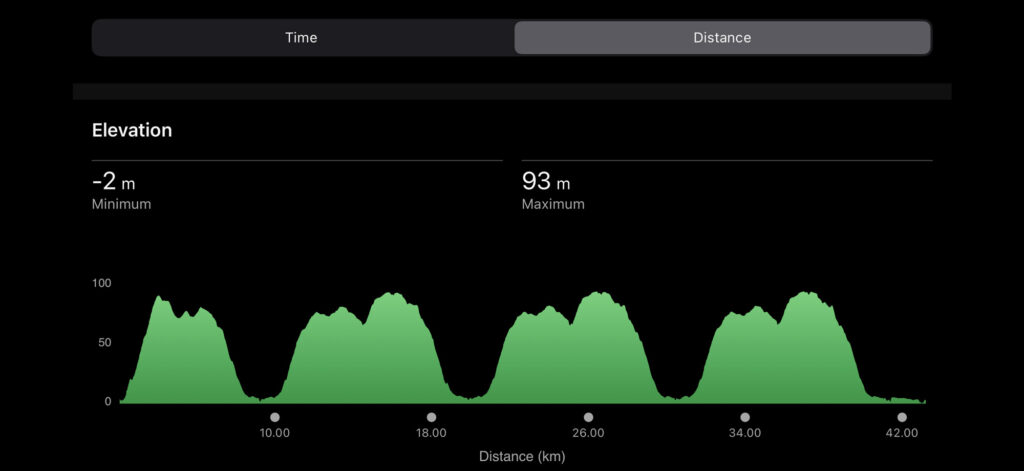
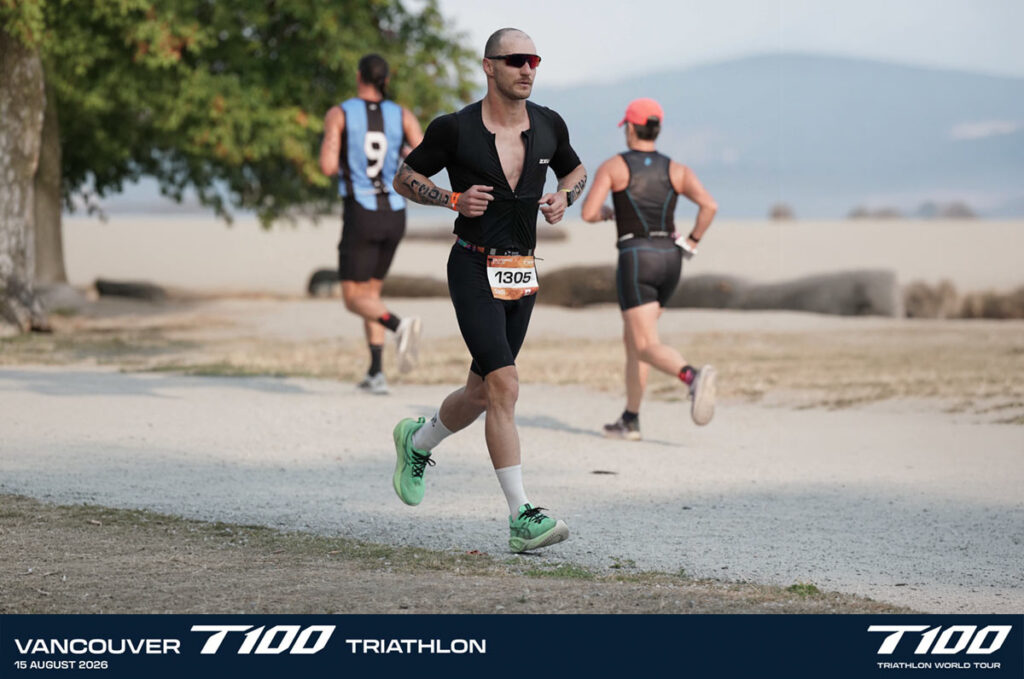
Run is two 5km laps through Jericho Beach Park and along the Spanish Banks seawall. Four aid stations per lap, all stocked with Maurten drink mix, gels, water, cola, and food.
Swim: Cold Water and a Kayak Stop
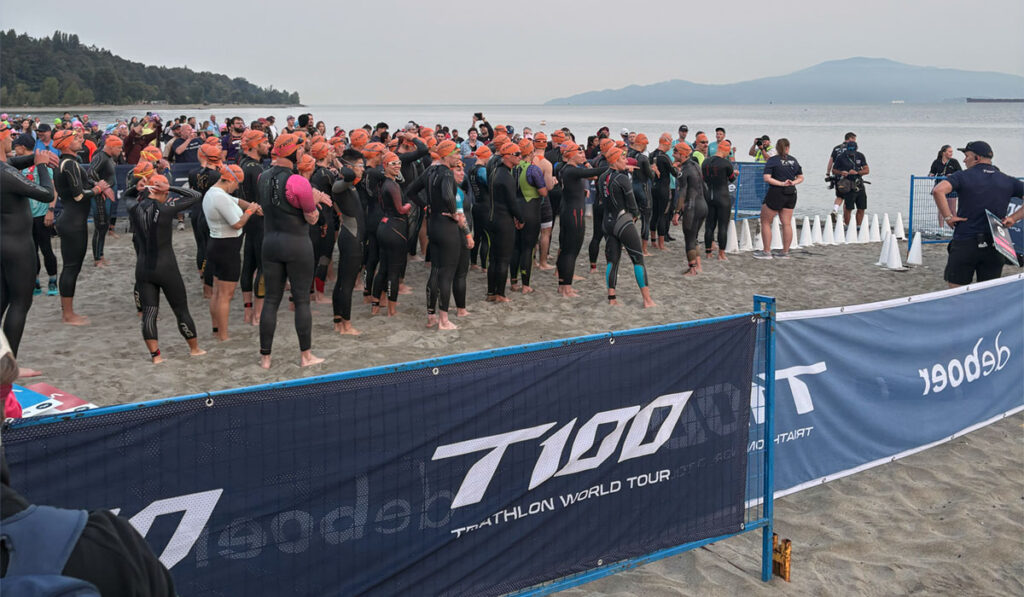
I’ll be honest about this one. My shuttle out to the venue was delayed, and I had a last-minute problem with my bike pump on top of that. By the time I got down to the water, officials had already closed the acclimatization window. Straight into a cold-water race start, no warm-up.
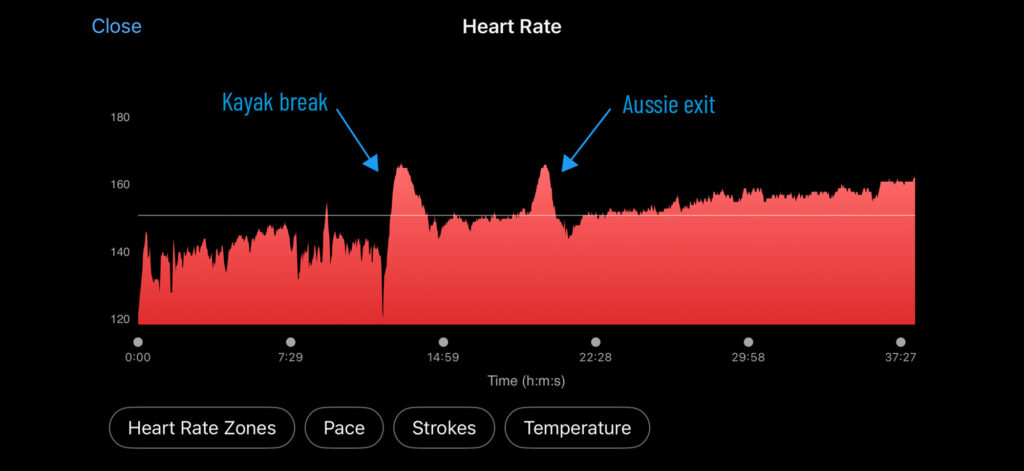
First lap, that caught up with me. The cold hit and I started hyperventilating, and I had to stop at a safety kayak to get my breathing back under control before continuing. Second lap was fine, no stopping.
My heart rate backs up the story: it climbed steadily from 137 to 161 bpm across the swim, a front-loaded climb rather than the settle-into-rhythm pattern you’d usually see with even a short warm-up first.
If you’ve never had to manage that kind of cold-water panic mid-swim, it’s worth reading through our open water swimming tips for beginners before your next race, not after.
Total swim time came out to 37:34 for 1.532km, an average pace of 2:27/100m.
I’m not a fast swimmer under the best of circumstances. My last Olympic-distance swim went fine, no drama, no cold shock, just a normal warm-up and a normal race. This one was a good reminder that all the planning in the world doesn’t matter if the morning itself falls apart around you. Shuttles run late. Gear breaks. The atmosphere on race day can undo weeks of prep before you’ve even gotten in the water. Plan ahead anyway, it stacks the odds in your favour, but go in knowing stuff can go sideways and you still have to swim through it.
Transition: Not a Quick Hop
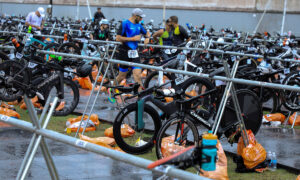
T1 took 5:00 and covered 337m from swim exit to bike out, a real run, not a jog around a cone.
One thing worth calling out: this year’s bike rack layout was fairer than last year’s. Racing the sprint distance in 2025, I landed second-to-last rack, and the layout meant that came with one of the longest run-outs in transition on top of it. I actually flagged it in T100’s post-race feedback survey afterward. This year, racing Olympic, that got fixed. Rack position doesn’t cost you extra time the way it used to.
T2 was shorter, 2:41 over 96m.
More on shaving transition time in our triathlon transition tips post.
Bike: Strong Legs, Light on Fuel
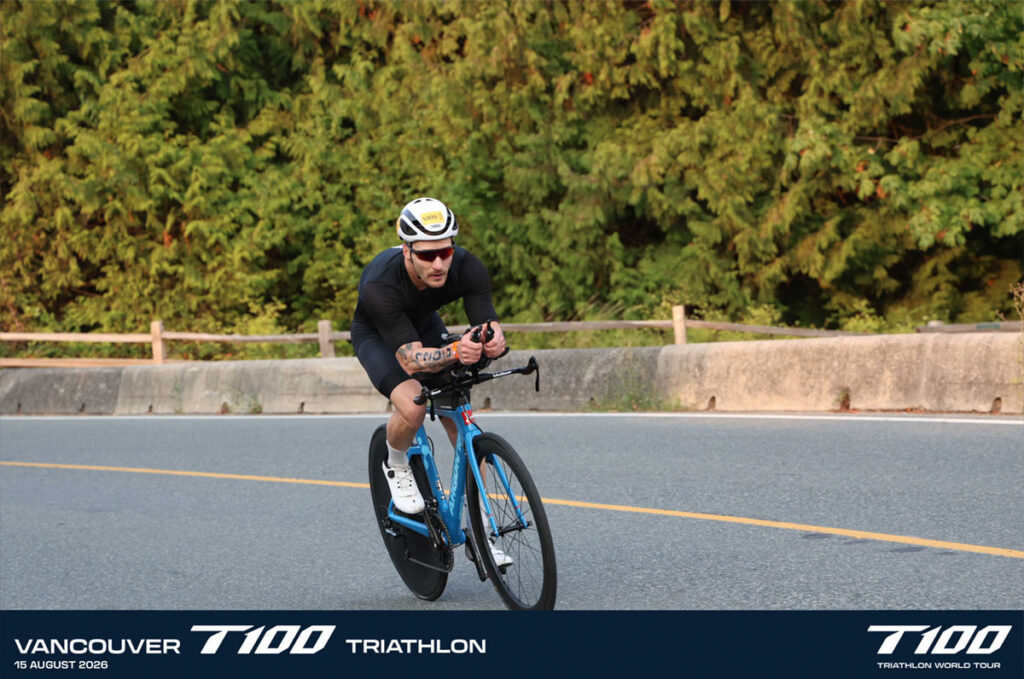
41.491km in 1:20:43, averaging 30.9km/h with a top speed of 49.3km/h, 176W average power. Honestly, it felt good the whole way, hard but sustainable. I’d ridden the course before but never at race effort, so I didn’t have a great time estimate going in. Ended up 3rd in my age group on the bike split, which I only found out afterward.
Where it caught up with me was fuel, not legs. I had 90g of carbs mixed into a 750ml bottle for the full ride, and in hindsight I’d have liked another 30g gel on top of that. There’s no aid station on the Olympic bike course, so whatever you carry out of T1 is what you’ve got.
Not sure how much you need on the bike?
Run your weight and ride time through Our Fuel Calculator to get a real number instead of guessing.
If you’re still dialing in what to carry, our best energy gels roundup is a good place to start.
The drafting rule is real, not decorative. On lap two I noticed a rider behind me trying to pass but not quite committing. A motorcycle official rode up and gave him 25 seconds to complete the pass or drop back. He dropped back. World Triathlon’s competition rules set the 12-metre gap and the penalty structure, and T100 Vancouver was actually policing it.
Run: Where the Data Gets Interesting
The fuel gap from the bike showed up here, not on the bike itself. I felt mild cramping in the first couple of kilometres, gone by km 2 to 3. I can’t say for certain that’s what caused it, cramping usually comes down to neuromuscular fatigue more than fuel in the tank, but under-fuelling on the bike is the more likely explanation than anything else that changed that day.
What actually made me want to write this section: across the run, my pace held in a tight band even with the early cramping and a hard bike leg behind me.
| Segment | Pace (min/km) |
|---|---|
| 0–1.2 km | 4:34 |
| 1.2–3.6 km | 4:54 |
| 3.6–6.0 km | 4:54 |
| 6.0–8.4 km | 4:46 |
| 8.4 km–finish | 4:46 |
Pace stayed inside a 20-second band the whole way, 4:34 to 4:54/km, even through the early cramping. Heart rate started in the low 160s and climbed steadily through the run, spiking to 176 bpm in the final stretch. That’s real cardiac drift under fatigue, not a sign anything went wrong with the pacing.
If HR drift like this is new to you, our heart rate zones guide breaks down why it happens, and our high heart rate on easy runs post covers the same pattern in training.
Logistics Worth Knowing
- Parking at UBC North Parkade isn’t free, $12 for the day. The shuttle to the venue is free, though mine ran late.
- Swim waves are assigned by predicted time and colour-coded by cap: orange (fastest) through blue (slowest).
- Build in real buffer before your wave time. My shuttle was delayed and I had a pump issue on top of it, and by the time I reached the water they’d already closed the acclimatization window. That’s the kind of morning arriving early actually protects you from.
Who Should Race the T100 Vancouver Olympic Distance
For a first or second triathlon, this can feel like a lot. It’s a bigger production than most local Olympic-distance races, with more athletes on course and more going on around race weekend. That’s not a knock, it’s just a different scale of event.
If open water is your main hesitation, the sprint distance uses the same venue and swim format at a shorter distance, which is a reasonable way to get a feel for it first. If you’ve done a triathlon or two already and want a bigger event with real production value, the Olympic distance delivers.
For how this distance compares to going longer, see our T100 vs 70.3 breakdown, and our triathlon distances post if you’re still working out what Olympic distance even means.
FAQ
Is the T100 Vancouver Olympic distance beginner friendly?
It’s manageable for a newer triathlete, but it’s a bigger, more intense event than a typical local race. If open water is your main concern, consider the sprint distance first.
Does T100 actually enforce drafting rules for age groupers?
Yes. Motorcycle officials monitor the bike course, and riders get a 25-second window to complete a pass before it’s called as drafting.
What’s the cutoff time for the T100 Vancouver Olympic distance?
Swim finish by 7:55am, bike finish by 10:00am, run (and overall) finish by 11:30am, based on a 6:30am wave start.
How much does parking cost at T100 Vancouver?
$12 for the day at UBC North Parkade. The shuttle to the venue itself is free.
Related Posts
If you’re deciding between distances, read: T100 vs 70.3
New to open water and want to avoid a cold-water panic of your own: Open Water Swimming: 5 Things Nobody Tells You Before Your First Race
Want to shave time off T1/T2: Transition Tips