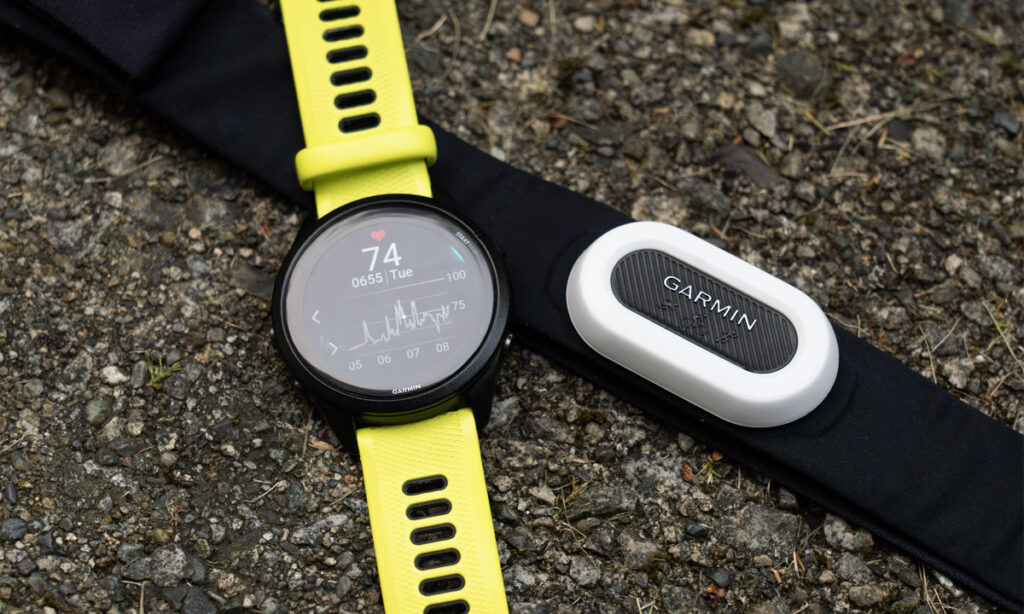
You are two minutes into a run, the watch says 178, and you are fairly confident you are not dying. So you spend the next half hour quietly negotiating with a number on your wrist. I wanted to stop guessing, so I ran a track session wearing a Forerunner 265 on one arm and an HRM-Pro+ chest strap paired to a second watch, then pulled both raw files apart second by second. Here is what 2,401 seconds of paired data says about wrist HR vs chest strap accuracy.
TL;DR
Across the whole session the two devices agreed within 5 bpm for 96.6 percent of the run, including ten hard intervals. They were also 48 bpm apart at one point. Where that happened is the part worth knowing about, because it is not where most people expect.
Key Takeaways
- Optical wrist sensors struggle with fast changes in heart rate, not with high heart rate.
- My wrist error averaged 0.51 bpm when heart rate was steady and 10.26 bpm when it was climbing quickly.
- The worst gap was 48 bpm, and it happened during the easy warm-up jog.
- Through ten reps at Zone 4, peak heart rate never differed by more than 3 bpm.
- The wrist reading trailed the strap by about 7 seconds on average.
The session and the setup
Fifteen minutes of Zone 1 to 2 warm-up, then 10×1 minute at Zone 4 off 1 minute recovery, then five minutes easy. Flat track, 24 degrees, overcast, evening.
The Forerunner 265 was on my wrist, worn snug. The HRM-Pro+ went on my chest, paired over ANT+ to a Venu 3S recording independently. Both files start on the same timestamp, which made aligning them straightforward. I compared them second by second rather than eyeballing two screenshots, which matters more than I expected.
A chest strap is not a hospital ECG. It is, however, the reference that validation studies use, so it is a fair benchmark. Here is the whole session.
What the numbers actually showed
Over the full session, the wrist read 0.80 bpm lower than the strap on average, with a typical error of 1.95 bpm. The two agreed within 5 bpm for 96.6 percent of the run.
Then you split the file at the one minute mark, and the picture changes completely.
| Phase | Average error | Worst error | Within 5 bpm |
|---|---|---|---|
| First 52 s | 27.3 bpm | 48 bpm | 13% |
| Warm-up | 1.27 bpm | 9 bpm | 98.4% |
| Intervals | 1.39 bpm | 7 bpm | 98.9% |
| Warm down | 1.03 bpm | 8 bpm | 98.7% |
Almost all of the disagreement in the entire session is packed into the opening minute. Strip that minute out and the average error drops to 1.30 bpm and the worst reading in the remaining 39 minutes is 9 bpm off.
The first 52 seconds
This is the interesting bit. Second by second, in the opening stretch:
- At 0 seconds: strap 81, wrist 75
- At 10 seconds: strap 112, wrist 75
- At 20 seconds: strap 122, wrist 74
- At 40 seconds: strap 122, wrist 99
- At 52 seconds: strap 127, wrist 127
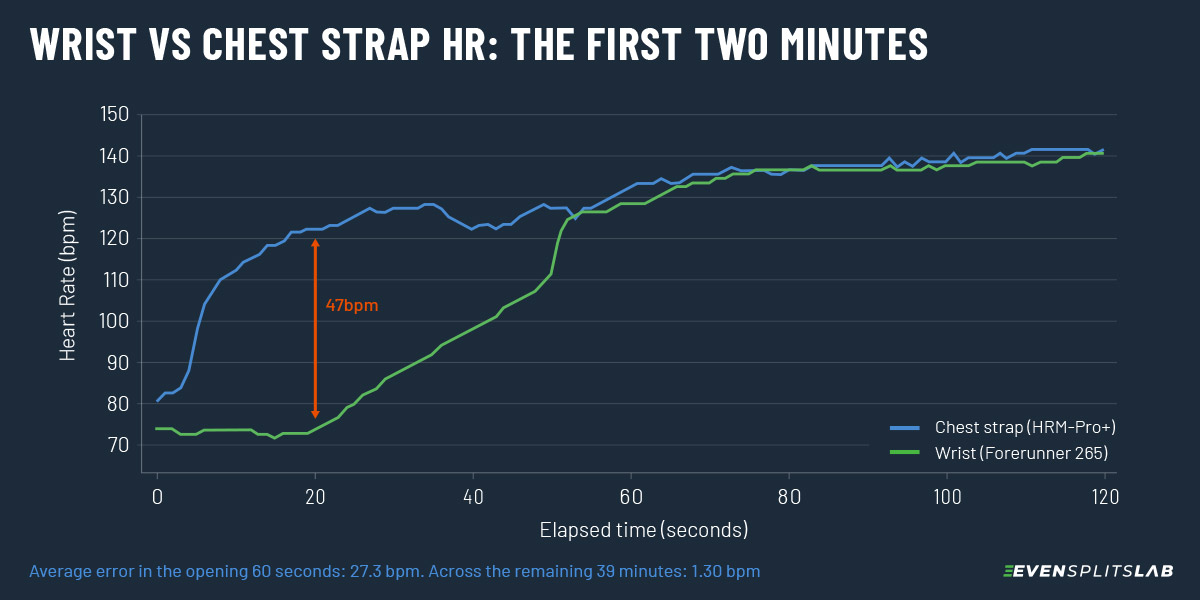
The wrist did not read low. It did not read anything. It sat frozen on 75, my standing heart rate, for the better part of twenty seconds while my actual heart rate climbed past 120. Then it started to catch up, but slowly, and there is a stretch around the 40 second mark where it is moving in the right direction and still 23 bpm short. That is the dangerous part. A wrong number that looks entirely plausible.
It converged at 52 seconds and never drifted apart again.
If you have ever glanced at your watch early in a run and thought the number looked wrong, this is usually why, and it is worth knowing before you conclude that your heart rate is genuinely high on easy runs. The sensor simply has not caught up yet.
Why ten hard intervals did not break it
On paper a 1 minute on, 1 minute off session should be exactly what wrecks an optical sensor. It is close to the protocol researchers use when they want these devices to fail. Mine handled it without complaint.
I pulled the ten reps out of the file automatically using the speed trace. Across all ten, peak heart rate on the strap ranged from 171 to 173. On the wrist, 170 to 173. The largest single deviation inside any rep was 7 bpm, and most were 3 to 5.
The reason is in the shape of the data rather than the difficulty of the session. With only a minute of recovery, my heart rate never dropped far. Across the entire twenty minute interval block it moved between 156 and 173, a total swing of 17 bpm. Compare that to the first two minutes of the warm-up, where it went from 81 to 141, a swing of 60 bpm.
So the intervals were hard but hemodynamically smooth. The warm-up was easy but abrupt. That distinction turns out to be the whole story.
The thing that actually predicts wrist error
I grouped every second of the run by how fast my true heart rate was changing at that moment, then measured the wrist error in each group. When heart rate was flat, the wrist was off by an average of 0.51 bpm. When it was climbing faster than 30 bpm per minute, that rose to 10.26 bpm. A twentyfold increase, driven entirely by rate of change.
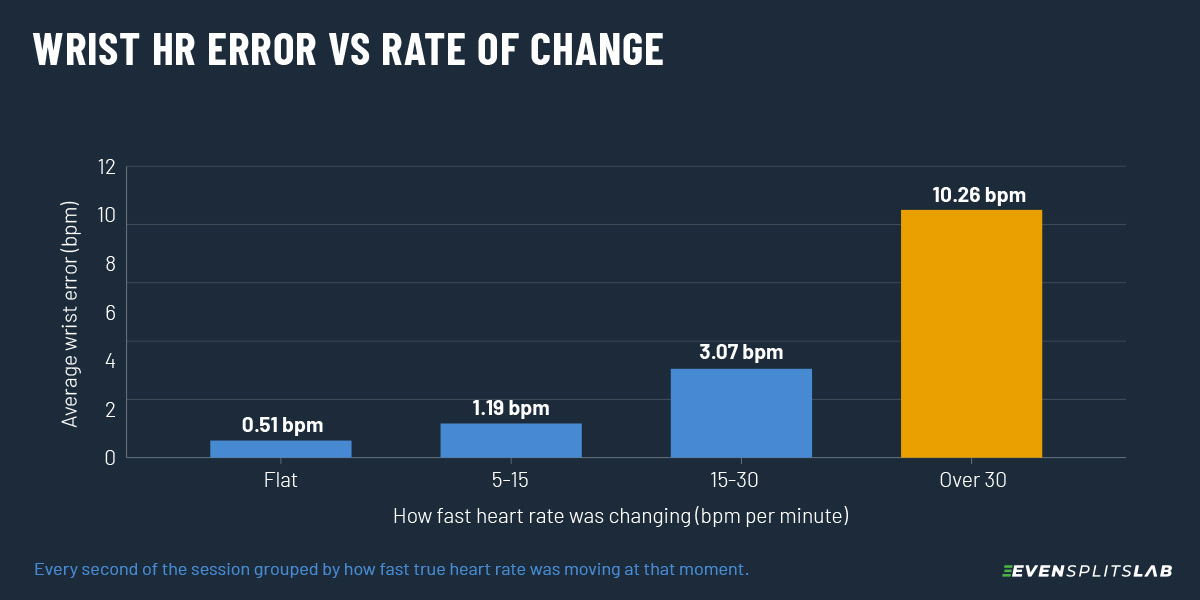
Intensity is not what separates those groups. Plenty of the steady-rate samples came from the middle of Zone 4 reps.
The mechanism is physical. A chest strap reads the electrical signal of the heart contracting. Your watch shines light into your wrist and infers your pulse from changes in blood volume under the skin. There is a genuine delay between the heart speeding up and that showing up at your wrist. Across my whole file, shifting the wrist trace forward by about 7 seconds gave the best match to the strap.
Cadence lock, and why my file is a warning rather than an example
There is a specific failure mode worth being able to spot. Sometimes an optical sensor stops tracking your pulse and latches onto your footstrike instead, because your cadence is a strong, steady rhythm in the same signal. Your heart rate reads 175 while you are jogging easily, and it stays there.
It did not happen to me. I checked directly, and there is not a single second in the file where the wrist heart rate sat close to my cadence while also being wrong.
But look at the numbers side by side during the intervals. My cadence ran between 169 and 179 steps per minute. My heart rate ran between 163 and 172 beats per minute. Those two ranges overlap.
That is the real lesson. If the sensor had locked on during a rep, it would have reported something entirely believable for a hard interval. No obvious spike, nothing to raise an eyebrow at. The failure would have been invisible.
The way to catch it is to put cadence and heart rate on the same watch screen. If the two numbers are moving together, or heart rate is parked at almost exactly your steps per minute, distrust it. Cold weather, a loose band, and hills all make it more likely, and none of those applied to my session.
What my test cannot tell you
One run, one athlete, one watch, in conditions that flattered the sensor. It was 24 degrees, so blood flow at my wrist was good. It was a flat track, so my cadence was metronomic, which actually helps, because the algorithms use an accelerometer to subtract motion noise and predictable motion is the easiest kind to subtract.
Rerun this on a cold trail with uneven footing and I would expect a worse chart. Cold in particular is the classic trigger, because your body pulls blood away from the extremities and leaves the sensor with less to read.
What the wider research says
A December 2025 study tested 16 optical monitors against a chest strap using ten well-trained runners and triathletes, across an incremental test to exhaustion and a HIIT session. Two findings match my file closely. Averaged over a whole recording, nearly every device looks excellent. Split by intensity, most stop looking excellent, and the interval protocol was harder on them than the incremental one. The authors point to the same lag mechanism I measured.
The spread between models is the part worth acting on. The Forerunner 935 and Forerunner 45 were close to flawless above 160 bpm. The much older Forerunner 35 managed an agreement score of 0.161, a bias of 11 bpm, and lost 9.5 percent of its data outright. So “is wrist heart rate accurate” is the wrong question. Which watch you are wearing matters far more than the technology in general, and that holds even among the cheaper models.
Placement matters too. A 2026 study strapped three identical devices to one arm at the wrist, forearm and upper arm, so position was the only variable. Upper arm beat forearm, forearm beat wrist, at every intensity. Your wrist has thin skin, little padding, and tendon and bone that scatter light whenever the joint flexes. A separate 2025 trial found wearing the device three finger-widths above the wrist bone beat one finger-width, which is higher than most people wear a watch.
On tightness, snug is right but there is a ceiling. Too loose and the sensor loses contact, too tight and you restrict the blood flow it is trying to measure.
So do you need a chest strap
Based on my file and the research behind it, here is where I have landed.
Probably not, if your training is mostly steady. Easy runs, long rides, and tempo and threshold work all keep heart rate settled, and my wrist tracked a genuinely hard interval session to within a few beats because of it. Getting your zones right will do far more for you than upgrading the sensor.
Probably yes, if you do short, sharp reps with full recovery, where heart rate swings 40 or 50 bpm between efforts and a 7 second lag will hide what you are actually doing. Same if you train in the cold, if you race off heart rate, or if you track HRV, where beat-to-beat timing has to be exact and optical sensors are on much shakier ground.
And whatever you wear, give it a minute before you believe it. The number on your wrist at minute two is not measuring your fitness. It is measuring how long light takes to notice what your heart already did.
Questions worth answering
Does the chest strap measure cadence better too?
Barely. I checked, expecting the strap to win, because it sits on your torso and registers footstrike directly while a watch infers it from arm swing. They agreed to within 0.8 steps per minute on average, and within 2 spm for 96.5 percent of the run. The strap is about twice as settled second to second, so it gives you a calmer number to run to, but the averages are effectively identical.
Does an armband sensor fix the lag?
Largely. Forearm and upper arm optical sensors beat wrist placement in every condition tested, and they are more comfortable than a chest strap. They are still optical, so the lag does not vanish, but it is a genuine middle ground.
Does a chest strap need to be wet?
Yes, and dry electrodes are the most common reason a strap produces nonsense in the first kilometre. Wet the contacts before you go. Research protocols do this as standard.
Why does my heart rate look fine on the bike but terrible running?
Your wrist barely moves on the bike, especially on the hoods or aero bars. Running swings your arm through a large arc at speed, which is a far harder problem for the sensor.
Do I need to pair the strap a particular way?
For heart rate alone, either connection works. For running dynamics like cadence and ground contact time, Garmin straps have to be paired over ANT+ rather than Bluetooth, which catches people out.
Related Posts
- Working out where your numbers should sit: How to Read Your Heart Rate Zones
- If your easy runs keep reading high: Why Is My Heart Rate So High on Easy Runs?
- Choosing the watch in the first place: Best GPS Watches for Triathletes
Sources
- Oropesa et al. (2026), Concurrent Validity of 16 Commercial Photoplethysmography-Based Heart Rate Monitors, Applied Sciences. https://doi.org/10.3390/app16010126
- Moghaddam et al. (2026), Impact of Anatomical Placement on the Accuracy of Wearable Heart Rate Monitors, Sensors. https://doi.org/10.3390/s26010176
- Vermunicht et al. (2025), Optimization and pre-use suitability selection for wrist photoplethysmography-based heart rate monitoring, European Heart Journal Digital Health. https://doi.org/10.1093/ehjdh/ztaf084
- Bent et al. (2020), Investigating sources of inaccuracy in wearable optical heart rate sensors, npj Digital Medicine. https://doi.org/10.1038/s41746-020-0226-6
- Garmin, HRM-Pro Plus Owner’s Manual, Running Dynamics.