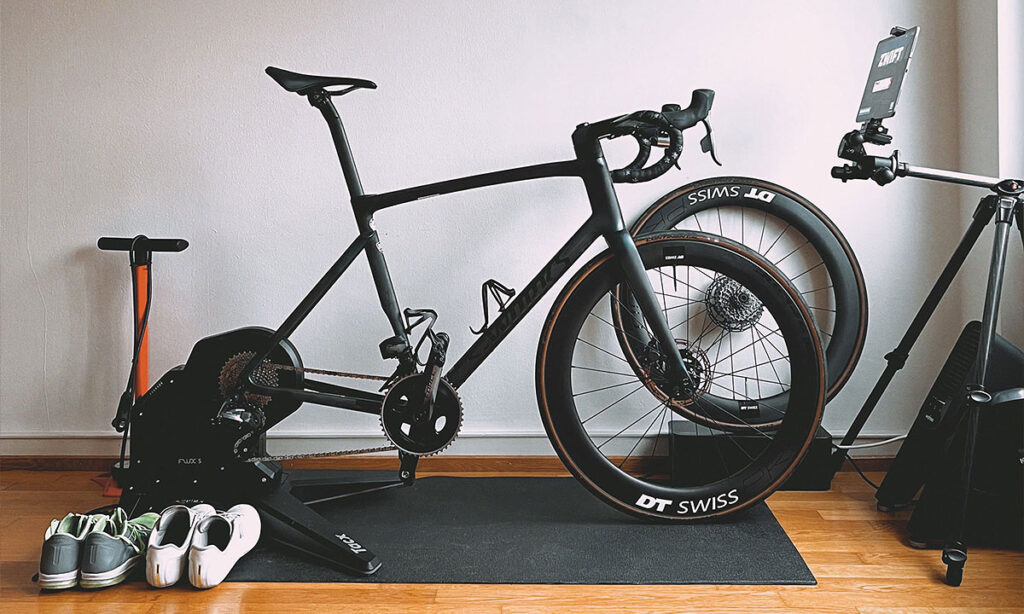
You can cruise along at 150 watts outside, chat with a friend, and feel like you could keep going all afternoon. Put the same 150 watts on an indoor trainer and, 30 minutes later, you’re staring at the clock, sweating through your towel, and wondering why an easy ride feels suspiciously like work. Same bike. Same power. Supposedly the same Zone 2.
So what’s going on?
TL;DR: Zone 2 can feel harder indoors because you lose the cooling effect of moving air, indoor trainers often remove the little breaks you get on the road, and your setup may be measuring power differently. Heart rate can climb as you heat up, even when watts stay steady. But indoor heart rate isn’t always higher. Before changing your training zones, check your cooling and power source.
Key takeaways
- A strong fan can make a bigger difference than another trainer setting.
- In ERG mode, the trainer keeps you working at the target power. There’s no coasting through the easy bits.
- Heart rate and power measure different things. They won’t always tell the same story.
- You usually don’t need separate indoor and outdoor Zone 2 targets just because one ride feels tougher.
- Indoor Zone 2 still counts. It doesn’t need to feel exactly like an outdoor ride to build fitness.
The biggest difference is probably airflow
Outside, you’re creating your own breeze. Even on a relatively calm day, riding at 25 or 30 km/h moves a lot of air across your skin. That helps sweat evaporate and carries heat away.
Indoors, you can be doing the same work while barely moving any air at all. A cracked window isn’t the same as riding down the road. Neither is a small desk fan pointed vaguely in your direction.
Your body still produces heat. With less cooling, skin temperature rises and more blood is directed toward the skin to help get rid of that heat. Your heart may need to beat faster to maintain the effort. This contributes to cardiovascular drift, where heart rate gradually climbs even though power stays the same.
There is a useful study behind the fan advice. In a 2023 study by Fernandez and colleagues, 16 adults cycled indoors at a fixed heart-rate target, once with a fan and once without. With fan cooling, they were able to produce 15% more power on average at that same heart-rate target.
That’s not a promise that buying a better fan will give you 15% more watts. It was a small, controlled study using heart-rate-guided exercise. But it makes the point: cooling can change what a given heart rate costs you in watts.
Before you decide your indoor Zone 2 is broken, point a proper fan at your chest and face.
ERG mode removes the free recovery you get outside
On the road, power is messy. You stop pedalling for a corner, soft-pedal behind someone, roll down a gentle slope, then push a bit harder uphill. Your ride might average 150 watts, but you aren’t holding exactly 150 watts for every second.
ERG mode is different. Set 150 watts and your smart trainer adjusts resistance to keep you near 150 watts as your cadence changes. Wahoo’s explanation of ERG mode is straightforward: slow your cadence and resistance increases to maintain the target power.
That makes ERG brilliant for structured intervals. It’s also why 60 minutes of uninterrupted indoor riding can feel surprisingly demanding compared with an hour outside that includes traffic lights, descents, and stretches of easy spinning.
There’s also the mental side. Outside, you have corners, scenery, traffic and things to pay attention to. Indoors, sometimes your entertainment is watching the remaining workout time change from 37:21 to 37:20. Riveting stuff.
None of this means ERG mode is bad for Zone 2. It just means average outdoor power isn’t a perfect comparison with continuous indoor power. If you’re comparing rides, look at how steady the effort actually was, not only the average watts.
Why Indoor Zone 2 Feels Harder
Outdoor Cycling
-
01
Natural airflow Moving air helps cool your body and evaporate sweat.
-
02
Opportunities to recover Descents, corners and coasting provide brief breaks from pedalling.
-
03
Variable power Power naturally changes with terrain, traffic and conditions.
Indoor Cycling
-
01
Limited airflow Without strong fans, heat builds up and heart rate may drift upward.
-
02
Continuous pedalling ERG mode keeps the resistance steady with little opportunity to coast.
-
03
Consistent power target The trainer maintains your target watts, even as cadence changes.
Same target watts. Different riding conditions. Heart rate and perceived effort can respond differently.
Why is my heart rate higher indoors at the same watts?
Heat is a common explanation, but it’s not the only one.
| What you notice | What might be happening | What to check first |
|---|---|---|
| Heart rate steadily rises while power stays flat | Heat build-up or cardiovascular drift | Fan strength, room temperature, fluid intake |
| Legs feel heavy from the start, but heart rate is normal | Cadence, fatigue, bike position or constant trainer resistance | Cadence, recent training load, saddle setup |
| Indoor watts look much lower than outdoor watts | Two devices may be reporting power differently | Trainer calibration, power-meter source, firmware |
| Heart rate is lower indoors despite similar effort | Different cooling, riding conditions or physiological response | Perceived effort and repeatable trends |
Notice the last row. Heart rate isn’t automatically higher indoors. Older research comparing outdoor and laboratory cycling found that the cardiovascular response depended on the environment and how the laboratory conditions were simulated. The direction of the difference isn’t universal (Brown and Banister, 1985).
One workout with an unusually high heart rate doesn’t prove your zones are wrong, either. Poor sleep, accumulated fatigue, illness, dehydration and caffeine can all affect the number on your screen.
If the ride feels easy and your heart rate is only a little different, there’s usually no need to panic over a few beats.
Power vs heart rate: which should you follow for indoor Zone 2?
Ideally, use both, along with how the ride feels.
Power tells you how much work you’re producing right now. It’s excellent for keeping a steady effort, especially on a smart trainer.
Heart rate tells you how your body is responding. It tends to lag behind changes in effort and can climb with heat, fatigue or dehydration.
Perceived effort is your reality check. Zone 2 should generally feel controlled and sustainable, with breathing comfortable enough for conversation. If you’re struggling to speak in full sentences, the ride probably isn’t the easy session you planned, whatever colour your training app shows.
Say your planned Zone 2 session is 150 watts. For the first 20 minutes, it feels comfortable. By minute 50, heart rate has climbed substantially and your breathing is noticeably heavier.
Don’t force the wattage just to keep the workout looking tidy. Check your cooling and how you feel. If the effort has genuinely moved beyond an easy aerobic ride, lower the target a little.
This matters because Zone 2 isn’t one magic wattage. Different power-zone systems use different ranges, and an FTP-based estimate won’t perfectly identify everyone’s aerobic threshold. If you’re still working out where your easy intensity sits, start with how to find your Zone 2 without a lab test.
Do you need a different FTP for indoor cycling?
Sometimes, but don’t rush into it.
If you consistently produce less power indoors than outdoors, there are several possible reasons: limited cooling, differences in bike position and pedalling, how each power meter measures power, or just how much you dislike riding in one place.
Start with the simple checks:
- Use a strong fan and keep room conditions reasonably consistent.
- Make sure the trainer is set up and calibrated according to its manufacturer’s instructions. Some trainers auto-calibrate; others need a spindown.
- Compare the same power source if possible. A trainer and pedal-based meter won’t necessarily report identical numbers.
- Use a similar cadence and position for your comparisons.
- Look for a pattern across several rides, not a single bad Tuesday.
If there’s still a repeatable difference after that, separate indoor and outdoor FTP values or training targets may be useful. What matters is setting workouts that create the intended effort, not forcing two different environments to produce matching numbers.
Try this 60-minute indoor Zone 2 check
You don’t need a lactate meter or a new subscription. Just a trainer, heart-rate monitor, fan and a way to record power.
The session
- 10 minutes easy: Warm up gradually. Turn the fan on before you get hot.
- 40 minutes steady: Ride at a comfortably sustainable Zone 2 power, keeping cadence reasonably consistent. Don’t chase heart rate minute by minute.
- 10 minutes easy: Cool down.
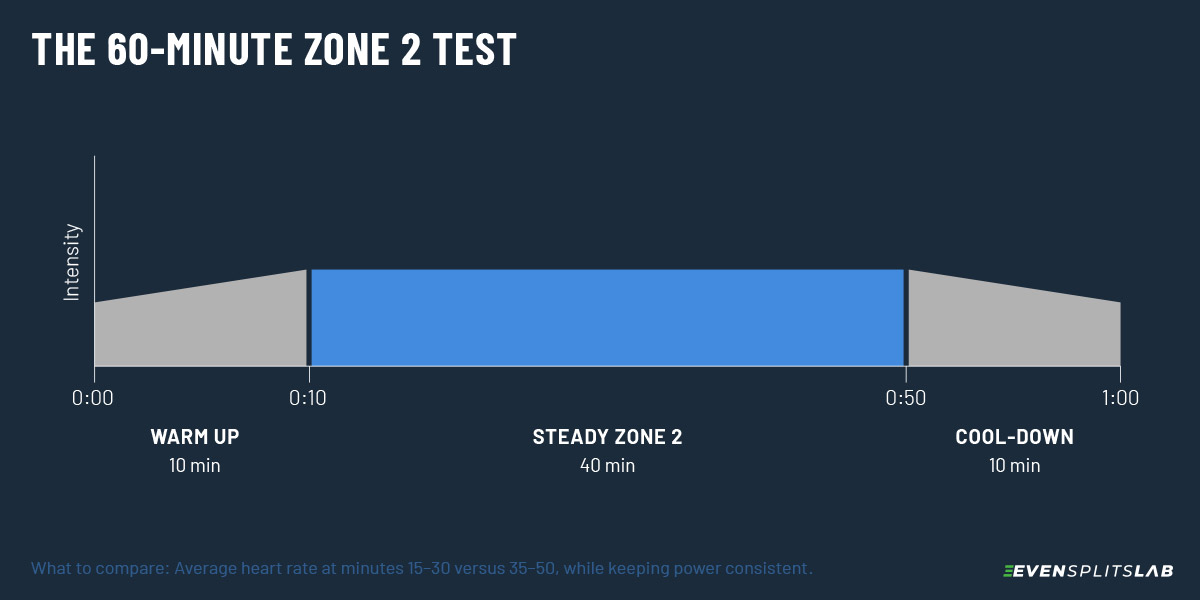
After the ride, compare the middle part of the steady block with the final part. For example, look at average heart rate during minutes 15–30 and minutes 35–50 of the full session, while confirming that power stayed similar.
Write down four things:
- Average power in each section.
- Average heart rate in each section.
- Whether breathing and leg effort changed.
- Room temperature, fan setup and roughly how much you drank.
If heart rate climbs while power stays steady, you’ve spotted drift. You haven’t yet proved why it happened. Repeat the test another day under similar conditions, changing one thing, such as using a stronger fan. A smaller rise with better cooling suggests heat was contributing.
You can also compare the result with a steady outdoor ride, but remember that a route with traffic lights and hills isn’t a controlled test.
If you’re curious about fluid loss indoors, the Sweat Rate Calculator can help you estimate it from a before-and-after workout weigh-in. Just don’t assume every bit of sweat needs to be replaced immediately or that sweat rate alone tells you your sodium needs.
Find your Zone 2 heart rate ceiling
The test only works if you know where Zone 2 ends. Our HR Zone Finder builds your zones from max heart rate or lactate threshold in about two minutes.
Is one hour of indoor Zone 2 as good as one hour outdoors?
For building aerobic fitness, an appropriately paced indoor ride is absolutely useful. Your muscles and cardiovascular system don’t stop adapting because there’s a wall in front of your bike.
What changes is the workout’s specificity. An indoor trainer lets you hold steady power without interruptions. Outside, you’re also practising bike handling, shifting, climbing, cornering and responding to the road. Those skills matter, particularly if you’re training for a triathlon or long ride.
Don’t fall for the idea that one hour indoors automatically equals some magic number of hours outside. There isn’t a reliable universal conversion. Compare duration, intensity and how much actual work you did.
And if your plan calls for a two-hour endurance ride, a one-hour trainer session doesn’t become two hours simply because you suffered more while watching Netflix.
How to make indoor Zone 2 feel better
You don’t need a complicated pain cave. I’d start here:
- Prioritise airflow. A strong fan aimed at your upper body makes a real difference. Two well-positioned fans can help if the room gets hot.
- Start cooling early. Waiting until you’re drenched means you’re already behind on heat management.
- Keep drinks within reach. Indoor riding can mean substantial sweating, even when the room doesn’t feel especially warm.
- Check cadence. If low cadence makes your legs burn, try a slightly higher, comfortable cadence rather than grinding against ERG resistance.
- Choose the right trainer mode. ERG is convenient for a precise target; resistance or simulation mode can feel more natural if you prefer small changes in effort.
- Keep easy rides easy. A Zone 2 session isn’t a fitness test. There’s no prize for finishing it completely cooked.
The bottom line
If Zone 2 feels harder indoors, your fitness probably hasn’t disappeared between the driveway and the trainer. Cooling, constant resistance and differences in measurement can all change how the same wattage feels.
Start with a fan, check that your power numbers are comparable, and pay attention to heart rate and breathing. Then adjust the workout if needed.
Indoor training is meant to help you build consistency through the months when riding outside is less practical. It doesn’t need to mimic every second of a road ride to do that job.
If you’re wondering how this fits into the bigger picture, read Zone 2 vs Zone 3 training and why Zone 2 heart rate differs between running and cycling.