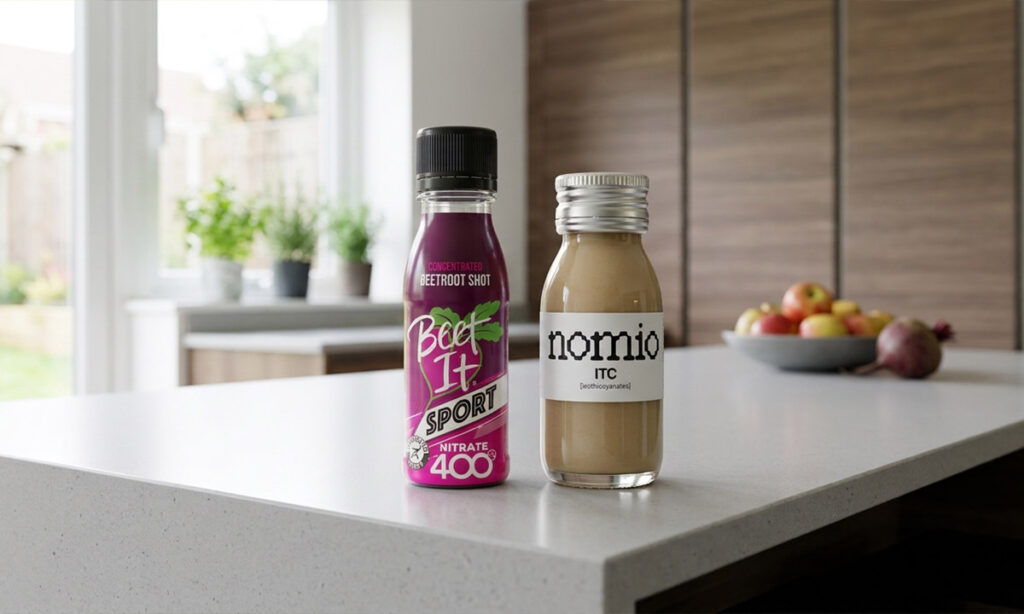
Beetroot juice vs Nomio sounds like the old favourite against the new kid. It’s not quite that. Both shots came out of the same corner of Swedish exercise science, and they do completely different jobs.
One has about 15 years of studies behind it. The other has Olympic champions, pro cycling teams, and some very confident marketing. Both cost more than a coffee and taste worse. If you missed it, the deep dive on the green one is in Does Nomio Work?.
Key takeaways
- Both shots come from the same Stockholm research group, but they work in completely different ways.
- Beetroot juice has the deeper research, but the benefit shrinks the fitter you are. Most age-groupers are still in the range where it helps.
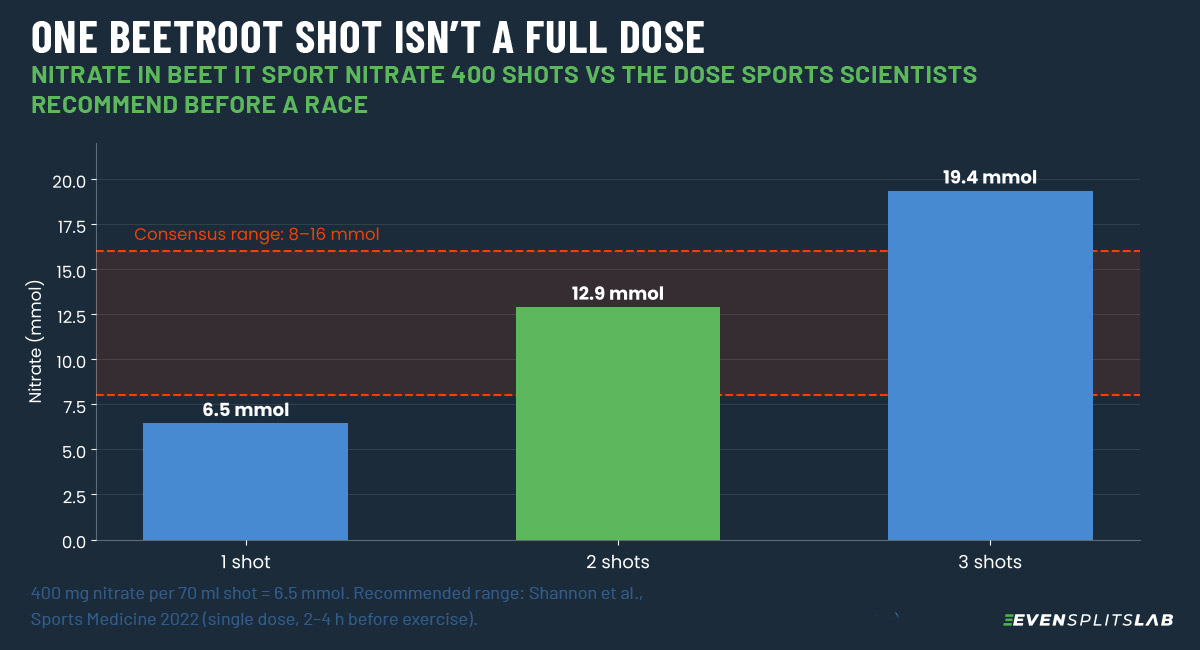
- One beet shot (400 mg nitrate) falls below the dose experts recommend. Two shots, 2 to 3 hours before, lands in range.
- Nomio’s 12% lactate drop comes mostly from the makers’ own lab. Independent proof is still missing.
- Neither one fixes bad fuelling. Sort your carbs first.
Same lab, two shots
A big chunk of the early research on nitrate and exercise came out of Stockholm, from researchers at Karolinska Institutet and the Swedish School of Sport and Health Sciences (GIH). That work is a big reason beetroot juice became a thing in endurance sport.
The same group then spent years on a second idea: compounds from broccoli sprouts. That became Nomio. Filip Larsen, the scientist behind it, also co-authored the 2022 expert consensus on how athletes should dose nitrate. He talks through the science in this Roadman Cycling interview.
So this isn’t hype versus science. It’s one lab’s first big idea against its second one. That’s a fairer fight, and a more interesting one.
How beetroot juice and Nomio actually work
Beetroot juice
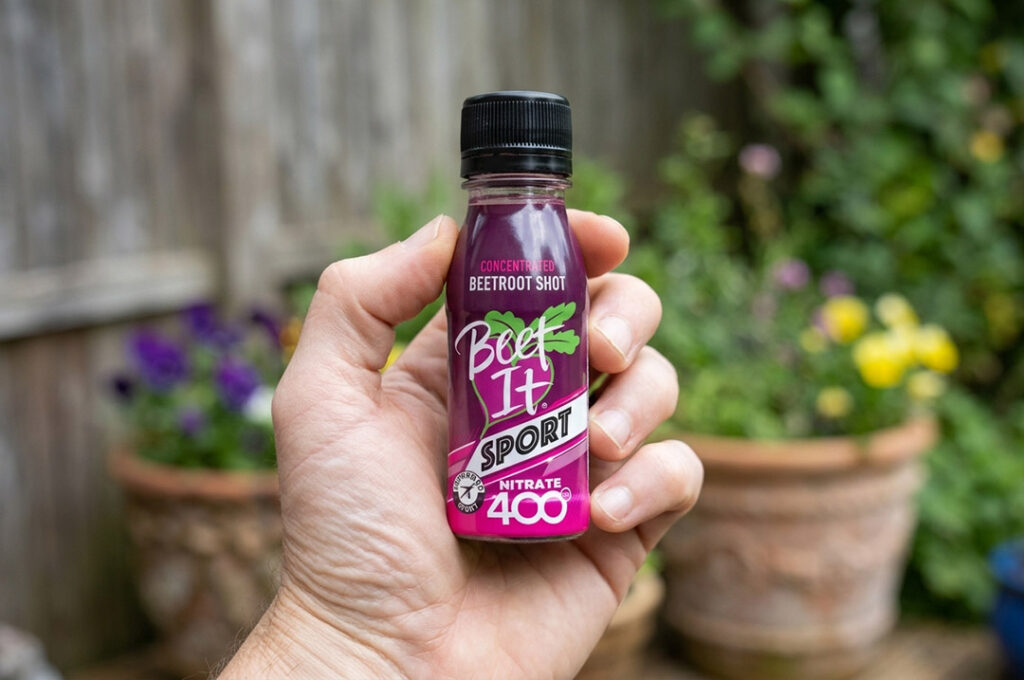
Beets are high in nitrate. Your body turns it into nitric oxide, and in plain terms, your muscles get the same work done with a bit less oxygen.
Here’s the weird part. The first step of that conversion happens in your mouth, thanks to bacteria on your tongue. Antibacterial mouthwash can blunt the effect, which researchers showed back in 2008 (Govoni et al.). So your morning mouthwash might be quietly cancelling your pre-race shot.
Nomio
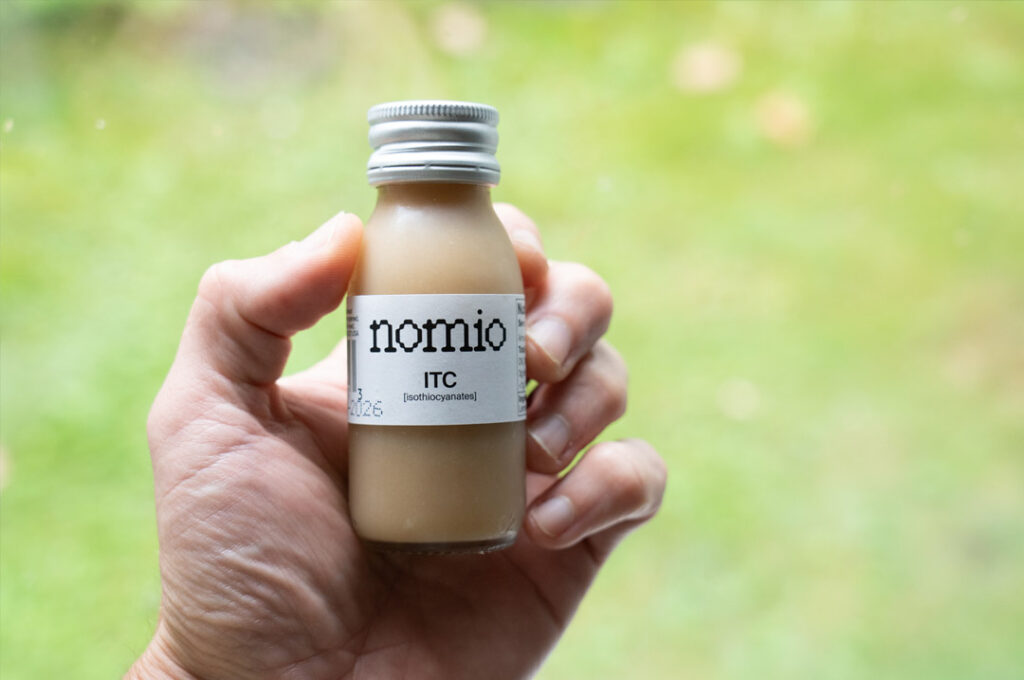
Nomio is a concentrated broccoli sprout extract. The active compounds are isothiocyanates, mainly sulforaphane. They switch on a pathway called Nrf2, which runs your body’s own antioxidant defences.
The idea is to prime that system a few hours before a hard session. You go into the effort better prepared for the stress, and in theory you produce less lactate at the same pace or power.
Different mechanisms, then. Neither one is a stimulant. Neither one replaces carbs.
What the evidence actually says
Beetroot juice: lots of research, with a catch
A 2021 meta-analysis in the Journal of the International Society of Sports Nutrition pooled 118 studies on foods that boost nitric oxide. Nitrate came out looking useful overall. The catch: highly trained endurance athletes didn’t seem to benefit from nitrate-rich foods.
That pattern keeps showing up. The fitter you are, the smaller the effect. Elite athletes may already be so efficient that there isn’t much left for nitrate to improve.
For most self-coached age-groupers, that’s actually good news. If you’re fit but not elite, you’re probably in the range where beet still helps. Probably. People respond very differently, and some barely respond at all.
Nomio: promising, but mostly from one lab
Nomio’s headline claim is about 12% lower blood lactate during steady, below-threshold efforts. Those numbers come from studies at GIH, the makers’ own research group. The most recent one is a preprint, which means it hasn’t been through peer review yet. If lactate is new territory, the basics are in our post on lactate gels.
Independent evidence is thin. As of April 2026, Marathon Science pointed out that no fully independent trial on broccoli sprout extract and exercise performance existed. One outside study (Cesanelli et al., 2026) tested a broccoli powder mixed with mustard seed and found no performance benefit. That’s a different product, so it doesn’t sink Nomio. It just doesn’t help it either.
Also worth saying: lower lactate isn’t the same as a faster race. It’s a marker. Promising markers have a habit of not showing up on race day.
The good news is an independent timing trial is now registered on ClinicalTrials.gov. If it confirms the lactate effect, Nomio’s case gets a lot stronger.
Who each one suits
Beetroot juice makes sense if you’re fit but not elite and want the option with the most research behind it. That covers most age-groupers.
Nomio makes sense if you’re curious about newer science, you’re heading into hard training blocks, and the price doesn’t bother you. Just go in knowing it’s still a bet.
Neither makes sense if your fuelling isn’t sorted yet. A shot won’t rescue a race where you ran out of carbs at 60 minutes. Start with a simple homemade carb drink and come back to this later.
Dose and timing: the part most people get wrong
Beetroot juice
One Beet It Sport Nitrate 400 shot has 400 mg of nitrate, which works out to about 6.5 mmol. A 2022 expert consensus in Sports Medicine recommends 8 to 16 mmol for a single pre-event dose, taken 2 to 4 hours before you start.
Do the maths and one shot falls short. Two shots land right in the middle of the range.
Two more things. Skip antibacterial mouthwash on the day. And swallow normally afterwards, since your saliva is part of the process. Odd advice, but that’s how it works.
Side note: beet can turn your pee pink. It’s harmless. Better to hear it here than discover it in a race-morning portable toilet.
What about beet capsules and powders?
Most of them don’t list nitrate content at all, and that matters. A 2019 study by Gallardo and Coggan tested 24 beet products marketed to athletes and found a roughly 50-fold difference in nitrate between the lowest and the highest. Only five of them reliably delivered a useful dose.
If the label doesn’t state nitrate in milligrams, assume you don’t know what you’re getting. You might be paying for beet-flavoured hope.
Nomio
Nomio’s guidance is one 60 ml shot about 3 hours before a hard session or race, one to four times a week. On especially hard days, the brand suggests a second shot before bed. No loading phase.
The race-morning problem
Both shots want roughly 2 to 3 hours before your start. For a 7 a.m. race, that’s a shot at 4 a.m. Good luck with that alarm. If you’re already up for breakfast, fold it into your pre-race eating plan and test it in training first.
Cost per session
Prices checked November 2026. They move, so check before you buy.
| Shot | Box price | Per shot | Per session |
|---|---|---|---|
| Nomio | $40 CAD (4) | $10 CAD | $10 CAD (1 shot) |
| Beet It 400 | [VERIFY] (15) | ~$4 USD | ~$8 USD (2 shots) |
On box price, beet looks like the bargain. At the dose that matches the research, that advantage mostly disappears. Two beet shots per session lands in the same ballpark as one Nomio.
[Some links below are affiliate links. If you buy through them, Even Splits Lab earns a small commission at no extra cost to you. It helps keep the calculators free.]
If you want to try beet the way the studies used it, Beet It Sport Nitrate 400 is the standardised option: Check it on Amazon
Can you take both?
In theory, there’s no conflict. They work in different ways and the timing overlaps nicely. In practice, no study has tested them together, so any combined benefit is a guess.
If you want to try it, add one at a time in training and see how your stomach handles it. Three shots before dawn is a lot of liquid. Never try it for the first time on race day.
The verdict
Beetroot juice is the better-backed bet for most age-groupers. Take enough of it, give it two to three hours, and leave the mouthwash in the cupboard.
Nomio is a bet on newer science from a credible lab. It might turn out to be excellent. Right now, most of the evidence comes from the people who make it, and that’s worth knowing before you pay $10 a shot.
Neither one fixes bad fuelling. Like carbon plate shoes, these are small gains you pay for once the basics are done. If your gels and bottles still need work, start with the gels.