The Great Trek will always mean something to me. It was my first 5K, back in 2022, and it was cold and raining. This year I went back for my third half marathon, and the forecast said cold and rain again. I finished in 1:46:55, ten minutes faster than my BMO half last year, or almost nine once you take out a bathroom break. Here’s my Great Trek half marathon review, with the splits, the route and what I’d tell anyone running it in the years ahead.
TL;DR: The Great Trek half marathon is two hilly loops around UBC, and it rewards runners who hold back early. I ran 1:46:55 in cold rain with an average heart rate of 168 bpm. The splits show exactly where the time came from.
Key takeaways
- The climb after km 3 is where people burn their matches. Let the pace drop and move on.
- A pace window works better than a single target. Mine was 4:55 to 5:30 per km.
- My second 10 km was 2:42 faster than my first, at the same heart rate (168 bpm in both halves).
- Cold rain was fine. I’d take it over desert heat any day.
- The route changed in 2026, so check the official map before you plan around old results.
My first race was the Great Trek 5K
The Great Trek is where my racing started. I just didn’t know it at the time.
It was 2022, the 5K, cold and raining. I wore my first running shoes, a grey pair of Brooks Ghost 14s. I finished in 25:30, 103rd in my age group (30 to 39), and my heart rate got up to 195. That’s not bad for someone who didn’t run regularly or follow a proper training plan.
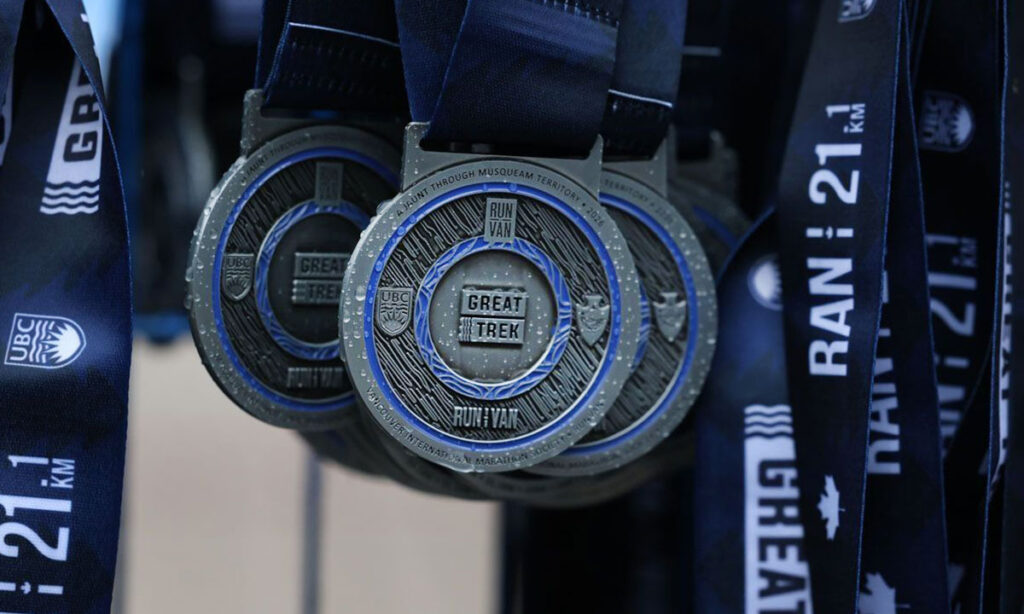
The medal went straight into a drawer and stayed there for quite a while.
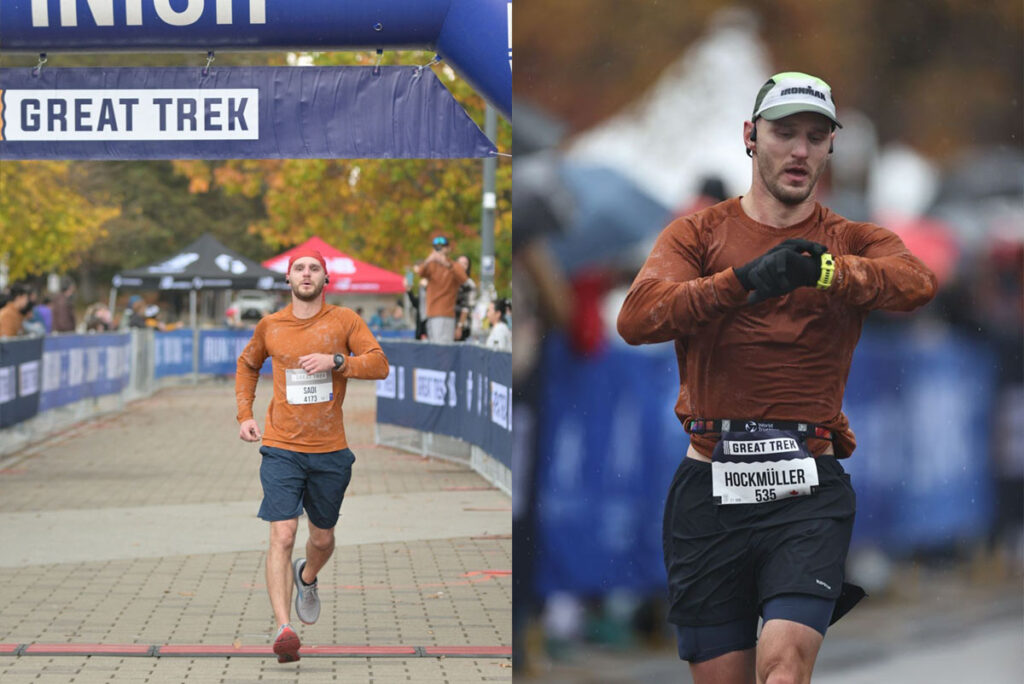
Back four years later for a third half marathon
Fast forward four years. I was getting ready for my third half marathon. The second one was the run leg of my first 70.3, after a 90 km bike ride.
A few days before the race I had the same dreading feeling as in 2022. The forecast said rain and cold. Vancouver in late October is a weather gamble you’ll most likely lose. Last year’s Great Trek 10K had the same kind of weather, and that’s the day I got my 10K PR.
On race morning I was at the corral by 8:20, near the start line. It was cold. I wore the same long-sleeve shirt as in 2022, but this time I had four gels in my shorts pocket and I was better prepared.
My goal was to beat the 1:55 I ran at BMO in 2025. The clock said 1:57:16, but I paused my watch for a bathroom stop, so the actual running was 1:55:48. I didn’t train properly for BMO. It was my C race that year, I was focused on triathlon, and my longest run before it was 16 km at an easy pace.
This time I had about three weeks of proper run training after my first 70.3 on September 20: roughly 25, 30 and 33 km a week, with a longest run of 15.7 km. On paper that’s not much, so I suspect the triathlon base did a lot of the heavy lifting. Matching 1:55:48 meant about 5:29 per km, which looked totally doable. It was also the last race of my season, so I put zero pressure on myself.
What the Great Trek half marathon course is really like
The Great Trek half marathon is two loops of the 10 km route through Musqueam territory and around the UBC campus, with a short extra bit added to make 21.1 km. The course certificate for the 2022 route describes it that way, but the campus section was different this year (more on that below), so check the official race site for the current map. The half starts at 8:30 a.m. on East Mall in front of the Irving K. Barber Learning Centre, and the finish is in University Commons, according to UBC’s event page. There’s no big hill on the course. There are a lot of small ones.
Strava gave me 163 m of climbing for the whole race. That’s not a mountain. It comes in small doses, and small doses are what catch people out.
About 3 km in, there’s a short climb on Old Marine Drive. I’d call it 500 m at roughly 3%. There’s a downhill right before it, and that’s the trap. People fly down it, hit the climb and spend their legs before the race has really started.
After the turnaround at about the halfway point of each loop, the way back is a steady drag of around 50 m over roughly 5 km. It runs along SW Marine Drive, then up West Mall and through Mathematics Road across to Main Mall, on the way back toward the finish area. You barely notice it, but your pace does. On my watch, km 6 to 8 each climbed 11 to 14 m. My pace sat at 5:15 to 5:17 and my heart rate at 170 to 172.
Most of my training runs gain 5 to 25 m in total, so hills are not my specialty. I let the pace drop to about 5:50 on the climb and kept the effort steady. The hills are what get people at this race, especially anyone who doesn’t train on them.
One thing to know if you ran it before: the route through campus was different this year. Last year’s course went up University Boulevard. This year it climbed West Mall and cut through Mathematics Road across to Main Mall. By Strava’s numbers the climbing is about the same either way, roughly 86 m for last year’s 10K and about 80 m per loop this year, though watch altitude is noisy. I can’t tell you whether the new version is faster or slower. Check the official map before you build a PB plan around old results.
Half marathon pacing: a window, not a number
I set two alerts on my Garmin: 4:55 for too fast and 5:30 for too slow. The plan was to run by feel and stay between them.
Shortly after the start, the watch told me my pace was too high. It said 4:22. That’s adrenaline, and it happens at every start line. The first kilometre came in at 5:04, a bit hot. I backed off to 5:18 for the second one. After that my pace moved up and down inside the window and I felt good, so I kept it there.
I started between the 1:50 and 1:55 pacers and tried to stay between them.
Loop two is where the race happened
After the first loop I took a caffeinated gel (30 g of carbs) and checked in with myself. Legs were fine. I was soaked, but not cold. So I nudged the pace toward 5:00 per km to see how it felt.
My main worry was a repeat of the 70.3 run, where I dragged myself through the last few kilometres. That day I’d had two gels and water, and my stomach complained for most of the run (our post on stomach issues during a run covers what I’d change). This time I had four gels with me.
From km 11 to 18, my watch showed eight kilometres in a row between 4:53 and 5:00, with my heart rate at 166 to 169. Around km 13, I got close to the 1:50 pacer and their group. That’s when sub-1:50 started to feel possible. There was still a long way to go.
At km 18 I took my last gel and spent whatever I had left. The next kilometres went 4:44, 4:47 and 4:38, and the last 300 m or so was at about 4:10 pace. My heart rate never went past 179.
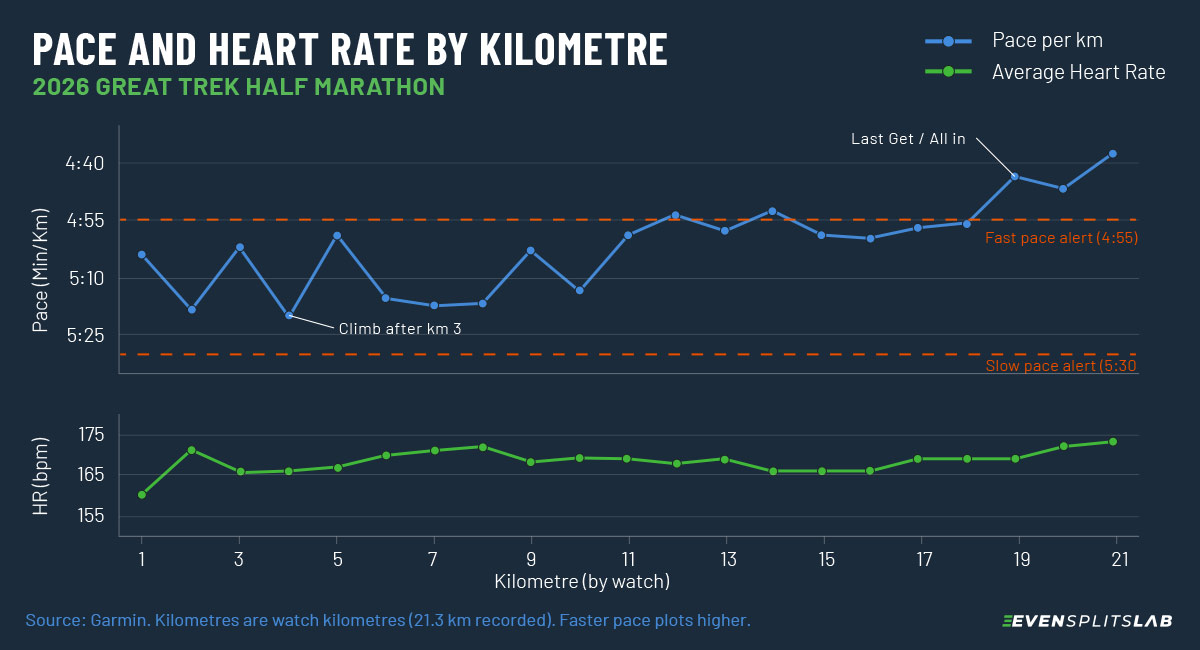
I like the bottom half of that chart best. From km 3 to the finish, my heart rate stayed inside a seven-beat band (166 to 173 bpm) while my pace went from about 5:11 per km over the first 10 km to 4:38 at km 21.
By watch laps, the first 10 km took 51:49 and the second 10 km took 49:07. That’s a negative split of 2:42 on a course that climbs about the same on both loops. Roughly the same drag back toward campus (km 17 and 18 on my watch) went 4:57 and 4:56 at a heart rate of 169. The first time through it was 5:15 to 5:17 at 170 to 172.
From a 25:30 5K to a 1:46:55 half
Saturday’s half marathon averaged 5:04 per km. My 2022 5K averaged 5:06, for under a quarter of the distance. Here’s how those two races and the two in between stack up.
| Race | Distance | Chip time | Pace | Avg HR |
|---|---|---|---|---|
| 2022 Great Trek | 5 km | 25:30 | 5:06 /km | 165 bpm |
| 2025 BMO Half* | 21.1 km | 1:57:16 | 5:29 /km* | 165 bpm |
| 2025 Great Trek | 10 km | 48:11 | 4:49 /km | 176 bpm |
| 2026 Great Trek | 21.1 km | 1:46:55 | 5:04 /km | 168 bpm |
*BMO includes a bathroom stop. The pace for that row uses my moving time of 1:55:48.
Compared with BMO last year, Saturday was 25 seconds per km faster for a heart rate three beats higher. Compared with 2022, it was the same pace for more than four times the distance. My fastest 5 km inside Saturday’s race, the final one, took 23:47 on my watch. That’s faster than my entire 2022 race.
My heart rate topped out at 195 in 2022. On Saturday it never got past 179. If you’re not sure what those numbers mean for you, our heart rate zones guide is a decent place to start.
Why cold rain keeps working for me
I dreaded the cold and rain right up to the start, and my body seems to like it anyway. There’s something about running in miserable conditions that I can’t explain. My best guess is that I just want it over with, so I get on with it.
For contrast, my 70.3 run in Washington’s Tri-Cities was scorching desert heat. It took about 2:01, with cramps at km 1 and stomach trouble after (our hot weather triathlon nutrition guide covers what heat does to fuelling). One race each isn’t a study. Still, I prefer cold, wet Vancouver to that heat, and my subconscious seems to agree.
Coming back from shin splints and soleus pain
I don’t think of myself as a good runner. Early this year I had persistent soleus pain and shin splints. I saw a couple of physios and tried different shoes. By February I was running and walking, slowly building back up. One Strava note from February 28 says it plainly: the pain built up fast and I had to stop. If that’s you right now, our posts on how to get rid of shin splints and keeping your fitness while injured cover the practical side.
One thing that changed was my step rate. In January my easy runs averaged around 160 steps per minute. By October they were sitting at 170 to 175, and the race averaged about 177. Part of that is just running faster, since cadence rises with pace. But the easy runs moved too.
A 2011 study from Heiderscheit’s group at the University of Wisconsin put 45 recreational runners on a treadmill and found that raising step rate by 5 to 10% reduced the load on the hip and knee. That’s hip and knee, not shins, and it’s one lab study, so I’m not claiming cadence fixed mine. I also changed shoes, saw physios and ran a lot slower for a while. I’ll just say the higher step rate fit with feeling better.
Patience is boring, and it works. At the finish the pain was still there once my body cooled down, but it felt like a different kind of pain. Two days later I’m stiff, with almost no shin pain.
Running the Great Trek half marathon in the years ahead
Dates, routes and registration details change, so treat this as what I’d do, not a rulebook. The Great Trek is held in late October at UBC, and it’s the last of RUNVAN’s four events of the year.
- Check the course map every year. The 2026 route through campus was different from 2025, so old notes and old results may not line up.
- Register early. RUNVAN’s preview for last year’s race listed it as sold out.
- Treat the climb after km 3 as a toll, not a fight. Km 4 came in at 5:20 and I got the time back later.
- Run loop one like a warm-up. Let loop two be the race.
- Use a pace window and ignore the first alert. Adrenaline lies for the first few minutes.
- Carry your fuel. I had four gels. The caffeinated one went in after loop one and the last one at km 18.
- Dress for wet more than cold. A long-sleeve shirt was enough for me, but I warm up pretty quickly, so use your own judgment.
- Make it part of a season. The Great Trek is the fourth event in RUNVAN’s Grand Slam, along with the First Half, the BMO Vancouver Marathon and the Granville Island Turkey Trot.
I’ve run three Great Trek races and all three were cold and wet. Plan for it. And yes, I’m probably signing up for another half marathon.
Plan your own pace window
Pick a goal time and see the pace per kilometre it needs. Our Pace Calculator takes about a minute.
Great Trek half marathon race day basics
What time does the Great Trek half marathon start? 8:30 a.m. The 10K goes later in the morning, and the 5K starts around noon.
Does the Great Trek course change from year to year? It did in 2026. The campus section was different from last year: the route climbed West Mall and went through Mathematics Road to Main Mall instead of going up University Boulevard. Look at the official course map each year before you plan around old results or old pacing notes.
Are there pacers? Yes, RUNVAN provides them. I started between the 1:50 and 1:55 groups.
Where do I pick up my race kit? RUNVAN lists package pickup at Forerunners on Main Street during race week. Check the official site before you go, because details change from year to year.
Sources
- Heiderscheit BC, et al. Effects of step rate manipulation on joint mechanics during running. Medicine & Science in Sports & Exercise, 2011. pubmed.ncbi.nlm.nih.gov/20581720
- Great Trek, official race site (RUNVAN). greattrek.ca
- UBC Planning, Great Trek event page. planning.ubc.ca/event/great-trek
- Athletics Canada road race course certificate, UBC Great Trek 2022 route. acroad.ca certificate