
The race season ends, the days get darker and wetter, and training quietly gets lighter. That part is normal. Most of us back off after the last race, and we should. The harder part comes after that. How do you stay motivated when the long ride is a trainer session and the run happens in the dark? And how much do you actually need to do to keep your fitness from slipping away? That’s what winter training for triathletes really comes down to.
TL;DR
You don’t need summer volume to hold your fitness through winter. You need a few sessions that still feel hard, one longer one, and a reason to keep showing up. The trainer and treadmill take care of the first two. The weight room is where winter can actually make you better, and it’s the part most age-groupers skip.
Key takeaways
- Fewer and shorter sessions are fine in winter. Dropping all the intensity is what costs you.
- The indoor trainer gets more work done per hour than riding outside, but it needs a fan and more fluid than you think.
- Set the treadmill to 1% for steady and faster runs, and run by heart rate or effort, not the console.
- Two heavy lifting sessions a week through winter can make you more economical on the bike and run.
- Keep one long session a week so your long-distance endurance doesn’t quietly fade.
What winter training for triathletes is actually for
Winter training for triathletes isn’t about building peak fitness. It’s about keeping the fitness you have, fixing one or two weak spots, and getting stronger in the weight room while the endurance load is lower. If you finish winter roughly as fit as you were in October, but stronger and less beat up, you’ve won.
That’s a lower bar than most of us set. It’s also a bar you can actually clear in January.
How fast fitness fades when you stop
Stopping completely is what hurts. Iñigo Mujika and Sabino Padilla, who wrote the reviews most of this field still leans on, split detraining at four weeks. Aerobic fitness starts slipping within the first few weeks off, and past four weeks the losses get bigger. Fitness you only recently built tends to go first.
So a one to three week break after your last race is fine, and probably smart. Your head needs it as much as your legs. A three-month break is not a break. It’s a rebuild.
How little you can get away with
The more useful research is about cutting back, not stopping. In a classic set of studies, Robert Hickson had people train six days a week, then reduced their training for 15 weeks. Cutting down to two or four days a week kept their VO2 max at trained levels. Cutting each session’s length by a third or two thirds also held VO2 max, but the group on the shortest sessions lost about 10% in a two-hour endurance test.
Then he cut the intensity instead. That’s when fitness dropped.
Quick caveat: these were young adults doing short, hard 40-minute sessions, not triathletes doing 12-hour weeks. Don’t treat the numbers as a prescription. The pattern is what matters. You can cut how often and how long you train. Cut the intensity and the fitness goes with it. And long endurance needs at least one longer session to stick around.
Which is convenient, because winter is exactly when nobody wants to train long.
The indoor bike trainer: less fun, more training
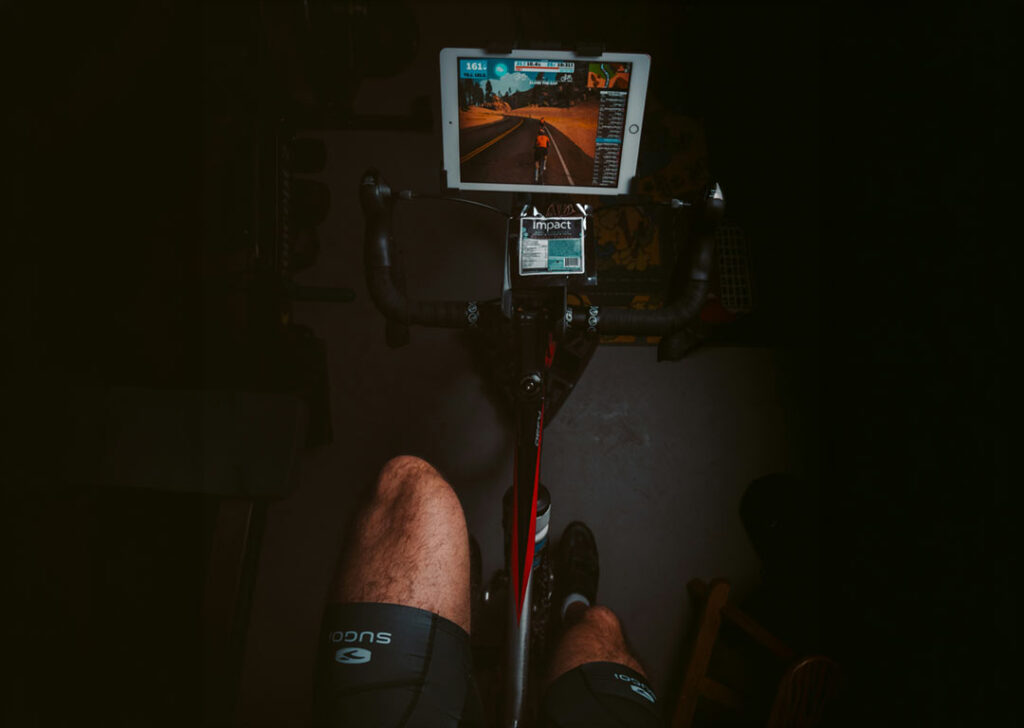
I’ll be honest. A trainer session is rarely as fun as riding outside. No scenery, no café stop, just you, a fan and a wall. Plenty of people get through it with a movie or a few episodes of a series. But per hour, it’s hard to beat. There’s no coasting downhill, no red lights, no waiting while someone fixes a flat. You pedal the whole time, so an hour on the trainer usually gets more work done than an hour outside.
What to actually ride
For most people, three rides a week covers it:
- One interval session. Early winter, something like 3 × 12 minutes at sweet spot (roughly 88 to 93% of FTP) with 4 minutes easy between. Later in winter, shift toward 4 × 8 minutes near threshold.
- One easy ride. 45 to 60 minutes in Zone 2. Boring on purpose.
- One longer ride. 90 minutes to 2 hours, mostly easy. Indoors or outside if the roads are dry. This is the session that protects your long endurance.
If your last FTP test was in spring, retest early in the winter so your zones are honest. Training off an old number either makes every interval too easy or turns every interval into a negotiation. It also matters later, when you set your race pacing off FTP.
Zwift or Rouvy: pick a plan, then trim it
If you’d rather not build your own workouts, both big training apps have off-season plans ready to go. The catch is that they’re written for cyclists. They assume the bike is your whole week. Yours also has running, swimming and, hopefully, a squat rack.
Zwift. The obvious pick is Active Off-Season, a 12-week plan that’s mostly steady endurance riding, with harder sessions in the second half. It’s also Zwift’s biggest plan, at a bit over eight hours a week. For a triathlete, that’s a lot of saddle time. FTP Builder (six weeks, just under five hours a week) or Build Me Up (13 weeks, about four and a half hours) usually fits better around everything else.
Rouvy. Rouvy uses real-world video routes instead of a cartoon world, including some Ironman race courses. Last winter it ran a three-month virtual training camp built around two pro-team plans. One was a 12-week Base Builder from Team Visma | Lease a Bike’s coaches. The other was a four-week FTP block from Lidl-Trek, aimed at more experienced riders. Rouvy’s regular plans mostly run four to eight weeks. One is a time-trial plan meant for riding on aerobars, which is about as triathlon-friendly as cycling apps get.
Whichever app you use, keep the plan’s interval sessions and its longest ride. If the easy filler rides would push your week past what you can handle, cut those first. It’s the same idea as before: the hard sessions and the long one do most of the work.
Both cost about the same, around CA$25 (US$20) a month, with cheaper annual options and a free trial. Zwift also has a pricier Zwift+ tier that adds Zwift Coach, which builds a personalized plan for you. Both apps work best with a smart trainer. A basic trainer with a speed sensor will run them, but the resistance won’t follow the workout.
Set it up so you actually go back
Get a real fan. Two if you can. Without airflow your body has no way to dump heat, so your heart rate climbs and your power drops even though nothing about your fitness changed.
Drink more than you think. You’ll often sweat more indoors than on a typical outdoor ride, for the same reason. If you’ve never measured it, weigh yourself before and after one trainer session and run the numbers in our Sweat Rate Calculator. The full method is here if you want the details.
Throw a towel over the bars. Sweat isn’t kind to headsets and bolts.
Ride a plan, not a wall. A structured workout makes 60 minutes pass faster than staring at the garage door. If you have a smart trainer, ERG mode holds the power for you, which is great for intervals and mildly soul-destroying for everything else.
One bonus: the trainer makes bricks easy. Hop off, put on shoes, and do 10 to 15 minutes on the treadmill. Indoor brick runs are short and simple, and they keep that heavy-legs feeling familiar for spring.
Treadmill vs outdoor running in winter
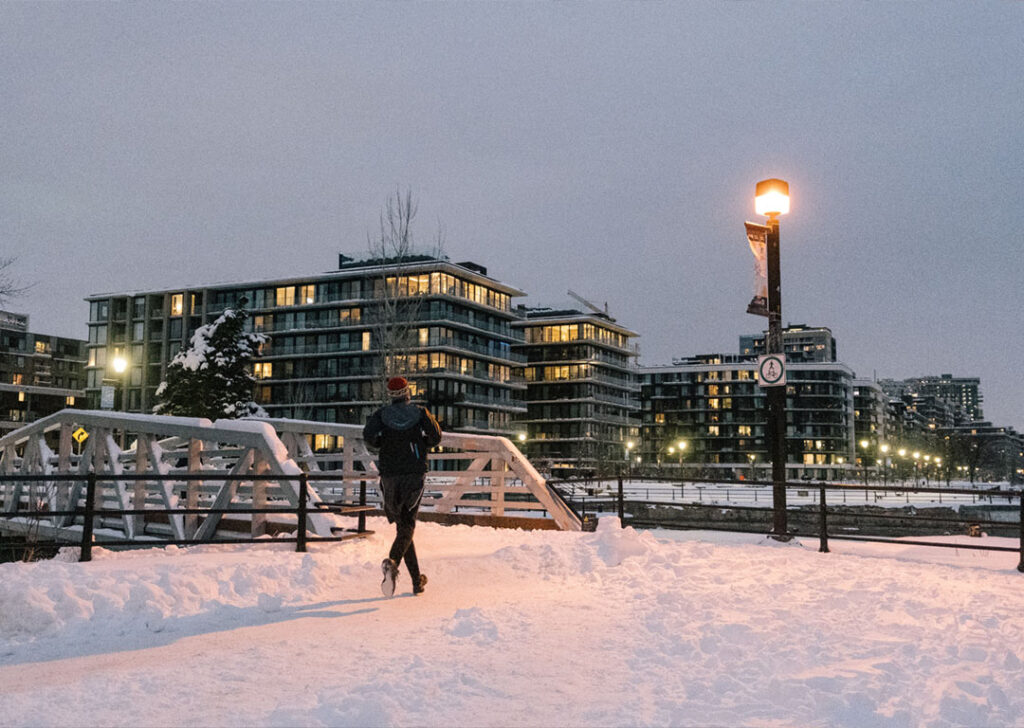
I don’t mind running in the cold, as long as I’m dressed for it. A crisp, dry winter run can be one of the best of the week. What sends me to the treadmill is pouring rain or snow on the ground. That’s a personal call, not a rule. Some people run outside in anything, and some would rather never see the belt. For most triathletes, a mix works: outside when conditions let you, the treadmill when they don’t. And if you’re on the treadmill, put a fan on it. Same reason as the trainer: no airflow means more heat, a higher heart rate and a run that feels harder than it should.
| Treadmill | Outdoor | |
|---|---|---|
| Effort | Slightly easier at the same pace. Set 1% to even it out. | The real cost, wind and all |
| Control | Exact pace, no ice, no dark | The weather decides |
| Race feel | Flat, no wind, no turns | Matches race day |
| Pace data | Console speed can be off | GPS, usually close enough |
| Best for | Intervals, easy runs on icy days | Long runs, hills, race prep |
The 1% incline thing, explained
The “set it to 1%” advice comes from one study. In 1996, Andrew Jones and Jonathan Doust had nine trained runners run on a treadmill at 0 to 3% grade, then on a flat road, and compared how hard each was. Outside costs a bit more, mostly because you’re pushing through air. A treadmill set to 1% matched the road across paces from about 5:42/km down to 3:20/km.
The interesting detail: at the slowest speeds, 0% and 1% weren’t meaningfully different from the road. So if your easy runs are slower than about 5:40/km, the incline barely matters. For steady running and intervals, set 1%. It’s not a magic number. It’s just a decent correction.
Does a treadmill change how you run?
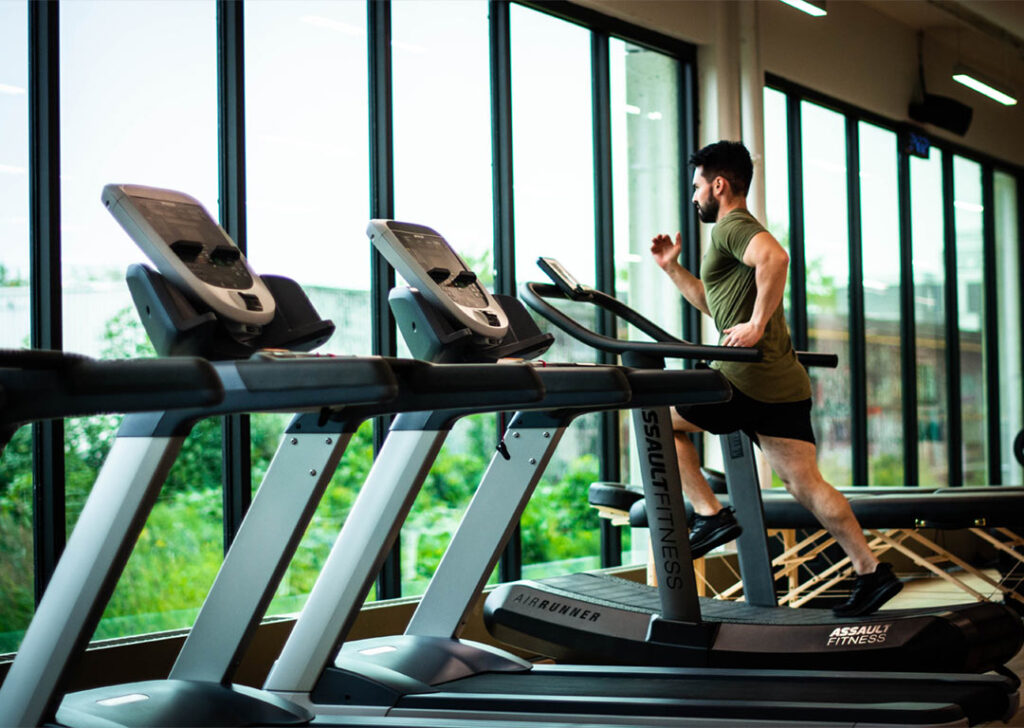
A little. A 2020 meta-analysis of 33 studies led by Bas Van Hooren found most running measures were the same on a treadmill and on the ground. The main difference was how your foot lands: flatter on the treadmill, with slightly longer ground contact. For most people that’s not worth worrying about. It is a good reason to get some outdoor runs in before race season, though.
Run by effort, not the console
Treadmill speed displays are often off, and different machines can disagree with each other. Your watch’s indoor pace estimate isn’t much better. Heart rate and perceived effort are more reliable indoors.
This matters most on easy days. Treadmills make it weirdly easy to lock in a pace that feels “fine” and quietly sits a zone too high. If that sounds familiar, read why easy runs end up too fast and why Zone 2 pace feels so slow. A clean set of heart rate zones fixes most of it.
If you run outside
- Dress like it’s about 10°C warmer than it is. You should feel a bit cold for the first ten minutes.
- Wear a light and something reflective. Or move runs to lunch, when there’s actual daylight.
- On ice, shorten your stride and slow down. Trail shoes or slip-on traction help. On really bad days, the treadmill wins and there’s no shame in it.
- Keep drinking. Cold usually blunts thirst, but you’re still losing fluid.
- Warm up longer before hard efforts in the cold. Or just do your intervals inside.
Weight training: the winter job most triathletes skip
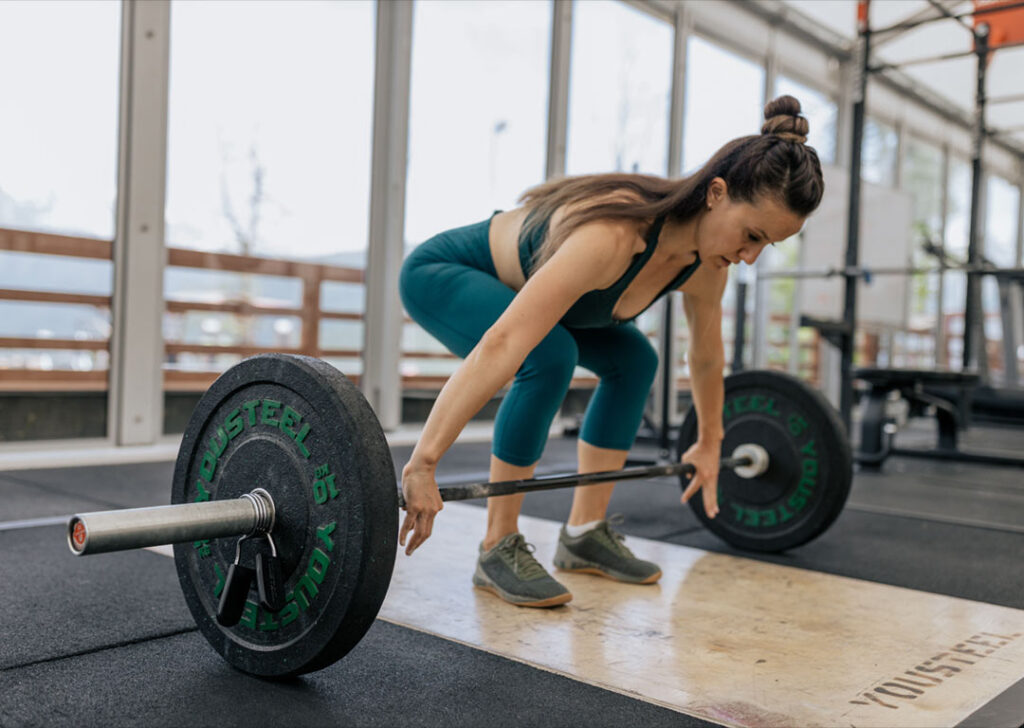
If winter has one real upgrade, this is it. A 2014 review by Bent Rønnestad and Iñigo Mujika looked at strength training in endurance-trained runners and cyclists. Adding heavy or explosive lifting improved running economy, and heavy lifting was the one they recommended for cycling economy. They also found no reports of lifting making economy worse.
Economy is basically how much energy it costs you to hold a pace or a power. Better economy means the same effort goes further. It’s free speed, except it costs you two gym sessions a week.
Winter is the right time because your endurance load is lower. You can lift heavy, be sore for two days, and it doesn’t wreck a key session three weeks out from a race.
A simple two-day plan
Day A
- Back squat or trap bar deadlift: 3 to 4 sets of 4 to 6
- Bulgarian split squat: 3 sets of 6 to 8 per leg
- Bent-knee calf raise: 3 sets of 10 to 12 (this one targets the soleus, which does a lot of work in running)
- Pull-ups or lat pulldown: 3 sets of 6 to 8
Day B
- Romanian deadlift: 3 to 4 sets of 5 to 6
- Step-ups: 3 sets of 6 to 8 per leg
- Single-leg calf raise, straight knee: 3 sets of 8 to 10 per leg
- One-arm dumbbell row: 3 sets of 8 per arm
- Farmer carry: 3 × 30 to 40 metres
Spend the first two or three weeks lighter, around 10 to 12 reps, and learn the movements. After that, go heavy: the last rep or two of each set should be hard but clean. Rest two to three minutes between heavy sets.
Heavy means heavy. Three sets of 20 with a light dumbbell is mostly cardio with extra steps.
Fitting it around swim, bike and run
The simplest rule: lift on your hard days, after the key session or later that day. That keeps your easy days easy and stops heavy legs from ruining tomorrow’s intervals. Try not to put a heavy leg session the day before a hard bike or run.
The question everyone asks: will lifting make me bulky? For most people doing triathlon volume, no. You might gain a little muscle and a kilo or so on the scale. That’s usually the point, not the problem.
If you’re over 40, lifting arguably matters more, not less. Muscle gets harder to keep with age, and recovery changes too, so the plan above might need an extra easy day around it.
What happens in spring
You don’t have to give it all up when the season builds. A 2021 review by Barry Spiering, Iñigo Mujika and colleagues found strength and muscle size can usually be held with as little as one session a week, as long as the weights stay heavy. So in spring, drop to one shorter session a week, keep the loads up, and stop lifting legs heavy about a week to ten days before your A race.
Don’t skip the pool
The pool is the one place winter changes nothing. It was already indoors.
It’s also the best time to work on technique, because you’re not trying to peak. Fewer hard sets, more drills, and if you can, get someone to film your stroke once. A masters group helps too, mostly because someone notices when you don’t show up. If open water is your weak spot, winter is a good time to read up on open water skills and practise sighting in the pool.
A sample winter week
This works out to roughly 8 to 9 hours a week. If that’s more than you have, the paragraph under the table shows what to keep and what to cut.
| Day | Session |
|---|---|
| Monday | Swim, technique focus (45 to 60 min) |
| Tuesday | Trainer intervals (60 min) + Lift A |
| Wednesday | Easy treadmill run (45 min) |
| Thursday | Swim (60 min) + easy spin (30 min) |
| Friday | Lift B, or rest |
| Saturday | Long ride, mostly Zone 2 (90 min to 2 h) |
| Sunday | Long run outside, easy (60 to 90 min) |
If you only have five or six hours, keep the intervals, the two long sessions and the two lifts. Cut the easy fillers first. That lines up with the reduced-training research: intensity and one long session do most of the heavy lifting, pun fully intended.
The real winter problem isn’t physiology
Most winter fitness isn’t lost in one dramatic moment. It’s lost one “I’ll go tomorrow” at a time.
A few things that help:
- Book sessions like meetings. Same days, same times. Decisions are where winter wins.
- Train with people. A masters swim, a virtual group ride, a running buddy who will text you at 6 a.m. Accountability beats willpower.
- Use a 10-minute rule. Start the session. If you still feel awful after ten minutes, stop and go home. Most days, you won’t.
- Lower the bar on bad weeks. A short session with a bit of intensity is better than a perfect one you skip. That’s literally what the research says.
Train indoors by heart rate
Treadmill paces and trainer readings can drift. Your heart rate zones don’t. Our HR Zone Finder builds them from your max HR or lactate threshold.
Quick questions
For structured winter training, usually yes. It controls resistance for you, measures power, and tends to be quieter. A basic wheel-on trainer still works, especially if your bike already has a power meter. You’ll just do more of the work in your head.
They’re good for general fitness and great when you’re working around an injury. They’re less specific, though. If you can ride and run, those should still be most of your winter.
A cross-country race, a cyclocross event or an indoor race on a trainer app can be a fun way to keep some intensity in your life. Just don’t build your whole winter around them. They’re a bonus, not the plan.
Sources
- Jones, A. M., & Doust, J. H. (1996). A 1% treadmill grade most accurately reflects the energetic cost of outdoor running. Journal of Sports Sciences.
- Van Hooren, B., et al. (2020). Is motorized treadmill running biomechanically comparable to overground running? Sports Medicine.
- Rønnestad, B. R., & Mujika, I. (2014). Optimizing strength training for running and cycling endurance performance: A review. Scandinavian Journal of Medicine & Science in Sports.
- Hickson, R. C., & Rosenkoetter, M. A. (1981). Reduced training frequencies and maintenance of increased aerobic power. Medicine & Science in Sports & Exercise.
- Barbieri, A., et al. (2024). Cardiorespiratory and metabolic consequences of detraining in endurance athletes. Frontiers in Physiology.
- Zwift. Zwift Cycling Training Plans.
- ROUVY. ROUVY training camp 2026.